Financial Advisor Referrals: How to Earn Them and Pass the AI Check
Referrals are still the first source of new clients for most advisors. What makes clients and CPAs refer you, what the rules say about paying for referrals, and the AI check a referred prospect now runs before calling.
 By Samy Thuillier · November 25, 2026
Financial advisor referrals come from two places: clients who are happy enough to introduce a friend, and professionals such as CPAs and estate attorneys who trust you with their own clients. You earn more of them by being easy to describe and easy to introduce, not by asking harder, and if you reward anyone for a referral, US rules treat that as a paid testimonial or endorsement. One step is new: the referred prospect now checks your name in Google or an AI assistant before calling, and that answer decides whether the introduction becomes a meeting.
That check is where referrals meet AI reputation management: what ChatGPT, Perplexity, Gemini and Google AI say about your firm when someone asks by name. This guide covers the classic work first, then the rules, then the check.
Why financial advisor referrals still matter
Referrals are still the backbone of advisor growth, and recent data says so. In its 2026 study on advisor marketing, Kitces Research found that client referrals are the most used marketing tactic, used by 88% of advisors, and that they bring an average of 44% of organic new clients and 48% of organic new client revenue (What Really Drives Client Referrals, Kitces.com, September 2026).
The same study carries a warning. Its authors conclude that practices looking to accelerate growth are unlikely to get there by optimizing referrals alone. Referrals compound slowly and you do not control their timing. That is why most firms run them next to other channels, which our guide on how to get clients as a financial advisor compares side by side.
The value of a referral is the trust that comes with it. A prospect who hears your name from a friend arrives half convinced. That trust is also fragile: it survives only if what the prospect finds next confirms what the friend said.
What makes a client refer you
Clients refer people they believe in, and they refer what they can explain. Both halves matter.
- An experience worth mentioning. Fast answers, details remembered, life events marked. People rarely talk about returns at dinner. They talk about how the advisor handled their mother’s estate or a job loss.
- A one-sentence description. “She does retirement planning for teachers in Ohio” travels. “Holistic wealth management” does not. Give clients the sentence, and use it on your site, your bios and your directory profiles, so the friend who looks you up finds the same words.
- A clear fit. Say who you work best with: profession, life stage, planning need, minimum. Clients then filter for you, and you get fewer introductions you have to decline.
- Moments that invite it. The natural opening is right after a visible result: a retirement income plan finished, a business sale closed, a tax bill reduced. That is when a client is most likely to mention you to someone in the same situation.
None of this is a tactic. Service comes first, and every referral idea below only amplifies it.
How to ask for referrals without pushing
Most guides say “just ask”. The data is less simple. Kitces Research measured a referral-driven growth rate (new clients from referrals in 2025, as a share of the practice) of 5.4% for practices that never ask, falling to 3.0% for practices that ask more than once a year (Kitces.com). That is a correlation, not proof that asking hurts, but it is a good reason to ask less often and better.
What tends to work better than a standing request:
- Ask for an introduction, once, at the right moment. After a visible result, in your own words: “If someone you know is facing the same decision, I’d be glad to talk with them.” Then drop it.
- Invite instead of ask. A client evening, a small dinner or a workshop where clients may bring a guest is an easy yes. The guest meets you in a relaxed setting, not a sales meeting.
- Give clients something to forward. A short guide or article on a question your niche asks makes the introduction easy: “my advisor wrote this, it answers your question”. Our guide to content marketing for financial advisors covers what to write and how to get it approved.
- Never pressure. A client who feels pushed refers no one and may start to wonder what else is being sold to them.
Event invitations, the guide you hand out and any script your team uses are marketing communications. Have them reviewed like any other piece.
Centers of influence: CPAs, attorneys and other professionals
CPAs, estate attorneys, divorce attorneys and business brokers meet your future clients at the moment they need planning. Referrals from them work when they run both ways and when each side looks good for having made the introduction.
- Pick a few, in your niche. Three or four professionals who serve the same people are worth more than a long list of business cards.
- Learn what they need. Ask which clients they want more of. Send them business first when you can.
- Work on a real case together. A joint review of a shared client’s plan, with the client’s permission, shows how you work better than any lunch.
- Bring the client’s team together. A yearly meeting with a top client and their CPA and attorney puts you at the center of the client’s financial life and builds trust with the professionals in the room.
Keep money out of it unless compliance has approved the arrangement. Paying a CPA or attorney for referrals falls under the same rules as paying a client, covered next, and those professionals often have their own rules on referral fees.
Referral rewards and fees: what the rules allow
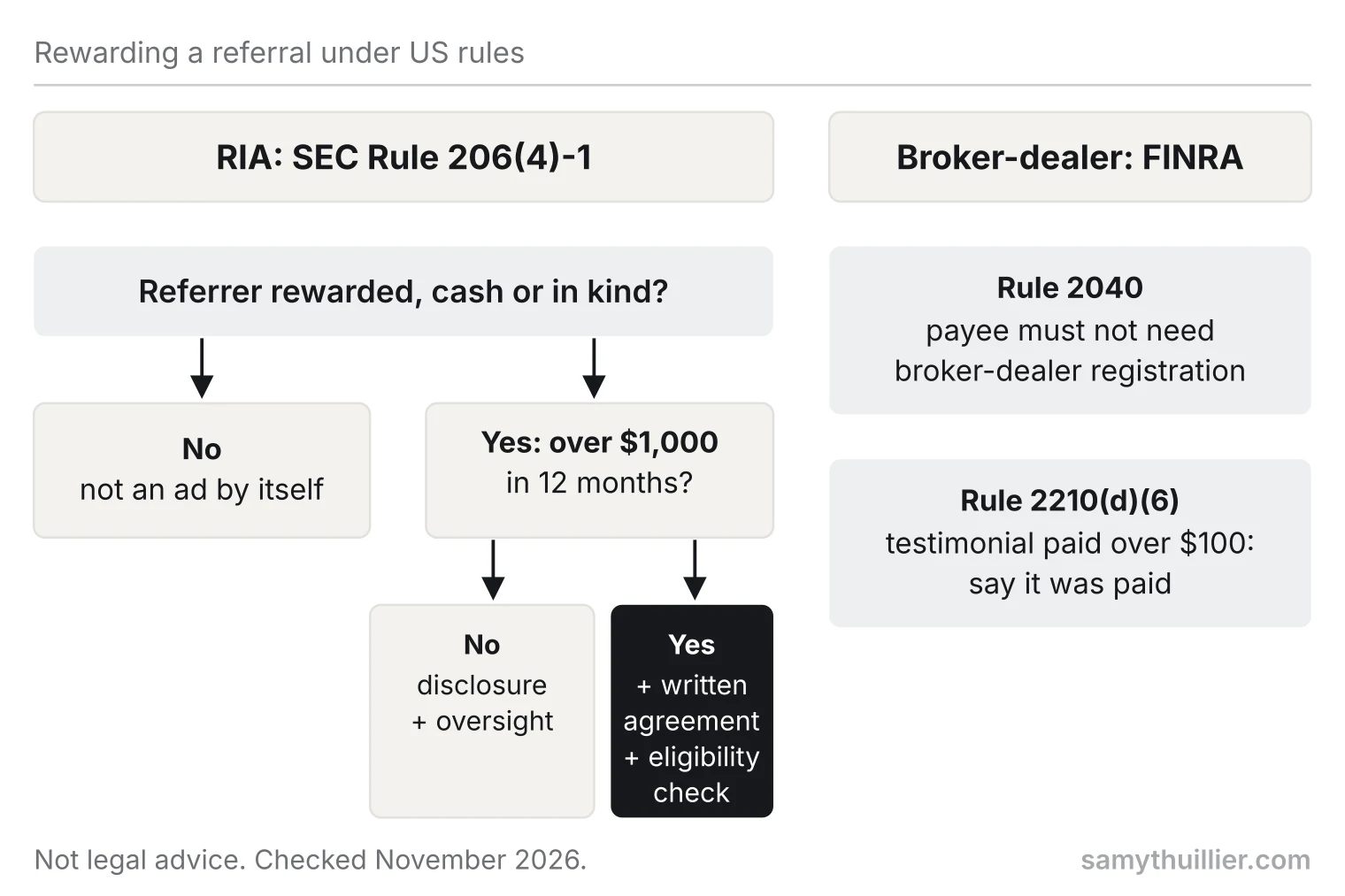
Several popular guides suggest gift cards, fee discounts or contests for clients who send referrals. In the US, each of those is compensation for a referral, and the rules attach conditions to it. Checked November 2026:
Registered investment advisers: the SEC Marketing Rule. Under Rule 206(4)-1, a testimonial is a statement by a current client, and an endorsement a statement by anyone else, that includes one that solicits or refers prospective clients. A client or CPA you compensate for referrals, in cash or in kind, is therefore giving a compensated testimonial or endorsement, and the rule, which replaced the old cash solicitation rule, applies (Investment Adviser Marketing, SEC).
| Condition | What the rule asks | Exemption |
|---|---|---|
| Disclosure | At the time of the referral, clearly and prominently: whether the person is a client, that they are compensated, and any material conflict of interest, plus the material terms of the compensation | Certain affiliated persons, such as your employees, when the affiliation is readily apparent or disclosed |
| Oversight | A reasonable basis to believe the referral activity complies with the rule | None for compensated promoters |
| Written agreement | A written agreement describing the scope of the activity and the compensation | Not needed for unpaid or de minimis promoters: $1,000 or less in total over the preceding 12 months |
| Disqualification | No compensation to a person you know, or should know, is an “ineligible person” (certain disciplinary history) | Unpaid or de minimis promoters |
Two practical consequences. A $50 gift card per referral looks harmless, but twenty of them to one client in a year adds up to more than $1,000, and the de minimis exemption is gone. And a client who refers friends without any reward from you is not giving you an advertisement just by talking; the rule bites when you compensate the referral or use the client’s words in your marketing.
Broker-dealers: FINRA Rules 2040 and 2210. FINRA Rule 2040 bars a member firm from paying compensation to a person who is not registered as a broker-dealer but would have to be, because of those payments and the related activity. A referral fee tied to accounts opened or trades placed is where that question comes up, and the rule expects the firm to support its determination. If you quote a client’s praise in a retail communication, FINRA Rule 2210 requires disclosures that it may not represent other customers’ experience and is no guarantee of future performance, and that it was paid for if more than $100 in value was given.
United Kingdom: the FCA. The FCA requires that all financial promotions be clear, fair and not misleading, whatever the medium (Regulating Financial Promotions and Adverts). Introducer and referral arrangements for UK firms bring their own questions that this guide does not cover; take them to your compliance team before you start.
The full treatment of testimonials, endorsements and ratings is in our SEC Marketing Rule guide, and the broker-dealer side in our guide to FINRA Rule 2210. This article is general information, not legal advice; your compliance officer has the last word on any referral arrangement.
The referral now passes an AI check
Here is the part none of the referral guides cover. A friend gives your name. Before calling, the prospect looks you up, and more and more often the lookup is a question to an AI assistant: “Is [your firm] a good advisor? What do they charge? Any complaints about [your name]?”
The assistant does not answer from memory alone. ChatGPT may search the web when a question benefits from current information, and shows citations to the sources it used, which OpenAI itself warns can be incomplete, outdated or incorrect (Searching the web with ChatGPT). Google says AI Overviews and AI Mode can issue several related searches across subtopics and sources to build one answer (AI Features and Your Website).
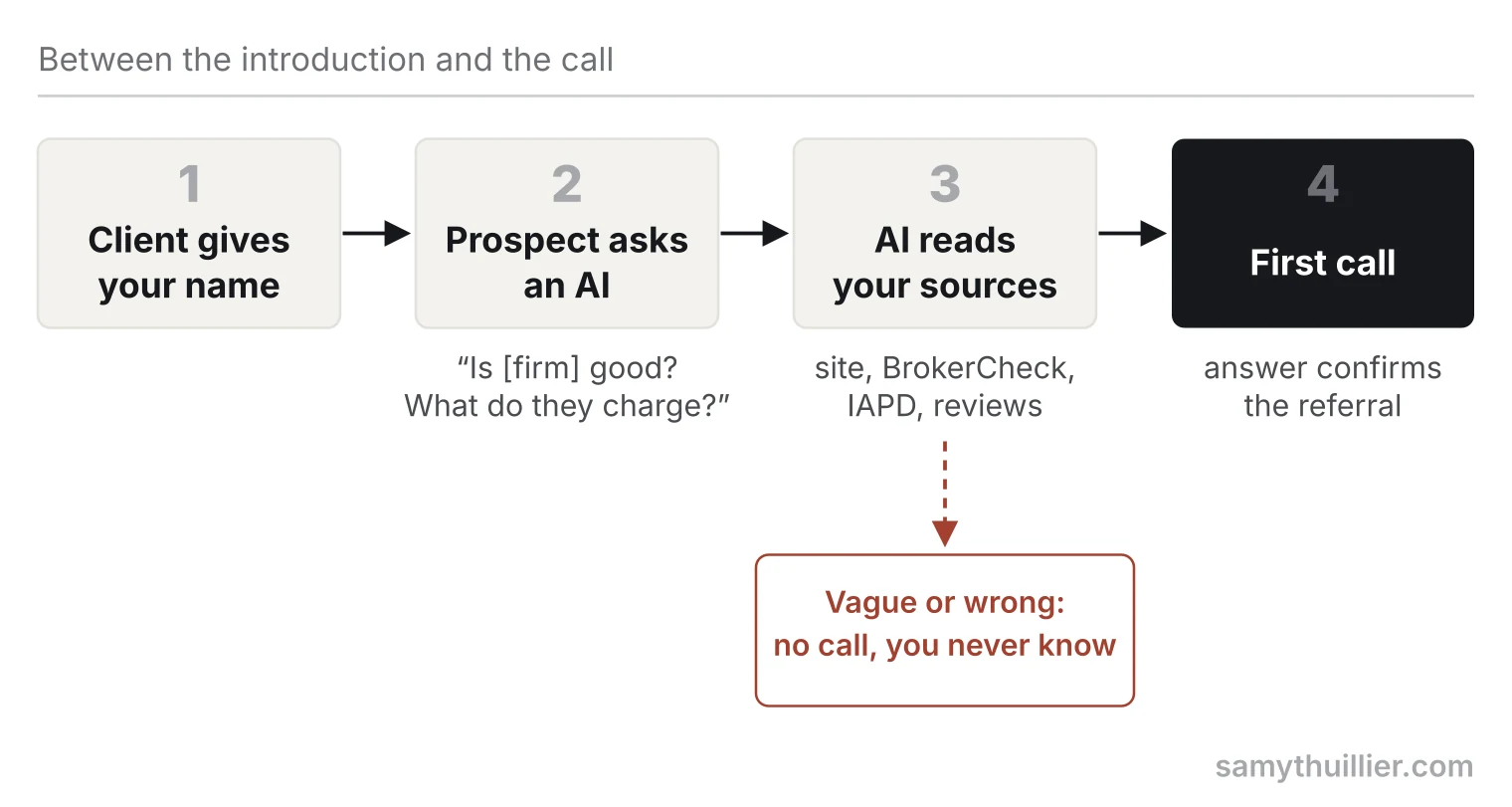
For a vetting question about an advisor, those searches usually land on:
- Your own pages: who you serve, fees, minimum, team bios.
- Registration records: FINRA BrokerCheck, the SEC’s Investment Adviser Public Disclosure site and, in the UK, the FCA’s Financial Services Register. Disclosures there are what prospects mean when they ask about red flags.
- Directories and your Google Business Profile, with their reviews where your rules allow them.
- Press, rankings and forums that mention you.
What the referred prospect needs is confirmation. If the answer matches what the friend said, the call happens. If it says “fees not disclosed”, quotes an old fee, places you at your previous firm or surfaces a stale forum complaint with nothing to balance it, the trust from the introduction drains away. You never hear about it: the prospect simply does not call.
Make your firm easy to describe, for people and for AI
The fixes that help a client describe you are the same ones that help an engine describe you correctly.
- State the facts in plain words on your site. Who you serve, how you charge, your minimum, where you are, how to start. A prospect who asks what a normal fee is, or what you charge, gets an answer from your page instead of a guess.
- Make every source agree. Firm name, advisor names, credentials, address and services should match across your site, your Google Business Profile, directories, LinkedIn and your registration records. Conflicting sources produce vague answers.
- Write bios as facts. Credentials, registration status, years of experience, specialties. No superlatives an engine might repeat as if you had made a claim.
- Give the referral a landing place. A page for people who were referred: who you work with, what the first meeting looks like, how to book. Clients can forward it, and it gives engines one more clear source.
- Keep records current. Update your regulatory filings (Form ADV, Form U4) when anything changes, so the official record and your site tell the same story.
Being found by people who do not know you yet is the job of search and AI visibility; SEO for financial advisors covers that side.
Test what a referred prospect sees
You can run the check yourself in an hour.
- Write the vetting questions. The ones a referred prospect asks once they have your name: “Is [firm] legit?”, “What does [firm] charge?”, “Does [firm] have a minimum?”, “Reviews of [lead advisor], financial advisor in [city]”, “Any complaints about [lead advisor]?”
- Ask every engine. ChatGPT with search, Perplexity, Gemini and Google AI Mode, in a fresh chat or a private window so your history does not shape the answer.
- Log answers and sources. For each question, note what the engine says about fees, minimum, credentials and history, and which sources it cites.
- Fix the sources, not the answer. You cannot edit an AI answer. You can correct the pages it reads.
- Repeat every month. Answers change between runs, so ask each question twice and keep the log next to your referral numbers.
A simple log:
| Question | Engine | What it says about you | Sources cited | Wrong or missing |
|---|---|---|---|---|
| What does [firm] charge? | ChatGPT | |||
| Reviews of [lead advisor], [city] | Google AI Mode | |||
| Any complaints about [firm]? | Perplexity |
When the log fills up across several advisors and engines, or shows errors you cannot trace, that is the point where an outside AI visibility audit maps every cited source and produces a fix list your compliance team can review. Samy Thuillier, who publishes this site, runs that audit for wealth management firms.
Why referrals do not convert: a debug table
When introductions arrive but clients do not, the cause is usually one of a few. Work through them in order.
| Symptom | Likely cause | What to check or fix |
|---|---|---|
| Clients say they referred people who never called | The AI or web check did not confirm the referral | Run the test above; publish fees and minimum; align every source |
| Referred prospects call but are poor fits | Clients cannot describe who you serve | Give them the one-sentence description; put it on your site |
| Referred prospects meet you but do not sign | Slow or generic follow-up | Contact within a day or two, tailor the first meeting to what the referrer told you |
| CPAs stopped sending people | One-way relationship | Send them business, work on shared cases, report back on each introduction |
| Referrals dropped after a move or a rebrand | Old firm name or address still in directories and records | Update every profile; check what the engines say about the old name |
| A prospect mentions a complaint you thought was resolved | One old source dominates | More current, accurate sources; talk to compliance before any public reply |
Turn the introduction into a meeting
The referral is a loan of someone’s reputation. Treat it that way.
- Respond fast and lightly. One call or email within a day or two, referencing the person who introduced you. No sequence of follow-ups that would embarrass them.
- Prepare from what you were told. If the friend mentioned a business sale or a widowed parent, open with that, not with your standard presentation.
- Close the loop with the referrer. Thank them, without sharing anything confidential about their friend. If the thank-you has any value, check it against the rules above.
- Say no gracefully. If the prospect is not a fit, point them to someone who is. The referrer will remember that you took care of their friend.
Track every referral, including the AI check
Ask every new prospect how they heard about you and what they did before calling. Add two options to your intake: “a client or professional referred me” and “I looked the firm up in an AI assistant (ChatGPT, Perplexity, Google AI)”. Many referred prospects did both.
Then follow each introduction through to a signed client. In an illustrative case: 20 introductions in a year, 12 prospects who make contact, 8 first meetings, 4 new clients. The gap between 20 and 12 is where the AI check sits, and the one you cannot see unless you ask referrers whether their friends called. If that gap is the largest, the fix is not a better script; it is what people find when they look you up.
Frequently asked questions
Can a financial advisor pay a referral fee?
Often yes, under conditions. For a registered investment adviser, a client or other person you compensate for a referral, in cash or in kind, gives a testimonial or endorsement under the SEC Marketing Rule, which brings disclosure, oversight, a written agreement above $1,000 over 12 months and a disqualification check. Broker-dealers must also respect FINRA Rule 2040 on payments to unregistered persons. Ask your compliance officer before you pay anyone.
How do financial advisors get more referrals?
By being easy to recommend: a service clients talk about, a one-sentence description of who you serve, events where clients can bring a guest, and steady relationships with the CPAs and attorneys who serve the same people. Then make sure that what a referred prospect finds when they look you up, on Google or in ChatGPT, confirms what they were told.
Should financial advisors ask clients for referrals?
Asking can work, but more asking is not more referrals. Kitces Research's 2026 marketing study found a referral-driven growth rate of 5.4% for practices that never ask and 3.0% for those that ask more than once a year. Invitations to events and a clear description of your ideal client tend to land better than a direct request.
What does a referred prospect check before calling an advisor?
Usually the firm's website, a Google search and, more and more, an AI assistant such as ChatGPT, Perplexity or Google AI Mode. They look for fees, minimums, credentials, reviews and any disciplinary history. The assistants build their answer from your own pages, FINRA BrokerCheck, the SEC's IAPD site, directories, reviews and press.
What is a red flag a referred prospect might find?
Disclosures on BrokerCheck or IAPD, such as customer complaints or regulatory actions, are what prospects and AI assistants look at first. Less obvious red flags are inconsistent facts: a different firm name on a directory, an old fee quoted by an AI answer, or a bio that does not match the registration record. Keeping every source accurate and consistent removes the second kind.
What does a good referral program for financial advisors look like?
It sets out who you serve so clients and professionals know whom to send, a simple way to make the introduction, a fast and respectful follow-up, and a thank-you that your compliance team has approved. If anything of value is given for referrals, it documents the Marketing Rule or FINRA conditions and tracks the totals per person over 12 months.
Samy Thuillier advises wealth management firms on AI authority and reputation. Former Deloitte financial consultant, SEO since 2013. More about Samy · Book a call