SEC Marketing Rule: Testimonials, Ratings, Performance and AI
What the SEC Marketing Rule allows and forbids, checked against the rule, the staff FAQ and the latest risk alert, plus what it means for the rankings and reviews that ChatGPT and Perplexity cite about your firm.
 By Samy Thuillier · November 20, 2026
The SEC Marketing Rule is Rule 206(4)-1 under the Investment Advisers Act of 1940: it governs every advertisement an SEC-registered investment adviser disseminates, directly or indirectly. It bans seven kinds of misleading content and allows testimonials, endorsements, third-party ratings and performance only under stated conditions. Those same conditions decide which rankings, awards and reviews a firm may republish or pursue, the sources ChatGPT, Perplexity and Google AI Mode lean on when they describe an adviser.
Everything below was checked against the rule text, the SEC staff FAQ and the SEC’s risk alerts in November 2026. This article is not legal advice: your chief compliance officer, and your counsel where needed, have the last word on any piece of marketing.
If what worries you is what AI engines already say about your firm, that work sits under AI reputation management for wealth management firms. This guide covers the rule itself first.
What the SEC Marketing Rule is
The SEC adopted the rule on December 22, 2020 (SEC press release 2020-334). It took effect on May 4, 2021, and advisers had an 18-month transition, so compliance has been mandatory since November 4, 2022. It replaced two older rules: the advertising rule (the previous version of 206(4)-1) and the cash solicitation rule (206(4)-3). That is why people still search “SEC marketing rule 2022” and “SEC marketing rule 206”.
Who it covers:
- Covered: investment advisers registered, or required to be registered, with the SEC under section 203 of the Advisers Act.
- Not covered: exempt reporting advisers and state-registered advisers. The Advisers Act’s anti-fraud provisions still apply to their communications, and state regulators have their own advertising rules.
- Broker-dealers: they answer to FINRA Rule 2210, not this rule. Dual registrants deal with both.
For context on a common search: the two statutes most people name for the securities industry are the Securities Act of 1933 and the Securities Exchange Act of 1934. Advisers are governed by a third one, the Investment Advisers Act of 1940, and the Marketing Rule sits under its section 206(4).
The primary sources are the final rule and adopting release (Release No. IA-5653), the SEC’s Small Entity Compliance Guide on investment adviser marketing, and the Division of Investment Management’s Marketing Compliance FAQ, last updated January 15, 2026 when we checked it. Staff FAQs and risk alerts are staff views: they are not rules and create no new obligations, but examiners read them.
What counts as an advertisement
The rule defines an advertisement in two prongs.
Prong 1: any direct or indirect communication an adviser makes to more than one person (or to one or more persons if it includes hypothetical performance) that offers its advisory services with regard to securities to prospective clients or private fund investors, or offers new advisory services to current clients or investors.
Prong 2: any testimonial or endorsement for which the adviser provides compensation, directly or indirectly. A paid endorsement is an advertisement in itself, whoever publishes it.
What falls outside prong 1:
- extemporaneous, live, oral communications;
- information in a required statutory or regulatory notice or filing, such as Form ADV;
- hypothetical performance given in response to an unsolicited request, or to a private fund investor in a one-on-one communication;
- most one-on-one communications, and communications to current clients that do not offer new or additional services.
The adopting release adds that general educational material (types of investment vehicles, asset classes, sectors) and general market commentary, including press interviews, usually do not offer advisory services. The line moves when a piece ends with how your services can help the reader invest: the release treats that portion as an offer.
“Indirect” matters. Content written by someone else can still be your advertisement, which is the subject of the adoption and entanglement section below.
The seven general prohibitions
Every advertisement must avoid all seven. An advertisement may not:
- include an untrue statement of material fact, or omit a material fact needed to keep a statement from being misleading;
- include a material statement of fact you have no reasonable basis to believe you can substantiate if the SEC asks;
- include information reasonably likely to create an untrue or misleading implication about a material fact relating to the adviser;
- discuss potential benefits without fair and balanced treatment of the material risks or limitations;
- refer to specific investment advice in a way that is not fair and balanced;
- include or exclude performance results, or present time periods, in a way that is not fair and balanced;
- otherwise be materially misleading.
The second one catches marketing copy most often. Superlatives such as “world class” or “unique”, and claims such as “conflict-free advice”, need a substantiation file or they go. The SEC’s April 2024 risk alert on initial observations listed untrue and unsubstantiated statements of material fact among the deficiencies examiners found under the general prohibitions. In September 2024 the SEC settled charges against nine advisers, with $1,240,000 in combined penalties, for marketing failures that included unsubstantiated “conflict-free” claims, testimonials attributed to clients who were not current clients, and third-party ratings shown without dates (SEC press release 2024-121).
SEC Marketing Rule testimonials and endorsements
Definitions first, because the disclosures depend on them:
- Testimonial: a statement by a current client (or current private fund investor) about their experience with the adviser, or one that solicits or refers people to it.
- Endorsement: the same kind of statement by anyone else: former clients, other professionals, influencers, lead-generation firms, other advisers.
You may use either in an advertisement, paid or unpaid, if you meet three sets of conditions:
| Condition | What the rule requires | Exempt when |
|---|---|---|
| Disclosures | At the time it is disseminated, clearly and prominently: client or non-client status, whether cash or non-cash compensation was provided, and a brief statement of material conflicts. Plus the material terms of any compensation and a description of the conflicts. | The promoter is your partner, officer, director or employee (or a control affiliate), the affiliation is readily apparent or disclosed at that time, and you document their status. |
| Oversight | A reasonable basis to believe the testimonial or endorsement complies, and a written agreement with the promoter describing the scope of activities and the compensation. | The written agreement is not required for unpaid or de minimis promoters ($1,000 or less in the preceding 12 months). |
| Disqualification | No compensation to a person you know, or should know with reasonable care, is an ineligible person (certain disciplinary history). | Unpaid or de minimis promoters. The staff FAQ posted January 15, 2026 also gives limited no-action relief for some persons subject only to a self-regulatory organization order, with a 10-year disclosure. |
“Clearly and prominently” has a precise meaning in the adopting release: the disclosure sits within the testimonial or endorsement and is at least as prominent as it. A hyperlink to the disclosure does not meet the standard.
What examiners found, from the SEC’s December 16, 2025 risk alert on testimonials, endorsements and third-party ratings:
- The most common failure was not giving the disclosures at the time the testimonial or endorsement was disseminated, often on websites, including d/b/a websites of individual advisers.
- Disclosures given by hyperlink, or in a smaller or lighter font than the testimonial.
- Current-client testimonials and former-client endorsements copied from third-party websites onto the adviser’s own site without disclosing who gave them.
- Gift cards given to clients to write reviews on third-party websites, without a basis to believe those paid reviews carried the required disclosures.
- Lead-generation firms, social media influencers, adviser referral networks and “refer-a-friend” programs, sometimes without the adviser realizing the arrangement created an endorsement.
- Payments of under $1,000 each that added up to more than $1,000 over 12 months, so the de minimis exemption did not apply.
- Missing or incomplete written agreements, paid promoters disqualified by state regulator history, and affiliations disclosed only when the prospect was introduced, not when the testimonial was seen.
SEC Marketing Rule third-party ratings, rankings and awards
A third-party rating, under paragraph (e)(18) of the rule, is a rating or ranking of an investment adviser provided by a person who is not your related person and who provides ratings or rankings in the ordinary course of its business. Awards, “top adviser” lists and rankings from publishers that run them as a business fall here. A one-off “best of” post by someone who does not rate advisers for a living looks more like an endorsement, and the adopting release draws exactly that distinction.
You may include a third-party rating in an advertisement only if you:
- Do due diligence. Have a reasonable basis to believe any questionnaire or survey behind the rating makes favorable and unfavorable answers equally easy to give and was not designed to produce a predetermined result. The release says you do not need the rater’s proprietary data: the questionnaire itself, the rater’s public methodology, or the rater’s representations about how the survey is designed and run can be enough.
- Disclose, clearly and prominently, or reasonably believe the rating itself discloses: the date the rating was given and the period it covers; the identity of the third party that created and tabulated it; and, if applicable, that you paid compensation, directly or indirectly, to obtain or use it.
Three points from the adopting release that most summaries skip:
- The disclosures must be at least as prominent as the rating, inside the advertisement, not behind a link.
- Compensation includes non-cash compensation. The release notes that some advisers pay for the right to use a rating and others pay to be included in the pool from which it is chosen. Both count.
- Disclosures do not cure a misleading rating. The release gives two examples: a recent rating based on a part of the business that has since materially changed, and an advertisement saying you are “rated highly” without saying the rating rests only on a criterion such as assets under management that may not reflect the quality of the advice.
The December 2025 risk alert listed what went wrong in practice: no information to support a reasonable basis about the survey; links to rater websites that showed the rating with no disclosures; logos that did not identify who created the rating; a range of award years that included a year the adviser did not win; and undisclosed payments for logo use, reprints, priority placement, enhanced exposure, referral links on the rater’s site, and fees just to be considered. Disclosures placed at the bottom of the page, in smaller type or behind links, were flagged too. The September 2024 enforcement sweep included advisers that showed ratings, some more than five years old, without dates or time periods (SEC press release 2024-121).
Performance advertising rules
Paragraph (d) of the rule sets specific requirements for any performance shown:
| Type of performance | What the rule requires |
|---|---|
| Gross performance | Only with net performance of at least equal prominence, in a format that eases comparison, over the same period, with the same type of return and methodology. |
| Time periods | For any portfolio or composite other than a private fund: 1-, 5- and 10-year periods with equal prominence, ending no earlier than the most recent calendar year-end (or the life of the portfolio if shorter). |
| SEC approval | No statement, express or implied, that the SEC approved or reviewed the performance. |
| Related performance | All related portfolios, unless excluding some does not make results materially higher and does not change the required periods. |
| Extracted performance | Only if the advertisement provides, or offers to provide promptly, the total portfolio’s performance. |
| Predecessor performance | Only if the people primarily responsible now manage accounts at your firm, the accounts are sufficiently similar, all substantially similar accounts are included (with the same materiality exception), and you clearly disclose that the results came from another entity. |
Net performance may exclude custodian fees. If you use a model fee, it must either produce results no higher than the actual fee would, or equal the highest fee charged to the intended audience.
Staff relief since the compliance date, from the Marketing Compliance FAQ:
- Interim periods (April 14, 2021): right after a calendar year-end, the staff would not object to using interim performance until the year-end figures can be calculated, and considers about one month a reasonable time to do so.
- Extracted performance (updated March 19, 2025): the staff would not recommend enforcement for gross-only extracted performance if it is clearly labeled gross, the total portfolio’s gross and net performance appears with at least equal prominence, and the total portfolio covers the entire period of the extract. A single, clearly disclosed period can replace the 1-, 5- and 10-year periods for such extracts.
- Portfolio characteristics (March 19, 2025): similar relief for gross characteristics such as yield or attribution.
- Model fees (January 15, 2026): using actual fees is not categorically prohibited; whether it is misleading depends on the facts of each advertisement.
SEC Marketing Rule hypothetical performance
Hypothetical performance means results that no portfolio of the adviser actually achieved. The rule names model portfolio performance, backtested performance, and targeted or projected returns. It excludes predecessor performance shown in line with the rule, and interactive analysis tools that let a client run their own simulations, provided the adviser explains the methodology, assumptions and limitations, says results vary, and discloses that the outcomes are hypothetical.
You may advertise hypothetical performance only if you:
- adopt and implement policies and procedures reasonably designed to make it relevant to the likely financial situation and investment objectives of the intended audience;
- give enough information for that audience to understand the criteria and assumptions used;
- give enough information to understand its risks and limitations (for private fund investors, you may offer to provide this promptly).
When those conditions are met, the 1-, 5- and 10-year, related and extracted performance requirements do not apply to it. Note that hypothetical performance makes even a one-to-one message an advertisement, unless it answers an unsolicited request or goes to a private fund investor one-on-one.
The practical consequence: a public web page is a mass audience. In September 2023 the SEC charged nine advisers, with $850,000 in combined penalties, for advertising hypothetical performance to mass audiences on their websites without the required policies and procedures; two also failed to keep copies of their advertisements (SEC press release 2023-173).
Websites, social media and third-party content: adoption and entanglement
The adopting release explains when content written by someone else becomes your advertisement. It depends on the facts, along two tests:
- Adoption: you explicitly or implicitly endorse or approve the content after it is published. Reposting it, quoting it, or putting it in your materials adopts it.
- Entanglement: you involve yourself in preparing it before publication.
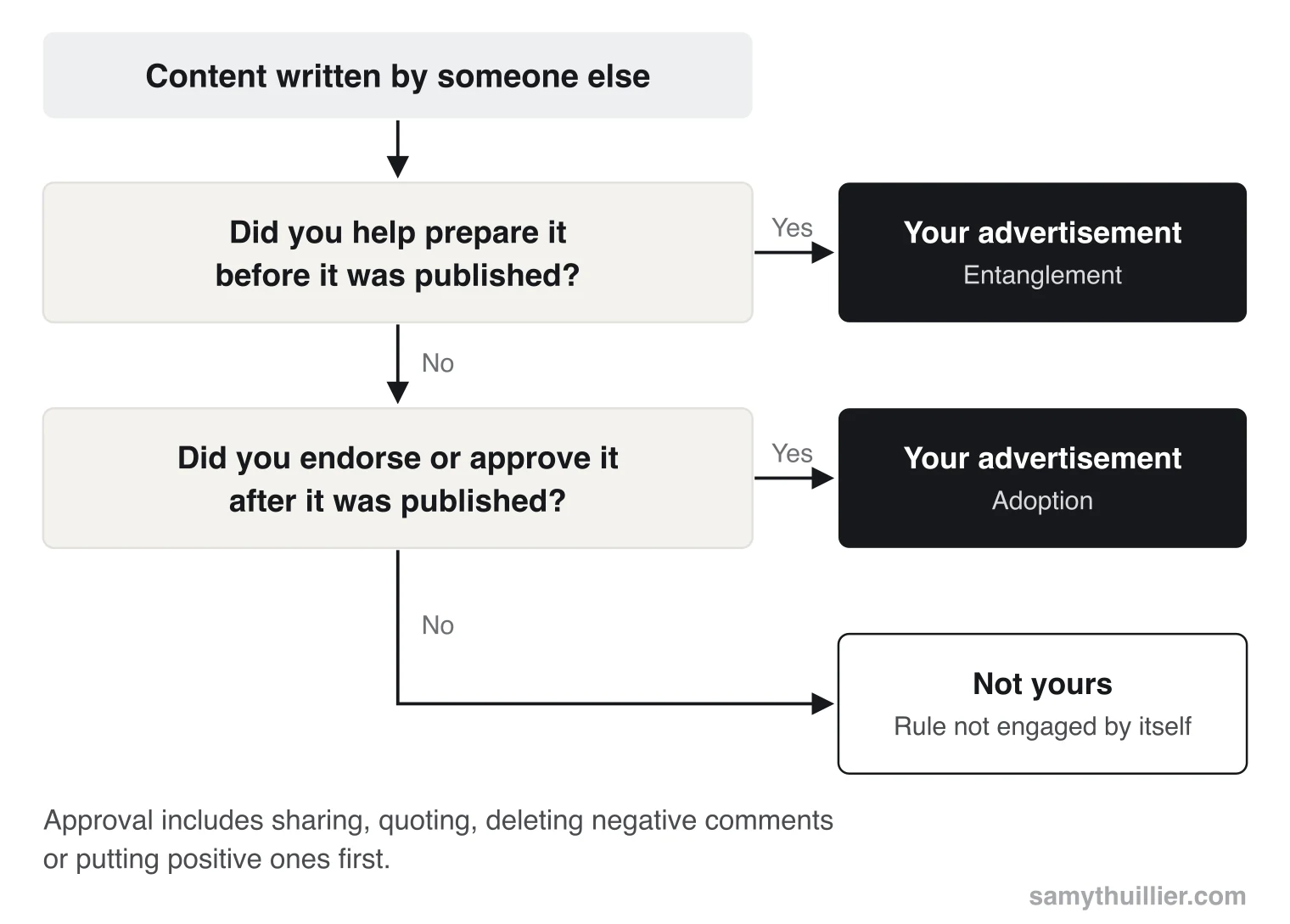
The release then applies the tests to the web:
- Hyperlinks: a link in your advertisement to third-party content calls for the adoption and entanglement analysis. Linking to content you know or have reason to know is false or materially misleading is fraudulent under section 206 regardless.
- Comments on your pages: letting the public comment does not make the comments yours, as long as you do not selectively delete or alter them and are not involved in preparing them. Having a sorting feature you do not use does not change that. Allowing “like”, “share” or “endorse” features does not engage the rule by itself.
- Curating: deleting or suppressing negative comments, or putting positive ones first, makes the comments yours, because you shaped them to market your business. Editing under a neutral, pre-existing, documented policy (profanity, unlawful content, spam, correcting a factual error) does not.
- Staff personal accounts: if you adopt and implement policies reasonably designed to prevent employees from marketing your services on personal social accounts, the SEC generally would not treat their posts as your marketing. The release suggests prohibitions, training, attestations and periodic review of what employees post publicly.
What the SEC Marketing Rule means when AI engines describe your firm
Ask ChatGPT, Perplexity or Google’s AI Mode for the best wealth manager or fee-only adviser in a city, and the answer comes with a list of sources. Run that prompt for your own market and look at what gets cited: typically ranking lists, award pages, directory profiles, review sites, press coverage and the firms’ own websites. Those sources are what firms chase when they want to be recommended, and each way of chasing them maps onto a provision of the Marketing Rule.
Note: As of November 2026, we found no SEC rule text, staff FAQ or risk alert that addresses AI-generated answers. What follows applies the rule’s existing provisions to them. Treat it as a reading for your compliance officer to confirm, not a staff position.
The starting point: an AI answer is written by a third party, not by you. On its own, it is not your advertisement. It becomes one the same way any third-party content does: through adoption, entanglement, or payment.
| What the firm does | What the rule says | What to do |
|---|---|---|
| Posts a screenshot of an AI answer recommending the firm | Reposting adopts it, so it becomes your advertisement and the general prohibitions apply in full. The answer changes with the prompt, the user and the day, which makes the implied claim hard to substantiate or present fairly. Whether an AI engine can be a “third-party rating” provider is an open question the SEC has not addressed. | Do not post it without your CCO’s written sign-off. |
| Applies for, or pays to be considered for, a “best advisor” list | Pursuing the list is not advertising. Advertising the result is: paragraph (c) applies, and fees to be considered, logo licenses and priority placement are compensation to disclose. | Keep the due diligence file and the payment record from day one. |
| Pays an outlet, blogger or influencer to name the firm as a top choice | A compensated endorsement is an advertisement under prong 2, wherever it appears. | Written agreement, disclosures carried by the promoter, ineligibility check. |
| Asks clients to leave reviews on Google or a review site | Unprompted, unpaid reviews you do not touch are not your advertisement. Gift cards or other rewards are compensation, and the December 2025 risk alert flagged exactly that. | Ask without rewards, or treat each review as a paid testimonial. |
| Republishes or links to the best reviews on its own website | Republishing adopts them as testimonials or endorsements. The risk alert found firms copying reviews without saying the authors were current or former clients. | Add client status, compensation and conflict disclosures next to each one. |
| Hides or reports negative reviews to push the positive ones up | Selectively deleting or suppressing negative comments makes the remaining ones yours. | Moderate only under a neutral, written policy. |
| Writes the profile copy that a directory or ranking site publishes | Involvement in preparing content can be entanglement, which makes the content yours. | Supply verifiable facts (services, registration, team), keep a record of what you sent, and avoid drafting praise. |
| Fixes factual errors about the firm at the source | The release treats correcting a factual error under a neutral, documented policy as not adopting content, in the context of third-party content on your own pages. Correcting your own website and filings is plain housekeeping. | Start with your own site and Form ADV, then ask third parties to fix errors of fact. |
One more consequence few firms notice: disclosures do not travel. When an AI answer repeats “named a top adviser by [publisher]”, it usually drops the date, the period, the rater’s identity and the fee you paid, all of which the rule requires next to the rating in your advertisement. You cannot control the AI answer, and it is not your advertisement unless you adopt it. You do control the pages it reads. Keep every rating on your site fully disclosed and current, remove expired ones, and make sure no page carries a claim like “conflict-free” that you could not substantiate, because an AI engine will repeat it without the context. Your Form ADV, excluded from the definition of advertisement as a required filing, is the most authoritative public description of your firm: keep your website consistent with it.
If you want an outside view of which sources AI engines use to describe your firm, and which of them carry compliance risk, that is the scope of an AI visibility audit.
Recordkeeping and Form ADV
The Marketing Rule came with amendments to the books and records rule, Rule 204-2. You must keep:
- a copy of every advertisement you disseminate, directly or indirectly (oral advertisements have alternative recordkeeping options);
- a copy of any questionnaire or survey behind a third-party rating you advertise, if you obtained one;
- the records needed to show how any advertised performance was calculated;
- documentation of your reasonable basis for believing each testimonial or endorsement complies, and that each third-party rating meets the due diligence requirement;
- a record of the names of affiliated promoters relying on the exemption;
- a record of the intended audience for hypothetical performance and for model fees based on the highest fee charged to that audience.
Advertisements and performance records are kept for at least five years from the end of the fiscal year in which you last disseminated them, the first two years in an appropriate office of the adviser. The rule was also paired with new Form ADV questions (Item 5.L): whether your advertisements include performance results, hypothetical or predecessor performance, references to specific investment advice, testimonials, endorsements or third-party ratings, and whether you pay, directly or indirectly, in connection with testimonials, endorsements or ratings. Answer them accurately: the April 2024 risk alert encouraged accurate completion of those items.
A compliance checklist for marketing teams
- Inventory every channel. Your website, any d/b/a sites of individual advisers, social profiles, newsletters, pitch decks, directory profiles, award pages, and every third-party page you link to.
- Back up every statement of fact. Keep a substantiation file for each material claim. Delete what you cannot prove.
- Put disclosures inside each testimonial and rating. Same font size and weight, next to the item, never only behind a link or at the foot of the page.
- Document due diligence on every rating. The survey or the rater’s methodology, plus the invoice for any fee: application, logo license, reprint, placement.
- Sign written agreements with paid promoters. Referral programs, influencers, lead-generation firms and paid lists. Add up payments over 12 months before relying on the $1,000 de minimis exemption.
- Check performance presentations. Net with gross, the required periods, and no hypothetical performance on public pages unless your policies cover the intended audience.
- Archive and review. Keep copies for five years from the end of the fiscal year of last use, and update your compliance policies when you start a new practice. The December 2025 risk alert found firms that had updated their policies but did not follow them.
How these limits shape a whole growth plan, from referrals to AI answers, is covered in RIA marketing within the Marketing Rule.
How the rule sits next to FINRA Rule 2210
Broker-dealers and their registered representatives follow FINRA’s communications rule, which has its own categories of communications, principal approval for retail communications and its own testimonial conditions. Dually registered firms often have content that falls under both rules at once, and the stricter requirement of the two usually decides the final copy. Our guide to FINRA Rule 2210 covers the broker-dealer side.
Frequently asked questions
What is the SEC Marketing Rule?
It is Rule 206(4)-1 under the Investment Advisers Act of 1940, adopted on December 22, 2020, with a compliance date of November 4, 2022. It replaced the old advertising and cash solicitation rules with one rule that bans misleading advertisements and sets conditions for testimonials, endorsements, third-party ratings and performance.
Who does the SEC Marketing Rule apply to?
Investment advisers registered, or required to be registered, with the SEC. Exempt reporting advisers and state-registered advisers are outside this rule, although the Advisers Act's anti-fraud provisions still reach their communications and state regulators have their own rules. Broker-dealers follow FINRA Rule 2210 instead.
Can financial advisers use client reviews and Google reviews?
Yes, under conditions. A review you republish, link to as an endorsement of your firm, or curate becomes a testimonial in your advertisement, and it needs clear and prominent disclosures: whether the person is a current client, whether they were paid, and any material conflict. Giving clients gift cards for reviews is compensation, and the SEC's December 2025 risk alert flagged it.
Can an adviser advertise a 'best advisor' award or ranking?
Yes, if it is a third-party rating used under paragraph (c) of the rule. You need a reasonable basis to believe the survey behind it was not rigged toward a result, and you must disclose the date and period of the rating, who created it, and any payment you made to obtain or use it, including fees to be considered. The disclosures must be as prominent as the rating and cannot sit behind a hyperlink.
What does Rule 204-2 require advisers to keep for marketing?
A copy of every advertisement disseminated, directly or indirectly, plus the records behind any performance shown, documentation of the reasonable basis for testimonials, endorsements and third-party ratings, and a record of who the intended audience is for hypothetical performance. Advertisements and performance records are kept for five years from the end of the fiscal year in which they were last disseminated, the first two years in an appropriate office.
Is hypothetical performance allowed under the Marketing Rule?
Yes, with three conditions: policies and procedures that make it relevant to the likely financial situation and objectives of the intended audience, enough information to understand the criteria and assumptions, and enough information to understand its risks and limitations. In September 2023 the SEC charged nine advisers for showing hypothetical performance on public websites without those policies.
Samy Thuillier advises wealth management firms on AI authority and reputation. Former Deloitte financial consultant, SEO since 2013. More about Samy · Book a call