FINRA Rule 2210 Explained: Categories, Approval, Social Media and AI
FINRA Rule 2210 governs every broker-dealer communication with the public. This guide covers the three categories, approval, filing, records, social media, the 2026 changes and what the rule means for pages written to be cited by AI engines.
 By Samy Thuillier · November 20, 2026
FINRA Rule 2210 is the rule that governs how FINRA member broker-dealers communicate with the public. It sorts every written or electronic communication into three categories (retail communication, correspondence and institutional communication), sets who must approve each one, which ones are filed with FINRA and how long they are kept, and requires all of them to be fair, balanced and free of promissory or misleading claims. It applies to websites, social media, emails and, according to FINRA, to content written with AI tools.
Every rule statement below was checked against the text of FINRA Rule 2210 and FINRA’s own guidance pages in November 2026. This article is general information, not legal advice: your firm’s compliance officer has the last word on how the rule applies to a given communication.
What FINRA Rule 2210 covers
Rule 2210 is FINRA’s core rule on “communications with the public”, the phrase it uses for what most marketers call advertising. It applies to member firms and their associated persons, whatever the medium: a website, a blog post, a LinkedIn post, a newsletter, a seminar slide, a chatbot reply.
The rule does four jobs:
- Defines the three categories of communication.
- Sets supervision: who reviews or approves each category, and when.
- Sets filing and records: which communications go to FINRA’s Advertising Regulation Department and what the firm keeps.
- Sets content standards that apply to every category.
For wealth management firms that want to show up in AI answers, this is the rule that decides what a broker-dealer can publish in the first place, so any AI visibility program for a wealth management firm has to be built inside it.
Retail communication vs correspondence vs institutional communication
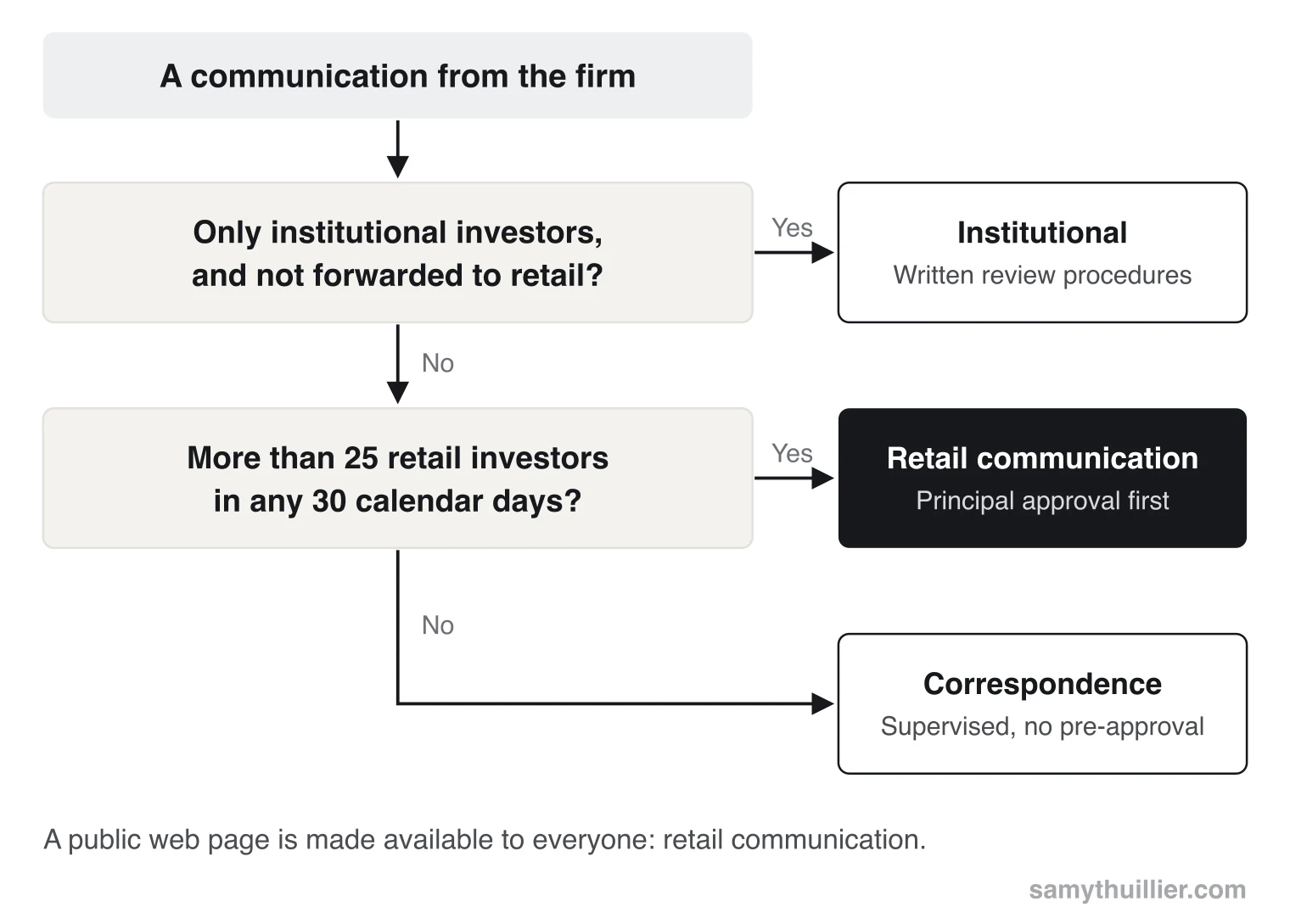
The category depends on who receives the communication and how many retail investors it reaches. A retail investor is anyone who is not an institutional investor, whether or not they hold an account with the firm.
| Category | Definition in Rule 2210(a) | Principal approval before use | Filing with FINRA |
|---|---|---|---|
| Retail communication | Distributed or made available to more than 25 retail investors within any 30 calendar-day period | Required, with exceptions | Some types, see below |
| Correspondence | Distributed or made available to 25 or fewer retail investors within any 30 calendar-day period | Not required; supervised under Rule 3110(b) | Excluded |
| Institutional communication | Distributed or made available only to institutional investors, excluding internal communications | Not required; written review procedures instead | Excluded |
Two details trip firms up:
- “Made available” counts. A public web page is made available to everyone, so it is a retail communication even if few people read it.
- Institutional status is fragile. A firm cannot treat a communication as institutional if it has reason to believe it will be forwarded to a retail investor.
How common pieces usually land:
| Piece | Usual category | Why |
|---|---|---|
| Public website page or blog post | Retail communication | Made available to more than 25 retail investors |
| Static LinkedIn post or profile | Retail communication | Same; static social content generally needs approval before use |
| Reply in a live social media thread | Retail communication, supervised like correspondence | Interactive forum posts are exempt from pre-use approval and filing |
| Email to 20 prospects this month | Correspondence | 25 or fewer retail investors in 30 days |
| Same email to 40 prospects | Retail communication | Over the 25-in-30-days line |
| Pitch book sent only to pension plans | Institutional communication | Only institutional investors, if not forwarded to retail |
| Chatbot answer on the firm’s site | Depends on the audience | FINRA FAQ B.4: it can be any of the three |
Approval: who signs off before use
Under Rule 2210(b)(1), an appropriately qualified registered principal must approve each retail communication before the earlier of its use or its filing with FINRA. The rule lists exceptions where the communication is instead supervised like correspondence:
- posts in an online interactive electronic forum;
- communications that make no financial or investment recommendation and do not otherwise promote a product or service of the firm;
- certain research communications, unless they make a recommendation;
- communications another member already filed and FINRA reviewed, used without material change.
Correspondence follows the supervision and review rules of Rule 3110(b). Institutional communications need written review procedures; when not every piece is reviewed before use, those procedures must include training, documentation and surveillance.
Filing with FINRA
| Requirement | What it covers | Deadline |
|---|---|---|
| New member filing | Retail communications in electronic or other public media, including websites, for one year from the firm’s membership date | 10 business days before first use |
| Pre-use filing | Investment company communications with rankings or comparisons not generally published, and security futures communications | 10 business days before first use |
| Post-use filing | Retail communications promoting a specific registered investment company or family, direct participation programs, CMOs and certain registered structured products | Within 10 business days of first use |
| Excluded | Among others: communications with no recommendation or product promotion, previously filed pieces used without material change, correspondence, institutional communications, forum posts | No filing |
Each filing states the date of first use and the approving principal’s name, title, CRD number and approval date.
Recordkeeping
Rule 2210(b)(4) requires firms to keep retail and institutional communications for the retention period of SEA Rule 17a-4(b). FINRA’s social media guidance describes that as at least three years. The record includes:
- a copy of the communication and its dates of first and, if applicable, last use;
- the name of the registered principal who approved it and the approval date;
- for pieces not approved before use, the name of the person who prepared or distributed it;
- the source of any statistical table, chart or graph.
Correspondence is kept under Rules 3110.09 and 4511.
Content standards that apply to every communication
Rule 2210(d) applies to all three categories. The core standards:
- Fair and balanced. Communications must rest on fair dealing and good faith, give a sound basis for evaluating the facts, and not omit any material fact or qualification that would make them misleading.
- No false, exaggerated, unwarranted, promissory or misleading claims.
- Balance risks and benefits. Benefits cannot be presented without the matching risks.
- Disclosures cannot hide. A legend or footnote is allowed only if it does not inhibit the reader’s understanding.
- Know the audience. Firms must consider the nature of the audience the communication is directed to.
- No predictions or projections of performance, and no implication that past performance will recur. Exceptions include hypothetical illustrations of mathematical principles, investment analysis tools under Rule 2214 and price targets in research reports with a reasonable basis. The 2026 amendment on projections is covered below.
- Name the firm. Retail communications and correspondence must prominently disclose the member’s name.
- Comparisons must disclose all material differences, such as objectives, costs, liquidity and guarantees.
- Testimonials about investment advice or performance must say they may not be representative of other customers’ experience and are no guarantee of future success, and must disclose when they were paid for (above $100 in value).
- Recommendations need a reasonable basis and specific disclosures, and past recommendations can only be shown in a complete list with a cautionary legend.
Note: A hyperlink does not fix a misleading statement. FINRA’s Rule 2210 FAQ (D.5) lets firms use links for additional information, but a firm may not rely on linked explanations or disclosures to correct a communication.
FINRA advertising rules: 2210 and its family
“FINRA advertising rules” usually means Rule 2210 plus the rules that sit next to it for specific products, such as Rule 2220 for options communications. Rule 2210 is the base layer: the categories, approval, filing, records and content standards. The product rules add requirements on top. FINRA’s Advertising Regulation Department reviews the communications firms file under these rules.
FINRA 2210 and social media
FINRA’s social media page states plainly that the communications rules apply to social media. The key distinctions:
- Static vs interactive. Static content, posted for the longer term (a profile, a banner, a pinned post), generally needs principal approval before use and may need filing. Interactive content, a real-time dialogue with others, does not need pre-approval if it is supervised like correspondence. FAQ C.6 treats interactive forum posts as retail communications that are exempt from pre-use approval and filing.
- The site itself. A registered principal must review any social media site an associated person plans to use for business before it is used.
- Business vs personal. Records depend on content, not on the device. Personal use is not subject to the advertising rules, and firms must train staff on the difference.
- Third-party content. Posts by others on a firm’s page generally are not the firm’s communication, unless the firm adopts them (endorses or approves them) or becomes entangled (helps prepare them).
- Links. A firm may not link to a third-party site it knows or has reason to know contains false or misleading content.
The guidance notices listed there go back to Regulatory Notice 10-06 (2010) and include Regulatory Notice 17-18 (2017) on social networking websites.
AI-written content is still your communication
FINRA has answered this directly. Its Rule 2210 FAQ (D.8, posted May 2024) says firms are responsible for their communications whether a human or AI technology generated them. FAQ B.4 adds that chatbot communications must be supervised under FINRA rules and can be correspondence, retail or institutional depending on who receives them.
Regulatory Notice 24-09 (June 2024) says FINRA’s rules are intended to be technology neutral and that the Rule 2210 content standards apply whether a communication is generated by a human or a technology tool. A blog post drafted by a language model goes through the same approval, content and records path as one written by a person.
FINRA 2210 and AI search: what counts as your communication
Firms now write pages to be quoted by ChatGPT, Perplexity, Gemini and Google AI Overviews: answer-first articles, FAQ blocks, comparison tables, “about the firm” pages. None of that changes the rule. Once the firm publishes the page, it is a retail communication like any other page of the site, with the same approval, content standards and records. Being written “for AI” is not an exemption.
The harder question is the AI engine’s own answer. When ChatGPT summarizes your page, the summary is produced by a third party, not by the firm. Rule 2210 does not address AI engines by name, but FINRA’s guidance on third-party content gives a reasonable frame (this is our reading, not a FINRA statement):
- The page you publish is your communication. You control it, so it must meet 2210 on its own.
- The engine’s answer is generally third-party content, much like a post someone else writes about you.
- Adoption and entanglement still apply. If the firm reposts a flattering AI answer, quotes it in a deck, or prompts an engine to write content that the firm then publishes, the firm has adopted or created that content and owns it under 2210.
This is also why an inaccurate AI answer about a firm is a reputation problem before it is a compliance one: the fix is to correct the sources engines read, not to amplify the answer. That work is what AI reputation management covers.
How to keep pages compliant and quotable
AI engines rarely quote a whole page. They lift one paragraph, one table row or one FAQ answer. That makes some 2210 requirements more concrete, not less:
- Keep balance inside the passage. If a paragraph states a benefit, put the matching risk or limit in the same paragraph. A disclaimer in the footer will not travel with the quote, and the rule already says disclosures cannot be placed where they inhibit understanding.
- Write answers, not promises. “The firm offers fee-only planning for business owners” is quotable and factual. “Our clients retire earlier” is a promissory, unwarranted claim. Strip “will”, “guaranteed” and “best” unless you can substantiate them.
- No performance projections unless the 2026 amendment is in effect and its conditions are met, and your compliance team has signed off on the format.
- Date your facts. Write “as of November 2026” next to fees, assets or team size. Engines reuse old text, and a dated fact is easier to defend as fair at the time.
- Make structured data repeat approved text only. FAQ markup and organization schema are part of the page; their wording should match the approved visible text word for word.
- Treat material edits as new versions. Rule 2210’s filing exclusion covers communications used without material change, which implies a materially changed page is a new piece to review. Keep a version log: the copy, the approving principal, the approval date, the dates of first and last use.
- Check what you link to. Linking to a third-party article that misstates facts can create responsibility, and a link cannot correct your own page.
A good test: cut any paragraph out of the page and read it alone. If it would still be fair, balanced and identify the firm, it is ready to be quoted. If you want this checked against what engines currently say about your firm, an AI visibility audit starts there.
What changed in 2026
Two developments, status as checked on finra.org in November 2026:
- Projections and targeted returns: approved, not yet in effect. The SEC approved FINRA’s amendment to Rule 2210 (SR-FINRA-2026-004) on October 15, 2026. It allows performance projections and targeted returns in communications with the public, subject to conditions. FINRA’s announcement of the SEC approval says the effective date will be set in an upcoming Regulatory Notice.
- A broader rewrite: proposed only. Regulatory Notice 26-14 (July 2026) asks for comment on replacing principal pre-use approval of retail communications with risk-based supervisory procedures (retail research reports would still need pre-use review), streamlining some filing requirements, replacing the recommendation rules in (d)(7) with a general fair-and-balanced standard, and removing the distinction between static and interactive social media content. The comment period closed on September 11, 2026. Nothing in it is in effect.
Until FINRA publishes final rules and dates, the current text applies: principal approval of retail communications before use, and the static vs interactive split on social media.
Does Rule 2210 apply to RIAs?
Rule 2210 binds FINRA members, which are broker-dealers, and their associated persons. A registered investment adviser that is not a FINRA member follows the SEC marketing rule, Rule 206(4)-1 under the Advisers Act; the SEC staff’s marketing compliance FAQ is the reference there. Many wealth firms are hybrids: an adviser who is also a registered representative of a broker-dealer, or a dually registered firm, usually has to meet both rules. Outside the US, the regulator changes (the FCA in the UK, the AMF in France), and so do the rules, so check each market separately.
Frequently asked questions
What is the difference between retail communication and correspondence under FINRA Rule 2210?
The difference is reach. Correspondence goes to 25 or fewer retail investors within any 30 calendar-day period; retail communication goes to more than 25. Retail communications generally need a registered principal's approval before use, while correspondence is supervised under Rule 3110(b) without pre-use approval.
Does FINRA Rule 2210 apply to social media?
Yes. FINRA says its communications rules apply to social media. Static content such as a profile or a post that stays up generally needs principal approval before use, while interactive posts in a real-time forum are exempt from pre-use approval and filing but must still be supervised and kept.
Does FINRA Rule 2210 apply to registered investment advisers?
Rule 2210 binds FINRA member broker-dealers and their associated persons. An RIA that is not a FINRA member follows the SEC marketing rule, Rule 206(4)-1 under the Advisers Act. Dually registered firms and advisers who are also registered representatives usually have to satisfy both.
How long must communications be kept under Rule 2210?
Retail and institutional communications must be kept for the retention period of SEA Rule 17a-4(b), which FINRA's social media guidance describes as at least three years. The record includes the communication, its dates of first and last use, and the name of the principal who approved it with the approval date.
What is FINRA Rule 2220?
Rule 2220 governs options communications. It sits in the same family of communications rules as Rule 2210 and adds product-specific requirements on top of it.
What do SEC Rule 17a-4 and FINRA Rule 4511 have in common?
Both are recordkeeping rules. Rule 4511 requires FINRA members to make and preserve books and records, and SEC Rule 17a-4 sets how long and in what format broker-dealers keep them. Rule 2210 points to Rule 17a-4(b) for how long retail and institutional communications are kept.
Samy Thuillier advises wealth management firms on AI authority and reputation. Former Deloitte financial consultant, SEO since 2013. More about Samy · Book a call