SEO for Financial Advisors: Google, AI Answers and Compliance
How advisory firms get found on Google, in AI Overviews, ChatGPT and Perplexity: the searches worth owning, the pages and technical basics, the crawlers to let in, the SEC, FINRA and FCA limits, and how to judge SEO services.
 By Samy Thuillier · November 24, 2026
SEO for financial advisors is the work of making an advisory firm the one prospects find, and trust, when they search for the help it gives: in Google’s results and map, in Google’s AI Overviews and AI Mode, and in answers from ChatGPT, Perplexity and other assistants that search the web. It rests on the same foundations as any SEO (pages that answer a specific client’s questions, a site search engines can crawl, mentions from sources they trust), with two differences: every page passes a compliance review, and the searches that matter are few, specific and worth a great deal.
The part of that work that decides whether AI assistants name your firm is covered on the page about GEO for financial advisors. This guide covers SEO from the ground up, then shows where AI answers change it. Platform statements below were checked against Google, OpenAI and Perplexity documentation in November 2026.
What SEO for financial advisors means in 2026
A prospect looking for an advisor now meets your firm on three surfaces:
- Classic results. The ten links, plus the map pack for local searches.
- Google’s AI features. AI Overviews sit above the results; AI Mode is a conversational search. Both cite a few supporting pages.
- AI assistants that search. ChatGPT, Perplexity, Gemini and Claude answer “who should I talk to about selling my practice?” with a few names and links.
Is SEO dead, then? No. Google states in AI Features and Your Website that SEO best practices remain relevant for AI Overviews and AI Mode, that there are no additional requirements to appear in them, and that a page must be indexed and eligible to show with a snippet to be a supporting link. The assistants that search the web read pages the same way: through crawlers, from what is written in plain text. Financial advisor SEO done well is the entry ticket to all three surfaces. What changed is the prize: being the page an answer is built from, not only a link someone may click.
Why advisor SEO is held to a higher bar
Three things make SEO for advisory firms different from SEO for a restaurant or a software company.
Google treats your topic as “Your Money or Your Life”. In its guide to creating helpful, reliable, people-first content, Google explains that its systems give even more weight to content that shows strong experience, expertise, authoritativeness and trustworthiness (E-E-A-T) on topics that could significantly affect people’s financial stability. Of the four, Google says trust matters most. For an advisor, that means named authors with real credentials, a clear “who we are”, accurate facts, and no claims you cannot back up.
Every page is regulated marketing. A public web page of an RIA is generally an advertisement under the SEC Marketing Rule; a broker-dealer’s public page is a retail communication under FINRA Rule 2210; a UK firm’s page can be a financial promotion. The tactics generic SEO guides recommend, such as review widgets, bold performance claims and case studies with numbers, all need a compliance answer first. The rules are covered below.
One client is worth years of fees. A searcher who becomes a client may stay for a decade. That changes the maths: a page that brings two right-fit prospects a year can be worth more than one that brings thousands of visitors who will never hire anyone. It also means decisions take months, and content has to earn trust over several visits.
Keyword research: the searches with clients behind them
Most advisor sites chase “financial advisor” or “retirement planning”. Those terms are dominated by banks, brokerages, publishers and directories, and most people typing them are not about to hire anyone. The searches worth owning are narrower and say who the searcher is.
Four kinds of query bring clients:
| Query type | Examples | Why it matters |
|---|---|---|
| Niche and situation | “financial planner for physicians”, “equity compensation planning for tech employees” | The searcher describes themselves; few firms compete |
| Life event | “selling a business tax planning”, “what to do with an inheritance” | A decision is in progress, which is when advisors get hired |
| Local | “fee-only financial advisor in Denver”, “fiduciary advisor near me” | High intent, decided largely in the map pack |
| Evaluation | “fee-only vs fee-based advisor”, “questions to ask a financial advisor” | Prospects comparing options; trust gets built here |
How to find yours without paid tools:
- Write down the questions clients asked in their first meeting over the past year. Those are your queries, in their words.
- Type the main ones into Google and read autocomplete, the “People also ask” box and the related searches at the bottom.
- Open Google Search Console for your site and read the queries you already show up for. Pages on page two for a niche query are the cheapest wins.
- Ask the same questions to ChatGPT and Perplexity. Note which firms and which sources they cite. That tells you what kind of page wins the question.
Then match intent. If the results for a query are checklists, a page of opinions will not rank; if they are local firms, a national article will not either.
The pages that do the work
For an advisory firm, the pages that bring clients are rarely blog posts. They are the pages that state plainly who you serve and how.
- One page per niche or service. “Retirement planning for teachers in Idaho” tells a reader and a search engine who should land there. “Comprehensive wealth management” tells them nothing. One topic, one audience, one page.
- Advisor bios. Credentials (CFP, CFA, CPWA), registration status, years of experience, what each advisor works on. This is where E-E-A-T is visible.
- How you are paid and who you work with. Fee model, minimums if you have one, what happens in a first meeting. Prospects ask these questions first, to Google and to AI assistants, and if your site is silent, the answer comes from someone else’s page.
- Location pages, only for places where you really meet clients, with the office address and what is specific to clients there.
Use this on-page template for each of those pages:
| Element | What to do | Example |
|---|---|---|
| URL | Short, the topic in words | /retirement-planning-for-teachers |
| Title tag | The query first, then the firm; about 60 characters | Retirement Planning for Idaho Teachers, Firm Name |
| Meta description | What the reader gets and for whom, 150 characters or so | Fee-only planning for Idaho public school teachers: PERSI, 403(b) and retirement timing |
| H1 | One per page, says the same as the title | Retirement planning for teachers in Idaho |
| First paragraph | Answers the query in two or three plain sentences | Who you help, with what, how you are paid |
| Subheadings | The questions the reader asks next | When can I retire with PERSI? |
| Internal links | To the related service, the bio of the advisor, the contact page | |
| Images | Descriptive file name and alt text | |
| Author and date | Named author with credentials, last reviewed date | |
| Disclosures | Next to the claim they qualify, not only in the footer |
Technical SEO for advisor websites
Technical work rarely wins rankings by itself, but technical problems cap them. Many advisor sites run on template platforms built for looks, so the same faults come up again and again.
| Check | Why it matters | How often |
|---|---|---|
| Pages indexed in Search Console | A page Google has not indexed cannot rank or be cited in AI Overviews | Monthly |
| Mobile speed and layout | Many local searches happen on phones | Quarterly |
| HTTPS and clean redirects | Baseline trust; broken redirect chains waste crawling | On every site change |
| Crawlable navigation and internal links | Pages linked from nowhere rarely rank | Quarterly |
| Important content in text, not in images or PDFs only | Search engines and AI crawlers quote text | On every new page |
| Canonical URLs, no duplicate versions | Stops several versions of one page competing | Quarterly |
| Organization and Person structured data | Helps engines identify the firm and its advisors; must match the visible text | Once, then on changes |
| XML sitemap and robots.txt | Tells crawlers what exists and what they may read | On changes |
Pop-ups that cover the content, broken links and menus buried in scripts also hurt. If your site is due for a redesign, put these on the brief.
Let the AI crawlers in
Few advisor SEO guides mention it, and it is the cheapest fix on this page. Each search-connected engine reads your site with its own crawler, and each crawler can be blocked separately, by your robots.txt, or by a CDN or firewall setting your web vendor turned on without telling you.
- Google. Google says robots.txt rules for Googlebot are how site owners control crawling for Search, AI features included. A separate token, Google-Extended, concerns training and grounding in some of Google’s other AI systems, not Search (AI Features and Your Website).
- ChatGPT. OpenAI’s crawler documentation says OAI-SearchBot is used to surface websites in ChatGPT’s search features, and that sites that opt out of it will not be shown in ChatGPT search answers, though they can still appear as navigational links. GPTBot is a separate crawler for training OpenAI’s models: you can allow one and block the other. OpenAI says changes to robots.txt take about 24 hours to reach its search systems.
- Perplexity. Perplexity’s crawler page says PerplexityBot surfaces and links websites in Perplexity’s search results and is not used to train foundation models. It also explains that a web application firewall may need an explicit rule to let it through.
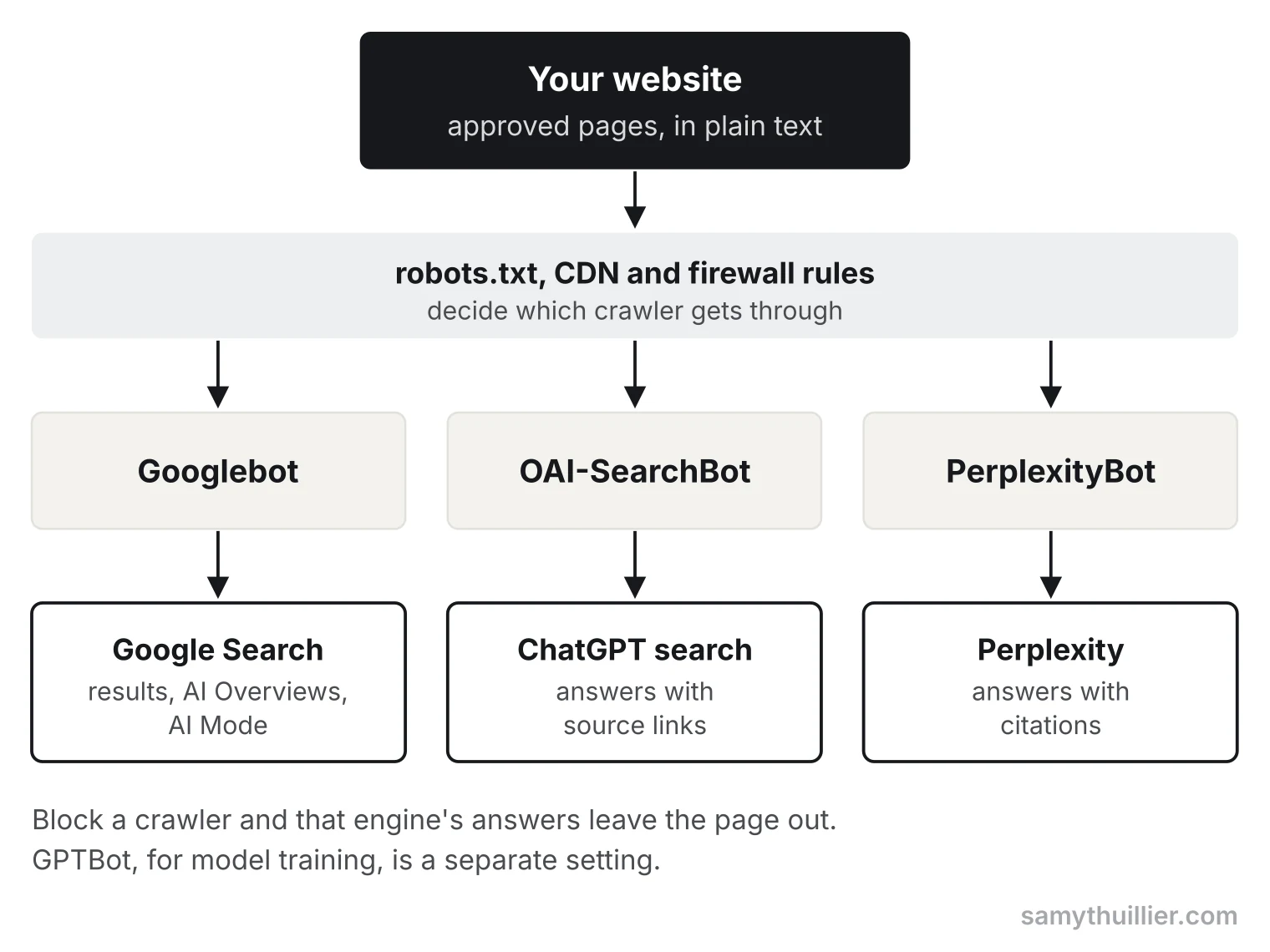
What to do: open yoursite.com/robots.txt and check that Googlebot, OAI-SearchBot and PerplexityBot are not disallowed, then ask your web vendor whether any bot-blocking feature is on at the CDN or firewall. Blocking GPTBot (training) is a business decision; blocking OAI-SearchBot (search) takes you out of ChatGPT’s search answers.
Local SEO for financial advisors, in short
For firms whose clients live near their offices, local search often brings inquiries sooner than content does, because Google answers “advisor near me” with a map and three firms before any website. The basics:
- Google Business Profile. Claim it, use your real firm name, the right category, address, hours and services, and keep it current. Google’s AI features page lists an up-to-date Business Profile among the SEO fundamentals that still matter.
- Consistent details everywhere. The same name, address and phone on your site, your profile and the directories prospects use (the CFP Board’s Let’s Make a Plan, NAPFA, custodian and network “find an advisor” pages).
- Reviews, inside the rules. Reviews help local rankings, and they are where compliance bites first. See the compliance section before you ask a client for one.
- One page per real location, with something specific to say about clients there.
Content that compounds
Single articles rarely move an advisory firm. Groups of linked pages on one topic do: a main page on, say, equity compensation planning, and supporting pages that each answer one question (ISOs versus NSOs, what to do before an IPO), all linking to each other. Publishing steadily matters more than publishing a lot, and so does refreshing the pages that are almost ranking before writing new ones. Content planning, formats and the review workflow are covered in depth in content marketing for financial advisors.
Write each section so it can be quoted on its own: a direct answer at the top, the condition or risk in the same paragraph, a date next to facts that change. AI engines lift passages, not pages.
Links and mentions: earned, never bought
When two sites are equally relevant and well built, links and mentions from sources search engines already trust decide which one ranks. They also matter for AI answers, which lean on independent sources more than on what a firm says about itself.
What works for advisors is slow and durable: quotes in trade and local press, guest articles in finance publications, podcast appearances, data or guides journalists want to cite, and accurate listings in professional directories. What does not: buying links. Paid link schemes break Google’s spam policies, and for a regulated firm they add a second problem, because a paid placement that praises the firm can raise questions under the advertising rules.
How Google AI Overviews and ChatGPT choose which advisors to cite
Google describes the mechanics in AI Features and Your Website:
- Query fan-out. AI Overviews and AI Mode may run several related searches across subtopics and sources to build one answer. A page that answers a precise sub-question (“can I roll over a 401(k) while still employed?”) can be cited even if it does not rank for the broad query.
- No special files or markup. Google says you do not need new machine-readable files, AI text files or special schema.org markup to appear.
- Structured data must match the visible text. For a regulated firm, that means your markup repeats the approved wording on the page, and nothing more.
- Text matters. Important content should be available as text, supported by images and video where useful.
ChatGPT and Perplexity work in a similar way when they search: they read pages their crawlers can reach and show the sources they used. Across all of them, a firm gets named when several independent sources agree on clear facts about it, and when its own pages state those facts in sentences an engine can lift. Which firms the engines actually name in each market is what this site’s AI visibility index tracks.
The searches for your own name
Not every important search is a generic one. A prospect who heard your name from a friend types it into Google, or asks an assistant “is [firm] a good advisor? What do they charge?” That vetting search decides whether a referral becomes a meeting, and most advisor SEO guides skip it.
What prospects and engines read for those searches:
- Your own site: the about page, bios, fees.
- Registration records: the SEC’s Investment Adviser Public Disclosure (IAPD) site for advisers, FINRA’s BrokerCheck for brokers, the FCA’s Financial Services Register for UK firms.
- Your Google Business Profile, directories and reviews.
- Press, rankings, forums.
Search your firm name and each lead advisor’s name every quarter, in Google and in two or three assistants. Make sure the firm name, address, services and registration details on your site match your Form ADV and the registers. When an answer is wrong, fix the source it came from; you cannot edit the answer itself. If an engine keeps repeating something wrong about your firm, that is a matter for AI reputation management more than for SEO.
SEO compliance: SEC, FINRA and FCA
Checked in November 2026. This article is general information, not legal advice: your firm’s compliance officer has the last word on what you publish.
RIAs: the SEC Marketing Rule. The SEC’s Investment Adviser Marketing rule (Rule 206(4)-1) governs advertisements, which include most of an adviser’s public website. It bans untrue statements and material claims the firm cannot substantiate, requires fair treatment of benefits and risks, and allows testimonials, endorsements and third-party ratings only under conditions, starting with clear and prominent disclosures. A review on an outside site can become your advertisement if you share it, curate it or help write it. For SEO, that means: no “best advisor in town” without a basis, no performance figures without the rule’s conditions, and a documented process before you ask clients for reviews. The full walk-through is in our SEC Marketing Rule guide.
Broker-dealers and their reps: FINRA Rule 2210. Under FINRA Rule 2210, a page made available to more than 25 retail investors within 30 days is a retail communication. A public website page is made available to everyone, so it generally needs approval by a registered principal before use, and it must be kept under the rule’s recordkeeping requirements. New member firms file their website with FINRA in their first year. Testimonials carry their own disclosures. Hybrid firms and dually registered advisers usually meet both rule sets. Details are in our FINRA Rule 2210 guide.
UK firms: the FCA. The FCA’s page on financial promotions and adverts says all financial promotions must be clear, fair and not misleading whatever the medium, and that a promotion can take the form of a website or a social media post. Retail investment promotions sit under the COBS rules of the FCA Handbook. Firms in other European markets answer to their own regulator, such as the AMF in France.
How to keep SEO moving inside these rules:
- Agree the guardrails once with compliance: what the firm will say about performance, testimonials, rankings and credentials.
- Write against them from the first draft, so review is a check, not a rewrite.
- Keep a version log for every page: the copy, who approved it, when it went live, when it changed. Updating a page for SEO is a new version.
- Make markup and FAQ blocks repeat approved text only.
Measure clients, not traffic
Impressions, visits and average position are diagnostics. The results are qualified inquiries, first meetings and new clients. Report backwards from those: clients signed, then meetings, then inquiries, then traffic. A program that doubles visits and produces no meetings is failing while looking healthy.
Three practical points:
- Search Console already includes AI features. Google says clicks and impressions from AI Overviews and AI Mode are counted in the overall “Web” search type of the Performance report. There is no separate AI report to wait for.
- Ask every new prospect where they heard of you, and add “an AI assistant (ChatGPT, Perplexity, Google AI)” to the options. Attribution in advice is imperfect: a prospect may read three of your pages over months, ask a friend, then call.
- Check AI answers on a schedule. The same 10 to 20 prospect questions, in the same engines, every month, logging who is named and which sources are cited.
How long SEO takes, honestly
The guides in this search quote different timelines, and none of them points to a primary study. What is certain: Google’s AI features page says recrawling a changed page can take from several days to several months, new domains and competitive cities take longer, and a fixed Business Profile or an unblocked crawler can show effects sooner than new content. Plan a year, review each quarter, and judge by inquiries from the clients you want.
Wealth management SEO for larger firms
Multi-office firms, private banks and wealth managers with several teams face the same basics at a larger scale, plus three problems of their own:
- Consistency. Dozens of advisor bios, office pages and directory listings drift apart. Engines then describe the firm differently depending on which source they read. One owner for firm facts, one master list, a quarterly check.
- Approval bottlenecks. The more people review, the slower pages ship. A shared set of pre-approved claims speeds every page.
- Several markets. A firm serving US and UK clients needs pages that state which entity, which regulator and which rules apply to whom, so neither a reader nor an engine mixes them up.
SEO services for financial advisors: in-house or hired
Most firms hire some help. Whoever you consider, an agency, a freelancer or an in-house marketer, ask:
| Question | A good answer | A warning sign |
|---|---|---|
| Do you work with advisory firms? | Names the SEC Marketing Rule or FINRA 2210 and explains how review fits the calendar | “Compliance won’t be an issue” |
| What do you report on? | Inquiries, meetings and clients, then rankings | Traffic and rankings only |
| How do you get links? | Press, contributed articles, directories | Packages of placements or bought links |
| Who does the work? | The people you meet, named | A team you never meet |
| What about AI answers? | Shows what ChatGPT and Google’s AI features say about you today, and why | Promises of rankings or AI mentions |
Be wary of guaranteed results, of anyone who promises first-page rankings in weeks, and of case studies with numbers you could not publish yourself.
If the open question is how AI engines see your firm today, before you choose who executes, that is what an AI visibility audit answers: your prospects’ questions run through ChatGPT, Perplexity, Gemini and Google’s AI features, the sources each one cites, and a fix list your compliance team can review. Samy Thuillier, who publishes this site, has worked on SEO since 2013 on more than 200 websites and now focuses on AI visibility for wealth management firms.
What to do first, by type of firm
| Your firm | Start with | Then |
|---|---|---|
| Solo or small RIA, local clients | Google Business Profile, a page per service, crawler check | Niche pages, directories, reviews within the rules |
| Firm with a national niche | Niche and life-event pages, advisor bios | Content around one topic, press and podcasts in that niche |
| Broker-dealer affiliated advisor | Principal approval workflow for web pages | Same pages as above, filed and kept per Rule 2210 |
| Multi-office wealth manager | One source of firm facts, consistent office and advisor pages | Topic clusters, authority, quarterly name-search check |
| UK or European wealth manager | Pages reviewed under the FCA or local regulator, register details aligned | The same plan, market by market |
Frequently asked questions
Is SEO dead or evolving in 2026?
Evolving. Google says its SEO best practices still apply to AI Overviews and AI Mode, with no extra requirement beyond being indexed and eligible for a snippet. What changed is where the answer appears: more prospects read a summary that cites a few pages, so the goal is to be one of the pages it is built from, not only a blue link.
How long does SEO take for a financial advisor?
Months, not weeks. A new domain in a competitive city takes longer than an established site targeting a narrow niche, and a Google Business Profile fix can show up sooner than new articles. There is no primary study of advisor SEO timelines, so plan for at least a year and judge progress by qualified inquiries, not by traffic alone.
Which AI platforms should a financial advisor be visible in?
The ones prospects use to shortlist and vet advisors: Google AI Overviews and AI Mode, ChatGPT, Perplexity, Gemini and Claude. Google's features draw on its search index, ChatGPT search relies on OpenAI's OAI-SearchBot crawler, and Perplexity on PerplexityBot, so your site has to be open to each of them. Check what each one says about your firm by asking it the questions your prospects ask.
Do financial advisors need local SEO?
Yes, if most clients live near your offices. Local results rest on a complete, accurate Google Business Profile, consistent firm details across directories, and pages that name the places and people you serve. Firms that serve a niche nationally should put more weight on niche pages and authority than on the map.
Can an RIA use client reviews for SEO?
Under conditions. The SEC Marketing Rule allows testimonials and third-party ratings in advertising if the adviser meets its disclosure, oversight and other conditions, and a review the firm shares or shapes can become its advertisement. Broker-dealers follow FINRA Rule 2210, which has its own testimonial disclosures. Your compliance officer decides what your firm may do.
Should a financial advisor hire an SEO agency?
Hire for the gap you have. If you need steady execution, such as pages, fixes and outreach, an agency that knows advisor compliance can do it. If you first need to decide who you serve, which questions to own and how AI engines see you today, get that answered before you buy execution.
Samy Thuillier advises wealth management firms on AI authority and reputation. Former Deloitte financial consultant, SEO since 2013. More about Samy · Book a call