Content Marketing for Financial Advisors: What Works and Gets Cited
What advisory firms should publish, what it really costs according to the 2026 Kitces study, what the SEC, FINRA and FCA say about it, and how to write pages that ChatGPT, Perplexity and Google AI quote.
 By Samy Thuillier · November 24, 2026
Content marketing for financial advisors means publishing material that answers the questions your ideal clients ask, articles, guides, newsletters, videos or podcasts, so they find you, trust you before the first meeting and remember you when they are ready to move. It works when each piece is aimed at one client type, passes your compliance review without rewrites, and is written so Google and AI assistants such as ChatGPT and Perplexity can quote it. It fails, expensively, when it is generic, irregular or never distributed.
That last point is new. Your content is now the raw material AI engines use to describe and recommend firms, which is why it sits at the center of GEO for financial advisors and, for larger firms, of AI visibility for wealth management firms. This guide covers what to publish, what it costs, what the rules say and how to make it count in both search and AI answers.
What content marketing does for an advisory firm
Content does four jobs, and a plan should say which one each piece serves:
- Get found. A page that answers “what happens to my RSUs when I leave the company?” brings people who already have the problem, through Google and, increasingly, through AI assistants that cite it.
- Earn trust before the call. A prospect who read three of your explanations arrives half convinced. Content is how a stranger checks that you think clearly.
- Give referrals something to land on. Most clients still come from referrals. The person referred will look you up. What they find either confirms the introduction or stalls it.
- Keep clients informed. A newsletter that explains a tax change saves fifty identical phone calls and keeps clients from wondering what you are doing for them.
What it does not do is sell on its own. Content that pitches reads as an ad, gets the heaviest compliance treatment and earns the least trust.
What the 2026 data says about content economics
The best primary data on advisor marketing is The Kitces Report, Volume 2, 2026, a survey with 506 qualified advisor responses. Its key measure is the revenue acquisition cost (RAC): how much a practice spends, advisor time included, to win each $1 of new client revenue. The typical practice had a RAC of $0.70 in 2026.
Content does not look good on average:
- Usage is falling. 51% of advisors used at least one content tactic in 2026, down from 60% in 2024.
- It is expensive. The content creation group had an aggregate RAC of $1.99, near the cost of buying clients through M&A, and a client acquisition cost of $13,776.
- The cost is mostly your time. Advisor time made up about 69% of content marketing costs, against 57% for other tactics.
- Most attempts produce nothing. Only 35% of advisors who blog won at least one client from it in a year.
By tactic, from the report’s Figure 4.1:
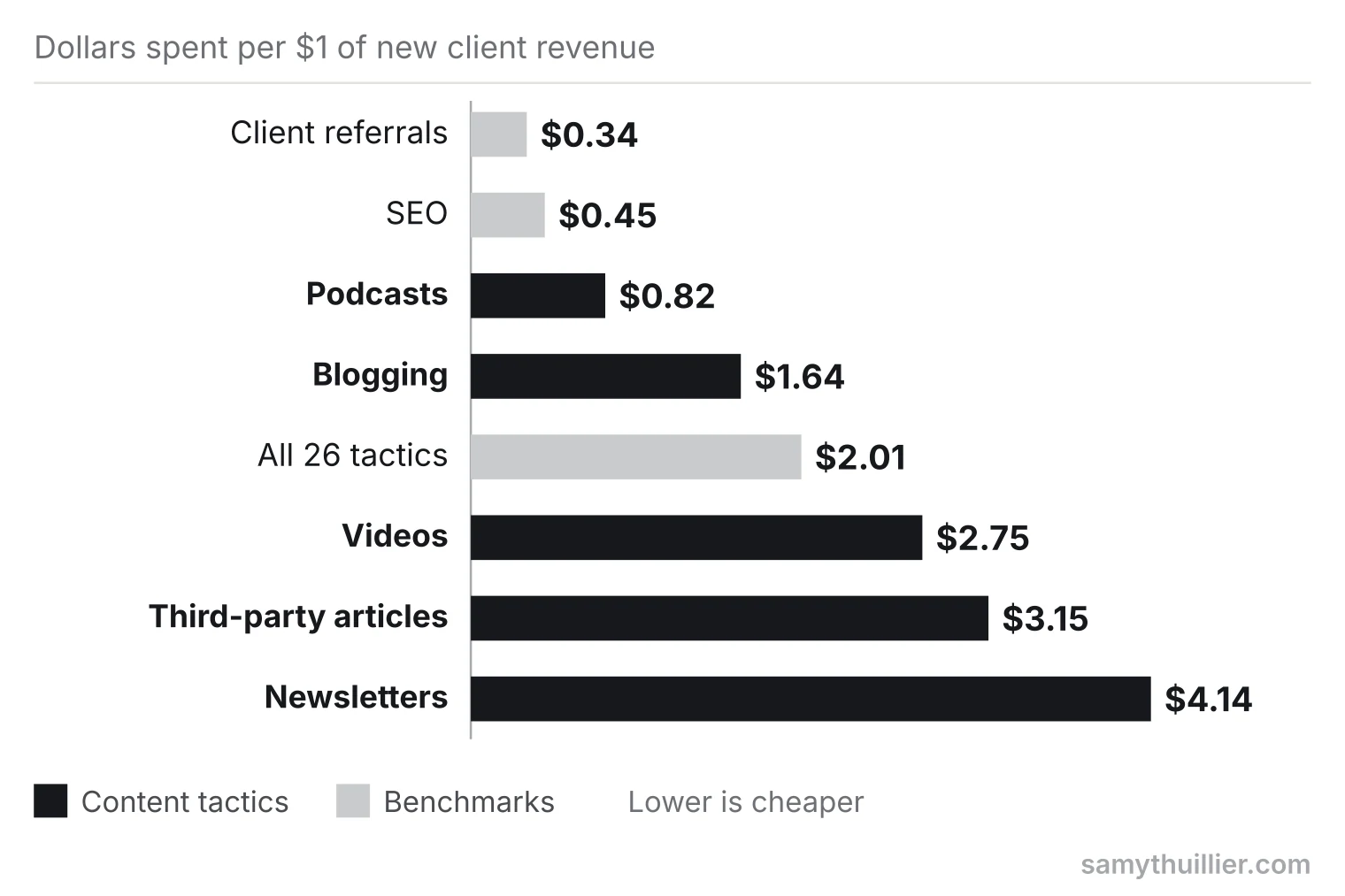
Podcasts cost $0.82 and blogging $1.64 per dollar of new revenue, videos $2.75, writing for third-party platforms $3.15 and newsletters $4.14. For comparison, client referrals cost $0.34, SEO $0.45, and the average across all 26 tactics was $2.01. (The report’s executive summary gives $0.62 for podcasts; its tactic table gives $0.82.)
The averages hide a split. High-growth practices ran content at a RAC of $1.36; everyone else at $5.47. Three habits explain most of the gap, according to the same report:
- They pair content with a supporting tactic. Blogging’s success rate rose from 22% alone to 35% with supporting tactics, and writing for third-party platforms from 24% to 48%.
- They niche. Niche-focused practices had higher success rates on blogging and podcasts than generalists.
- They delegate. The advisor supplies the ideas; staff or the firm’s marketing team edits, publishes and distributes.
The takeaway for a firm leader: content is not a cheap channel. It pays when it is aimed, distributed and produced without eating the advisor’s week.
Start with one client and their questions
Every page in the top results agrees on this, and the data backs it: write for one client type at a time. “Business owners two to five years before a sale” gives you a list of questions. “Anyone with investable assets” gives you generic market commentary that nobody remembers.
To build the list:
- Pull the last twenty questions clients asked by email or in meetings. Those are your first twenty topics.
- Ask your lead advisors what they explain over and over. Each answer is a page.
- Search the questions yourself in Google and in an AI assistant. Note what comes back and who is cited.
- Write down the trigger events of your niche: a job change, an equity vesting, a business sale, an inheritance, a divorce, a retirement date.
The Kitces data shows where most advisors land: retirement is the primary topic for 28% of advisors and general financial planning for 26%, while tax is the most common secondary theme (50%). Those crowded topics are hard to win. A narrower angle on the same subject (“Roth conversions for physicians in their last practice years”) is easier to rank, easier to be cited for and easier to approve.
Formats: what to publish and what each is for
| Format | Best for | Typical effort | Compliance notes |
|---|---|---|---|
| Website pages (who you serve, fees, process) | Being checked and quoted; every other channel points here | One-time, then updates | Advertisement or retail communication; the most-read pages you have |
| Blog posts and guides | Search, AI citations, answering niche questions | 800 words a month is the typical advisor blog (Kitces) | Educational posts are lighter; any service pitch makes them advertising |
| Newsletter | Keeping clients and prospects informed | Monthly | Usually goes to more than 25 retail investors, so treated like other mass communications |
| Video | Showing how you explain and who you are | Short, a few minutes; script reviewed before filming | Same rules as text; keep the approved script and the final file |
| Podcast | Depth with a loyal audience, guest partnerships | Interviews of about 30 minutes | Guests’ statements can become yours if you edit or promote them |
| Webinars and seminars | Trust in a teaching setting, direct questions | Per event | Slides, invites and recordings are marketing |
| Articles for third-party outlets | Credibility and independent mentions | Quarterly is typical | Press interviews and commentary usually are not advertising; reprinting them on your site may be |
| White papers and lead magnets | Capturing email for nurture | Heavy, then reused | Any performance or projection triggers the strictest rules |
| Social posts (LinkedIn first) | Distribution of the above | Weekly | FINRA treats static and interactive posts differently; keep records |
Pick one primary format you can sustain (writers blog, talkers podcast, performers film) and one distribution channel for it. Add a second format only once the first runs on schedule.
Topic ideas that match how prospects ask
Prospects ask at three stages, and a library should have pages for each:
- Learning the problem. “What happens to my stock options if my company is acquired?”, “How are inherited IRAs taxed now?”, “What should I do with a bonus?” These are the pages search and AI engines cite most, because they answer a question that has a clear answer.
- Comparing approaches. “Fee-only vs commission advisor for a business owner”, “Should I hire an advisor or use a robo-advisor before retirement?”, “What does a financial plan for a physician include?” Written fairly, these show judgment.
- Checking you. “What happens in our first meeting”, “How we charge and our minimum”, “Who we work with and who we do not”. These are the pages that vetting questions (“Is [firm] a good fit for me? What do they charge?”) pull from.
Other reliable angles: myth versus reality on one rule, a year-end checklist for your niche, a plain explanation of a rule change with the date it takes effect, and a “what we would do” walk-through of an anonymized, hypothetical case (labeled as hypothetical, with no performance shown).
Content that AI engines quote
None of the top-ranking guides on this topic explains what AI engines do with an advisor’s content, yet that is where a growing share of prospects meet it. A prospect asks ChatGPT, Perplexity, Gemini or Google AI Mode who to hire or whether your firm is a good fit, and the assistant answers from pages it finds and reads.
Google’s own documentation, AI Features and Your Website, sets the baseline: there are no additional requirements or special markup to appear in AI Overviews or AI Mode, a page must be indexed and eligible to show with a snippet to be used as a supporting link, and both features may issue several related searches across subtopics (“query fan-out”) to build an answer. In practice, that means the content that gets used is ordinary, well-built content with a few habits:
- Answer first. Put the direct answer in the first two or three sentences under each heading. Engines lift passages, not whole pages.
- Make each passage stand alone. A quoted paragraph loses the rest of the page, including the disclaimer in the footer. If a paragraph states a benefit, keep the limit in the same paragraph. That is also what the fair-and-balanced standards ask for.
- State facts plainly and date them. “Flat annual fee from $6,000, as of November 2026” (an illustrative example) can be repeated. “Competitive, transparent pricing” cannot. Engines reuse old text for months, and an “as of” date keeps an outdated fact defensible.
- Keep the same facts everywhere. Your site, your Form ADV, your BrokerCheck or IAPD record, directory profiles and press should agree on names, services, fees and locations. When sources conflict, answers get vague or wrong.
- Cover the question in pieces. Because of fan-out, a guide that answers the main question and the obvious follow-ups (cost, eligibility, timing, risks) under clear headings has more chances to be used.
- Earn mentions elsewhere. An assistant trusts several independent sources that agree more than one page that praises itself. Articles in trade outlets, association pages and partner sites are content too.
Search still matters as the first gate, since engines pick from pages they can find. The technical and local side is covered in SEO for financial advisors. To see which questions already name your firm and which sources the engines cite, the test in how to get clients as a financial advisor takes an afternoon.
Content marketing for financial advisors: what the rules actually say
Some of the top-ranking articles state “rules” that do not exist, such as content that “cannot promote services”. Content can promote your services. When it does, it is advertising and the full rules apply. Here is what the regulators say, checked in November 2026.
SEC-registered investment advisers. The Marketing Rule, Rule 206(4)-1, governs advertisements. The SEC’s adopting release explains that general educational material (about types of investments, asset classes or sectors) and general market commentary usually do not offer advisory services and so are not advertisements. The line moves when a piece goes on to explain how your services can help the reader: that portion is an offer, and the rule’s conditions apply to it. Every advertisement must avoid the rule’s general prohibitions, including untrue statements and material facts you cannot substantiate, and testimonials, endorsements, third-party ratings and performance have their own conditions. The detail is in our SEC Marketing Rule guide.
FINRA member broker-dealers. Under Rule 2210, a public web page or a post made available to more than 25 retail investors in 30 days is a retail communication. A registered principal must approve it before use, except, among other cases, a communication that makes no financial or investment recommendation and does not promote a product or service of the firm, which is supervised instead (FINRA’s advertising regulation FAQ, C.4, covers general market commentary). Two FAQ answers matter for content teams: D.8 says firms are responsible for their communications “regardless of whether they are generated by a human or AI technology”, and D.5 says a hyperlink can add information but a firm may not rely on a linked explanation or disclosure to correct a communication. More in our FINRA Rule 2210 guide.
UK firms. The FCA’s financial promotions page states that “all financial promotions must be clear, fair and not misleading regardless of the media type”, and points to the financial promotion rules for each product area in its Handbook (COBS for retail investments). A blog post, a video or a social post that promotes your services is a financial promotion like a brochure. Firms in other European markets should check their national regulator (the AMF in France, for example) before reusing US or UK copy.
What this means in practice:
- Pure education is the easiest content to clear and, conveniently, the most useful to readers and AI engines.
- A call to action is fine, but it turns the part around it into advertising. Keep pitches short, factual and separate from the explanation.
- AI drafting changes nothing about responsibility. Check every fact, number and rule a tool writes.
- A link does not fix a misleading sentence.
This article is general information, not legal advice; your firm’s compliance officer has the last word on what you publish and how it is reviewed.
A review workflow your compliance team can run
Most content programs die in review, not in writing. The fix is a workflow agreed with compliance before the first draft, with a turnaround time both sides accept.
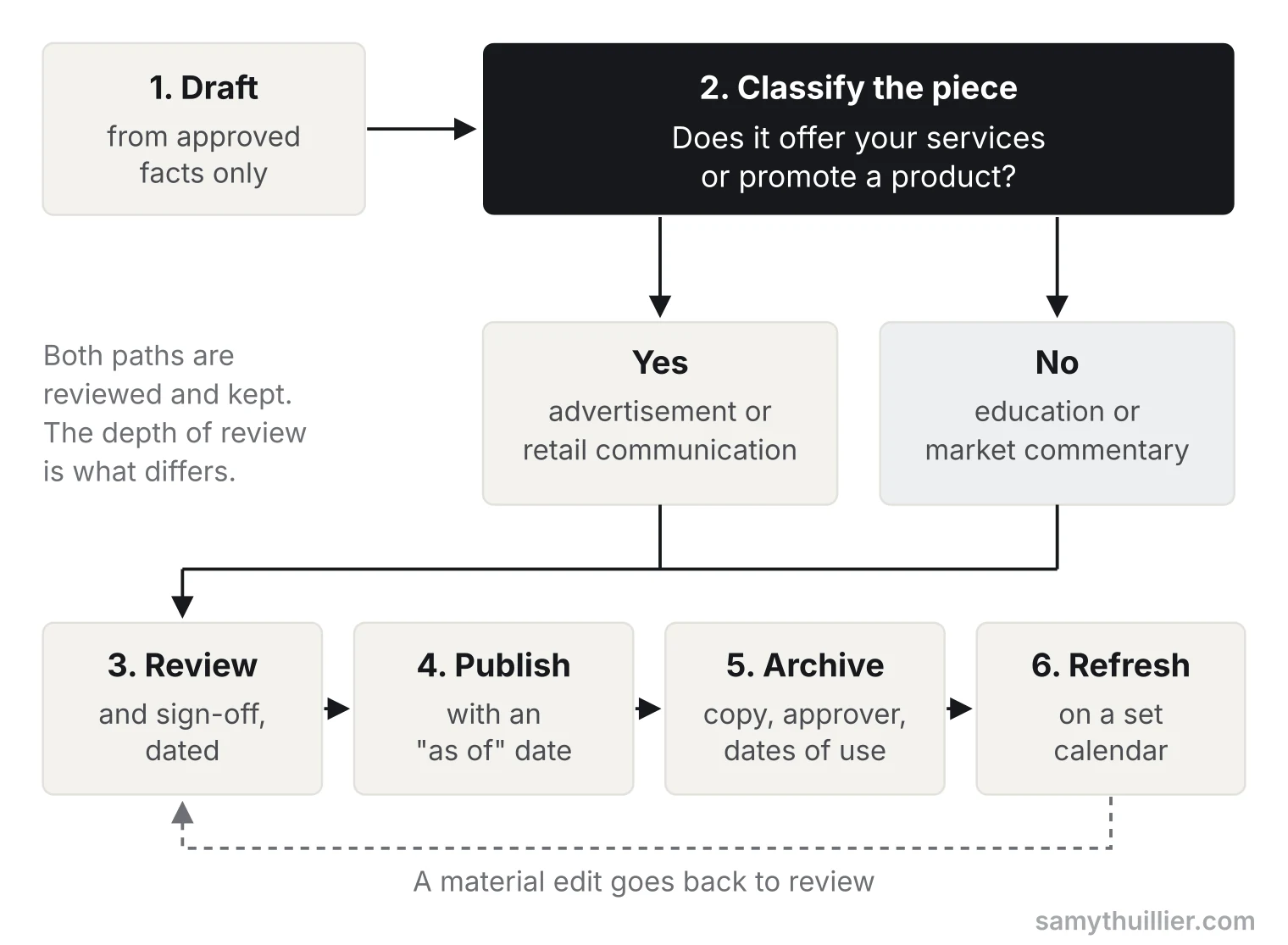
- Draft from approved facts. Keep one file of facts compliance has already cleared: services, fees, minimums, credentials, registration, team. Writers (and AI tools) draw from it, which removes most review comments.
- Classify the piece. Does it offer your services or promote a product? If yes, it is an advertisement or retail communication with every condition that implies. If it is education only, review is lighter but still happens.
- Review and sign off. Claims, balance, disclosures, links, any performance or testimonial. The approver signs and dates it.
- Publish with a date. Put “as of” dates next to anything that changes.
- Archive the record. Keep the copy, the approver, the approval date and the dates of first and last use. SEC-registered advisers keep advertisements for five years from the end of the fiscal year they were last disseminated; FINRA members keep retail communications for the retention period of SEA Rule 17a-4(b), which FINRA describes as at least three years. Your records policy sets the exact terms.
- Refresh on a calendar. Review published pages at least yearly. A material edit is a new version and goes back to step 3.
Agree on a service level, for example five business days for a standard post, and track it. A slow review quietly kills a content plan.
Distribution and repurposing
Publishing is half the job. The Kitces data shows content wins more clients when another tactic carries it, so plan distribution with the piece:
- One core piece, several cuts. A guide becomes a newsletter section, three LinkedIn posts, a short video script and a slide for your next seminar. Each cut is reviewed, but from approved source text, so review is quick.
- Email first. Your list is the one audience you own. Send the piece to clients and prospects with one line on why it matters to them.
- Give referrers a reason to share. A clear explainer is something a CPA or estate attorney can forward to a client without feeling they are pitching you.
- A next step on every page. A related guide, a checklist, a way to book a call. Readers who are ready should not have to hunt.
- Social as distribution, not as content. In the Kitces data, 82% of advisors using social media got no new client from it in a year. Use it to carry your best pieces to the right people, not as a daily obligation.
A 90-day content plan
An illustrative plan for a firm that serves business owners preparing a sale, with one lead advisor and one marketing coordinator:
| Weeks | What ships | Who | Review |
|---|---|---|---|
| 1 to 2 | Approved facts file; three core pages (who we serve, fees and minimum, first meeting) rewritten answer-first | Coordinator drafts, advisor checks | Compliance clears the facts file once |
| 3 to 6 | Two guides: “Selling your business: what to do in the year before” and “How sale proceeds are taxed” | Advisor gives a 45-minute interview, coordinator writes | Five business days each |
| 7 to 8 | Newsletter built from the two guides; a 20-minute talk for a CPA partner’s clients | Coordinator, advisor | Slides reviewed with the guides |
| 9 to 12 | Third guide on the next question clients ask; a guest article for a trade outlet; first refresh of the core pages | Same | Same |
| End of quarter | Check: which pages were visited and cited, which prospects mentioned them, how long review took | Coordinator reports |
Four substantial pieces in a quarter, all on one niche, all distributed, is more than most firms keep up for a year.
In-house, licensed libraries or outside help
Three ways to produce content, each with a trade-off:
- In-house. The advisor supplies the expertise in interviews or voice notes; a staff member writes, edits and publishes. This is how the high-growth firms in the Kitces data keep advisor time down. It needs one person who owns the calendar.
- Licensed content libraries. Pre-written, often pre-reviewed articles you can publish under your brand. Fast and cheap, but the same text appears on many advisor sites, so it rarely ranks or gets cited, and it says nothing specific about who you serve. Fine for a newsletter, weak for visibility.
- Outside writers or an agency. Useful for volume. Choose people who already know the SEC Marketing Rule or FINRA Rule 2210, and keep the facts file and the review step in-house.
Whichever you choose, someone has to decide what to write about, for whom, and whether it moves how search and AI engines describe the firm. If you are weighing outside help on that question, our AI visibility audit starts by running your prospects’ real questions through ChatGPT, Perplexity, Gemini and Google AI and mapping which sources they cite, so the content plan aims at the gaps. For the wider marketing strategy around content, see financial advisor marketing.
How to measure content marketing
Measure what ties to clients, not to applause:
- Source of every new client and prospect, asked in the first meeting and logged in your CRM, with options for “read an article”, “newsletter” and “an AI assistant (ChatGPT, Perplexity, Google AI)”.
- Visits and entrances by page, from search and from referrals, in your analytics.
- AI answers that name or cite the firm for a fixed list of your niche’s questions, checked the same way each quarter.
- Cost per new client by channel, time included. The Kitces RAC is a good model: total cost, advisor hours valued, divided by the first-year revenue of the clients it brought.
- Review turnaround, in business days.
Give a program at least two to three quarters before judging it, and judge it against the same measure you use for referrals and events.
Common mistakes
- Writing for everyone. Generic market commentary competes with every bank and media site and is cited by none.
- Publishing and stopping. A blog whose last post is a year old tells a prospect, and an AI engine reading dates, that the firm is not paying attention.
- No distribution. The data is clear that unsupported content rarely wins clients.
- Pitching in every paragraph. It makes the whole piece an advertisement and makes readers leave.
- Facts that drift. Fees on the site, in a directory and in an old article that disagree are a gift to an inaccurate AI answer.
- Treating review as the enemy. A facts file and an agreed turnaround make compliance a step, not a wall.
Frequently asked questions
What is content marketing for financial advisors?
It is publishing useful material, such as articles, guides, newsletters, videos or podcasts, that answers the questions your ideal clients ask, so they find you, trust you before the first meeting and come back when they are ready. For an advisory firm it is also marketing in the regulatory sense, so it runs through a compliance review.
Is content marketing worth it for financial advisors?
It can be, but the averages are poor. In The Kitces Report 2026, content creation tactics cost $1.99 for each $1 of new client revenue, against $0.70 for the typical practice overall, and only 35% of advisors who blog won a client from it in a year. High-growth firms do far better ($1.36) because they niche, support content with other tactics and delegate production.
Does compliance have to approve a financial advisor's blog posts?
Usually yes, in some form. For an SEC-registered adviser, a post that offers its advisory services is an advertisement under Rule 206(4)-1, while general education usually is not, though it must still not mislead. For broker-dealers, a public post is a retail communication under FINRA Rule 2210, and principal approval before use is required unless it makes no recommendation and promotes no product or service. Your compliance officer decides for your firm.
What type of content works best for financial advisors?
Content written for one client type and one question at a time, published where that client already looks. In the Kitces data, podcasts and blogging had the lowest cost per dollar of revenue among content tactics, and every content tactic did better when paired with a supporting tactic such as SEO, email or social distribution.
How often should a financial advisor publish content?
Pick a pace you can hold for a year with the review time included. The typical advisor blog in The Kitces Report 2026 was about 800 words a month, written in-house. One reviewed, well-aimed piece a month that you keep updated beats a weekly schedule that stops in March.
Can financial advisors use AI to write marketing content?
Yes, but the firm owns the result. FINRA's FAQ says firms are responsible for their communications whether a human or AI technology generated them, and an AI-drafted post goes through the same review, content standards and recordkeeping as any other piece. Check every fact and number the tool produces.
Samy Thuillier advises wealth management firms on AI authority and reputation. Former Deloitte financial consultant, SEO since 2013. More about Samy · Book a call