How to Get Clients as a Financial Advisor, Including From AI
The channels that bring advisors new clients, from referrals to seminars, plus the one most guides miss: prospects who ask ChatGPT, Perplexity or Google AI Mode who to hire, and a test to see if you are named.
 By Samy Thuillier · November 20, 2026
You get clients as a financial advisor by turning trust into introductions: referrals from happy clients, referrals from CPAs and attorneys who serve the same people, and visibility in the places prospects check before they call, from your website and Google profile to events and LinkedIn. One of those places is new: prospects now ask ChatGPT, Perplexity, Gemini or Google AI Mode to recommend an advisor, or to vet one by name, and the firm those assistants describe well gets the call. This guide covers each channel, what compliance allows, and a test you can run today to see whether AI assistants name you.
That last channel is what GEO for financial advisors is about, but the classic channels still come first. A prospect who hears your name from a friend will often check you in an AI assistant anyway.
How financial advisors get clients: the channels at a glance
Every advisor uses a mix. The table shows how each channel works, how fast it tends to move, and the compliance point to clear before you scale it.
| Channel | How it brings clients | Speed | Compliance point |
|---|---|---|---|
| Client referrals | Happy clients introduce friends, family, colleagues | Slow to build, steady after | Paying for referrals makes the referrer a promoter under the SEC Marketing Rule |
| Centers of influence | CPAs, estate attorneys, insurance and real estate pros refer shared clients | Months | Written agreements if any compensation flows |
| Events, seminars, webinars | Prospects meet you in a teaching role | Weeks per event | Slides and invitations are advertising or retail communications |
| Content and search | Articles, guides and a clear site bring searchers who already have the problem | Months | Review before publishing |
| Google Business Profile and directories | Local searchers and directory users find and compare you | Weeks | Reviews and ratings rules apply |
| LinkedIn and social media | Your network sees your expertise, shares it | Months | Recordkeeping and pre-approval for broker-dealer reps |
| Email nurture | Keeps prospects warm until they are ready | Ongoing | Same review as other marketing |
| Outbound prospecting (calls, email, mail) | You start the conversation with people in your niche | Immediate activity, slow results | Do-not-call rules, FINRA 2210 for reps |
| Paid ads and lead platforms | You buy attention or matched leads | Fast | Check how the platform describes you |
| PR and media | Quotes, articles and rankings build credibility | Months | Third-party ratings conditions |
| AI assistants | ChatGPT, Perplexity, Gemini or AI Mode name you, or describe you well when vetted | Depends on the sources | Same rules apply to the sources they cite |
Start with a niche you can name in one sentence
Every channel works better when you can say who you serve in one sentence: “fee-only planning for physicians in Denver” gets referred, “comprehensive wealth management” does not. A niche tells clients who to send you, tells a CPA which of their clients to introduce, and gives AI assistants something specific to match when a prospect asks for “an advisor for doctors in Denver”.
Look at your best ten clients. What do they share: profession, life stage, a liquidity event, a planning need such as equity compensation or business sale? Write that down, then write what you do for them that a generalist does not.
State your minimum and your fee model in public. Prospects ask whether their assets are enough to work with an advisor, and they will ask an AI assistant the same thing. A line such as “we work with families from $500,000 in investable assets, flat annual fee” (an illustrative example) lets you filter out poor fits before the first call and give the engines a fact to repeat. If your site says nothing, the engines will guess from other sources.
Referrals from clients: build the habit, not the ask
Referrals from existing clients remain the core of most practices because the trust transfers with the introduction. What separates advisors who get them steadily from those who get them by luck is process:
- Service worth talking about. Answer fast, remember the details, mark the milestones in clients’ lives. People refer an experience, not a portfolio.
- Clear timing. The natural moments are right after a visible win: a retirement plan finished, a house bought, a tax bill lowered. Mention then that you work best with people like them.
- A clear description. Clients cannot refer what they cannot describe. Give them your one-sentence niche.
- Events that include guests. A client appreciation evening where clients may bring a friend is a low-pressure first meeting.
- A system. Log life events and referral sources in your CRM so the follow-up happens every time.
One compliance point before you add rewards: if you compensate a client or anyone else for a referral, cash or not, the SEC treats that person as a promoter and the referral as an endorsement under the Investment Adviser Marketing rule, with disclosure, written agreement and oversight conditions. Check with compliance first.
Centers of influence: CPAs, estate attorneys and other pros
CPAs, estate attorneys, insurance agents, divorce attorneys and business brokers see your future clients at the exact moment they need planning. A good center-of-influence relationship works both ways: you send them clients, they send you clients, and both of you look better for having a trusted name to give.
Start with three or four professionals who serve your niche. Meet them to learn which clients they would like more of, then find a reason to work together: a joint workshop, a short guide for their clients, a case you solve together. Professional associations, such as your local estate planning council or a CPA society chapter, are where you meet them and where speaking slots open up.
Keep the arrangement clean. If you pay a CPA or attorney for referrals, the same Marketing Rule conditions apply as for paid client referrals, and many CPAs and attorneys have their own professional rules on fees.
Events, seminars and webinars
Teaching is still one of the fastest ways to be trusted by strangers. A seminar on Social Security timing, a webinar on equity compensation for employees of a local company, or a talk at a library or chamber of commerce lets prospects see how you explain things before they commit.
What makes events produce clients rather than attendance:
- A topic narrow enough to fill the room with your niche.
- A partner who brings the audience: an employer, an association, a CPA firm.
- A next step at the end, such as a free review or a planning checklist sent by email.
- Follow-up within days, not weeks.
Invitations, slides and recordings count as marketing. Have them reviewed like any other piece.
Content, search and your Google Business Profile
Content earns clients slowly and then keeps doing it. A page that answers a question your niche asks (“what happens to my RSUs when I leave the company?”) brings people who already have the problem. It also gives AI assistants a page to cite when they answer that question, which is the bridge to the channel covered below.
The pages that matter most are usually not blog posts:
- Who you serve and how. One page per niche or service, with the facts a prospect needs: who, what, fees, minimum, location, how to start.
- Team bios. Credentials (CFP, CFA, CPWA, CPA), registration status and experience, written as facts.
- Fees. A plain explanation of how you are paid. Fee questions are among the first a prospect asks, and an assistant with no source on your fees will say it does not know or guess.
For local searches, claim and complete your Google Business Profile, with your real firm name, correct category, address and hours, as Google’s guidelines for representing your business require. Then list your firm where prospects look for advisors: the CFP Board’s Let’s Make a Plan for CFP professionals, NAPFA’s Find an Advisor for fee-only members, and any directory your niche uses.
PR helps here too. A quote in a trade publication, a column in a local paper or a guest article in a niche outlet builds credibility with readers, and it becomes one more third-party source that describes you.
LinkedIn and social media
LinkedIn is where your clients’ colleagues, your centers of influence and your prospects already are. Post what you would tell a client in a meeting: a tax deadline, a planning mistake you see often, a plain explanation of a rule change. Comment on posts by people in your niche. Connect after every meeting.
Email does the same job for people who have raised a hand: a monthly note to prospects, with one useful idea, keeps you present until the moment they are ready to move.
Broker-dealer representatives need to check FINRA’s rules before posting. Under FINRA Rule 2210, a written communication sent or made available to more than 25 retail investors within 30 days is a retail communication, which needs approval by a registered principal before use, with some exceptions. The full picture is in our guide to FINRA Rule 2210.
Financial advisor prospecting: outbound, mail and paid leads
Financial advisor prospecting is the outbound side: you pick the people and start the conversation. It suits new advisors with time and no book, and established advisors entering a new niche.
- Cold calls and cold email. They work when the list is narrow and the reason to talk is concrete: an invitation to a seminar for that niche, a guide written for them. Respect do-not-call rules and your firm’s policies.
- Direct mail. A handwritten note or a short letter to a defined list (new business owners, recent retirees of a local employer) stands out because little personal mail arrives.
- Paid ads. Search ads on queries like “fee-only financial planner [city]” reach people with intent. Track cost per client, not cost per click.
- Lead platforms. Matching services sell introductions to people who said they want an advisor. Check how each platform describes your firm, because that description becomes one more source about you online.
Outbound fills the calendar fastest. It also has the lowest trust at the start, which is why most advisors use it to fill events and meetings rather than to sign clients cold. If you are deciding which of these sources to pay for, the page on financial advisor lead generation compares them on cost per client and compliance risk.
Which channels fit your stage
| Your situation | Start with | Add next |
|---|---|---|
| New advisor, no book | Outbound in one niche, events, centers of influence | Content on that niche’s questions |
| Established book, growth flat | Client referral process, centers of influence | Niche pages, directories, AI visibility test |
| Moving upmarket | Niche pages, PR and rankings, centers of influence in that market | AI visibility test on that market’s questions |
| Firm with several advisors | One page per advisor and per niche, consistent facts everywhere | Monthly AI test across the firm’s names |
The new front door: prospects asking ChatGPT for an advisor
Prospects now use AI assistants in two ways that matter to you.
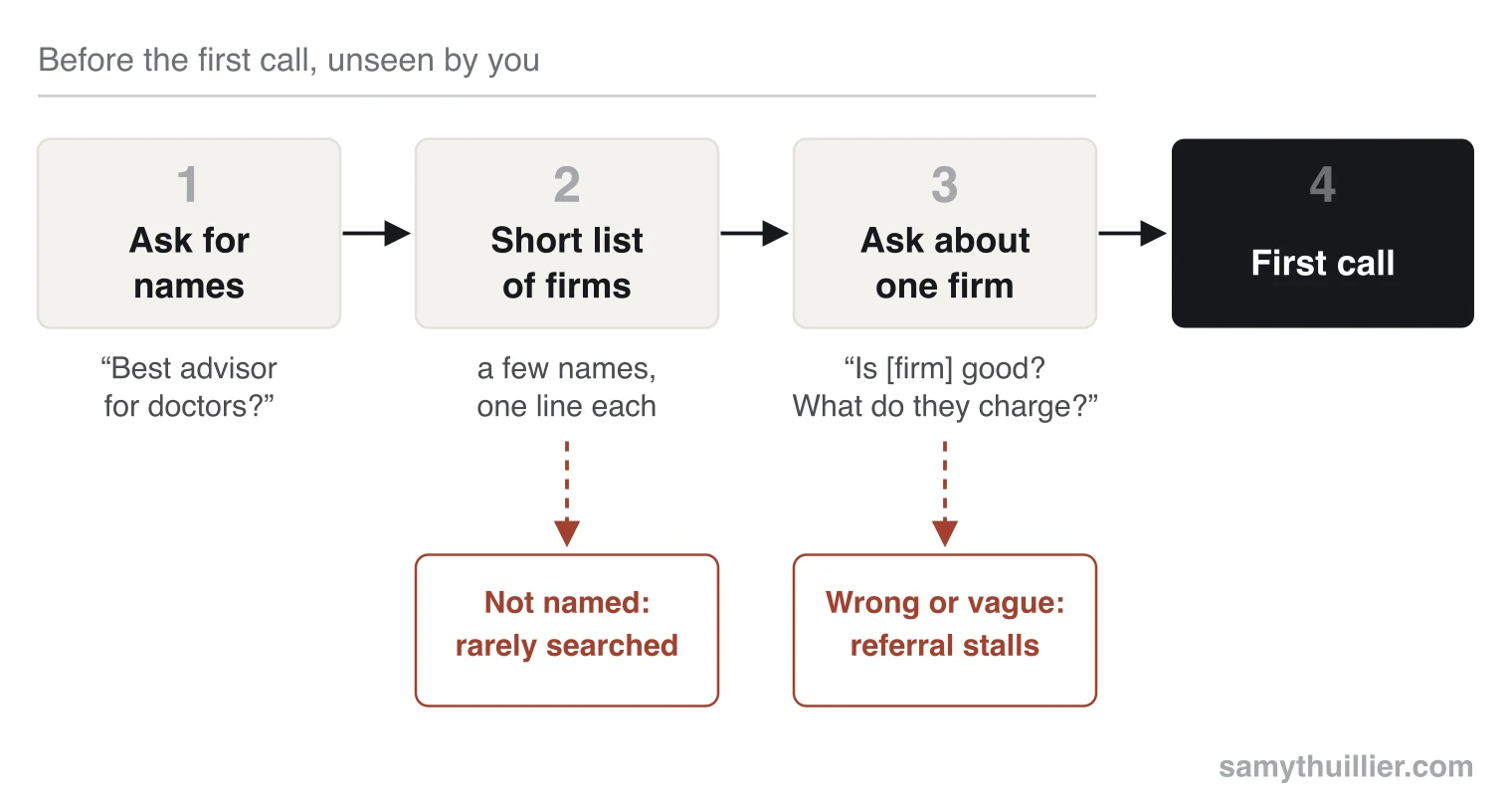
To get names. “Who are the best fee-only financial advisors in Austin for tech employees?” A search-connected assistant runs searches, reads pages and answers with a short list of firms, usually with a sentence on each and links to the pages it used. If your firm is not in that list, the prospect may never search for you.
To vet a name. A friend mentioned you, so the prospect asks “Is [your firm] a good advisor? What do they charge? Any complaints?” The assistant summarizes what it finds: your site, your public records, reviews, articles. If your fees are not online, it may say so or quote an old source. If a directory profile lists you at the wrong firm, it may repeat that.
Both questions happen before the first call, and you do not see them. Referrals now pass through this check too: a referral that ends in a confused or negative AI answer may never turn into a meeting. That is why being named well by AI assistants has become part of how to get clients as a financial advisor, not a separate marketing project.
Where AI answers about advisors come from
AI assistants that search the web build their answers from pages they can find and read. Google says its AI Overviews and AI Mode may run several related searches across subtopics and sources to build an answer (it calls this query fan-out), and that a page needs to be indexed and eligible for a snippet to appear as a supporting link, with no special file or markup required, according to AI Features and Your Website. Perplexity says it searches the internet in real time and that each answer includes numbered citations to its sources (How does Perplexity work?). ChatGPT with search on also shows the sources it used.
For a financial advisor, those sources usually fall into six groups:
- Your own pages. Niche pages, bios, fees, location. The engines quote what is written plainly; they cannot quote what is only implied.
- Directories. Let’s Make a Plan, NAPFA, your Google Business Profile, niche directories, custodian or network “find an advisor” pages.
- Registration records. FINRA BrokerCheck and the SEC’s Investment Adviser Public Disclosure site show registration, employment history and disclosures. These are also what prospects mean when they ask about red flags.
- Rankings and press. Industry rankings, local business journal lists, articles that quote you.
- Reviews, where allowed. Your Google reviews and other review sites, within the limits below.
- Forums and social. Reddit threads and LinkedIn posts that mention you, for better or worse.
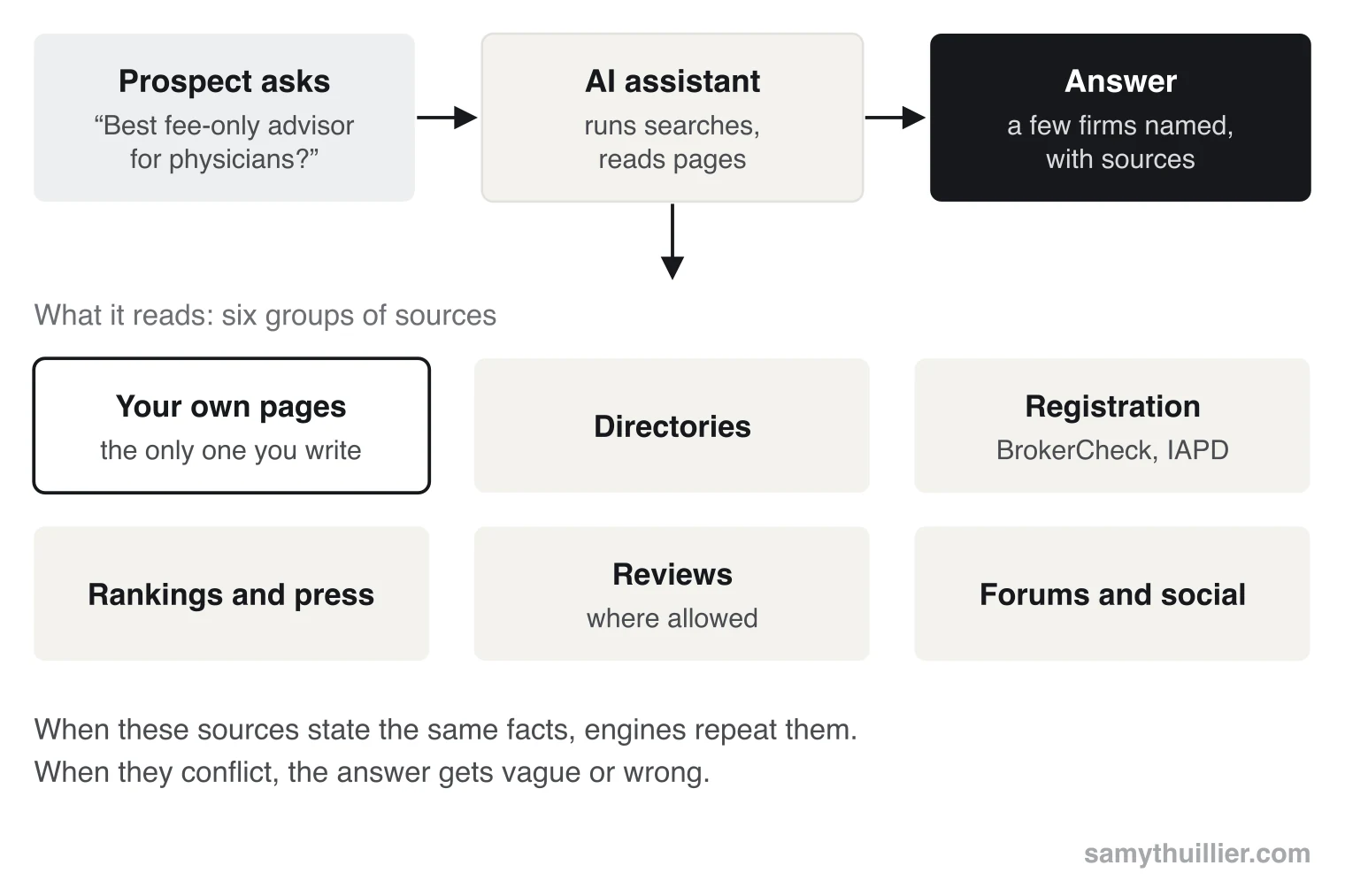
The pattern to notice: most of these are not your marketing. An assistant trusts several independent sources that agree more than one page that praises itself. When your site, your directory profiles and your records all state the same facts, the engines can repeat them with confidence. When they conflict, the answer gets vague or wrong. If an assistant already says something wrong about your firm, that is a reputation issue more than a visibility one; our AI reputation management page covers how to trace and correct it.
Test it today: the AI visibility check
You can see where you stand in an afternoon. No tools needed.
- Write 10 to 20 buyer questions. Use the words a prospect would use, not your marketing terms. Mix three kinds:
- Recommendation: “Best fee-only financial advisor in [city] for [niche]”, “Who should a [profession] in [city] hire for retirement planning?”, “Financial advisor near [neighborhood] who works with [need]”.
- Comparison: “[Your firm] vs [competitor]”, “Is a fee-only advisor better than [your competitor’s model] for [niche]?”
- Vetting: “Is [your firm] legit?”, “What does [your firm] charge?”, “Reviews of [lead advisor name], financial advisor in [city]”, “Does [your firm] have a minimum?”
- Ask every engine the same questions. ChatGPT with search on, Perplexity, Gemini and Google AI Mode. Use a fresh chat, ideally logged out or in a private window, so your own history does not shape the answer.
- Log what you see. For each question and engine, record the firms named, whether yours is among them, the sources cited, and any error about you.
- Repeat and compare. Run each question twice, since answers vary from one try to the next, and repeat the full test every month.
- Fix the sources, not the answer. You cannot edit what ChatGPT says. You can fix the pages it reads.
A simple log is enough:
| Question | Engine | Firms named | Yours named? | Sources cited | Errors about you |
|---|---|---|---|---|---|
| Best fee-only advisor in [city] for physicians | Perplexity | ||||
| What does [your firm] charge? | ChatGPT | ||||
| Reviews of [lead advisor], [city] | Google AI Mode |
What to fix after the test
| What the test shows | Likely cause | Fix |
|---|---|---|
| Competitors named, you are not | No page on your site matches the question; few third-party sources mention you for that niche | Publish a niche page with plain facts; get listed in the directories the engines cited; earn a mention in a source they cite |
| You are named, but described wrong | Outdated or conflicting sources | Update your profiles, Google Business Profile and bios so every source states the same facts; check your BrokerCheck or IAPD record is current |
| “Fees not available” or a guessed fee | No fee information on your site | Publish how you charge and your minimum |
| The cited sources are competitor blogs or lead platforms | Few independent sources about your niche | Press, rankings, associations and partner pages in that niche |
| Negative or old forum thread cited when vetting your name | One source dominates for lack of others | More accurate, current sources about you; consult compliance before any public reply |
This is the work behind our AI visibility audit: the same questions, run across engines at scale, with every cited source mapped and a fix list your compliance team can review. You can run the basic version yourself first.
Compliance limits on reviews, ratings and testimonials
Visibility work in wealth management happens inside rules. Checked in November 2026:
- SEC Marketing Rule (registered investment advisers). An advertisement may include a testimonial or endorsement only if the adviser meets the rule’s conditions, starting with clear and prominent disclosure of whether the person is a client, whether they were paid, and any material conflict of interest. A third-party rating requires a reasonable basis to believe the survey behind it was not designed to produce a predetermined result, plus disclosure of the rating’s date, period and the third party that created it, and any compensation paid. The text is at 17 CFR 275.206(4)-1. Whether a review on an outside site becomes your advertisement depends on what you do with it, such as sharing it or shaping it. Our SEC Marketing Rule guide goes through the cases.
- FINRA Rule 2210 (broker-dealers). Retail communications need principal approval, and a testimonial about the firm’s advice or performance must disclose that it may not represent other customers’ experience and is no guarantee of future results. If more than $100 in value is paid for a testimonial, it must say so (FINRA Rule 2210).
None of this stops the work in the earlier sections. Plain facts about who you serve, how you charge and what credentials you hold are what the engines need, and they are also the easiest content to approve. This article is general information, not legal advice; your compliance officer has the last word on what your firm publishes.
Track where every client came from
Most advisors cannot say which channel paid for itself, because they log “referral” or “website” and stop there. Ask every new prospect how they heard about you, and add one option to the list: “an AI assistant (ChatGPT, Perplexity, Google AI)”. Prospects who checked you in an assistant after a referral will say so if you ask.
Then compare channels on clients signed and assets per client, not leads. In an illustrative case, a seminar that brings 40 attendees and signs one client beats a lead platform that brings 40 leads and signs none. Rerun the AI test each month next to those numbers, and you will see whether being named moves the calls you get.
Frequently asked questions
How do financial advisors get clients?
Most advisors grow through referrals from existing clients and from professionals who serve the same people, such as CPAs and estate attorneys. On top of that come events and webinars, content and search, LinkedIn, outbound prospecting and paid leads. A growing share of prospects also asks AI assistants like ChatGPT or Perplexity for names, or uses them to check an advisor before calling.
How do people find a financial advisor?
Through a recommendation from someone they trust, then a check online: the firm's website, a Google search, directories such as the CFP Board's Let's Make a Plan or NAPFA, and public records on FINRA BrokerCheck or the SEC's IAPD site. More and more of that check now happens inside an AI assistant, which summarizes those same sources in one answer.
What is financial advisor prospecting?
Prospecting is the outbound side of client acquisition: finding people who fit your ideal client profile and starting a conversation, through cold calls, cold email, direct mail, events or LinkedIn. It works best with a narrow niche and a reason to talk, such as a seminar invitation or a guide written for that niche. Broker-dealer reps should check FINRA's communication rules before scaling any of it.
Can ChatGPT recommend a financial advisor?
Yes. When someone asks for an advisor in a city or for a specific need, search-connected assistants look up the web and name firms, often with links to the pages they used. They pick from what third-party sources and the firms' own pages say, so an advisor with thin or inconsistent information online is less likely to be named.
Will AI replace financial advisors?
Nothing in how AI assistants work today replaces the fiduciary relationship, the planning judgment or the trust a client places in a person. What AI is changing is how prospects shortlist and vet advisors before the first call. Advisors who make sure those assistants describe them accurately gain from the shift.
Can financial advisors use client reviews and testimonials?
In the US, registered investment advisers can use testimonials and third-party ratings under the SEC Marketing Rule if they meet its disclosure and oversight conditions. Broker-dealers follow FINRA Rule 2210, which also requires testimonial disclosures. Check with your compliance officer before you ask for, share or respond to reviews.
Samy Thuillier advises wealth management firms on AI authority and reputation. Former Deloitte financial consultant, SEO since 2013. More about Samy · Book a call