B2B SEO Strategy: A Complete Guide
Organic search accounts for more than 40% of B2B revenue. Companies that prioritize SEO often see more than seven times ROI within the first year. Yet a large share of published B2B content earns no organic traffic at all. That gap is where the opportunity sits.
This guide covers every component of a B2B SEO strategy: how it differs from B2C, how to build your roadmap, and the best practices that produce consistent organic growth.
What Is B2B SEO?
B2B search engine optimization (SEO) is the practice of improving your website's visibility in search engines so that decision-makers at other companies can find you when they research solutions. The goal is not to attract millions of casual visitors. It's to get your site in front of the specific people who have the authority (and the budget) to buy what you sell.
B2B SEO vs B2C SEO
Google uses the same ranking factors for B2B and B2C websites. There is no separate B2B algorithm. The same fundamentals apply: relevant content, technical health, and authoritative backlinks. But in practice, the two approaches are different enough to treat them as separate disciplines.
In B2C, you typically target a broad demographic: new parents, fitness enthusiasts, people who want to travel. Your keyword list often includes terms that thousands of people search for each month. In B2B, your audience is narrow. You target a defined group of decision-makers: a CFO, a director of IT, a procurement lead, within a specific type of company.
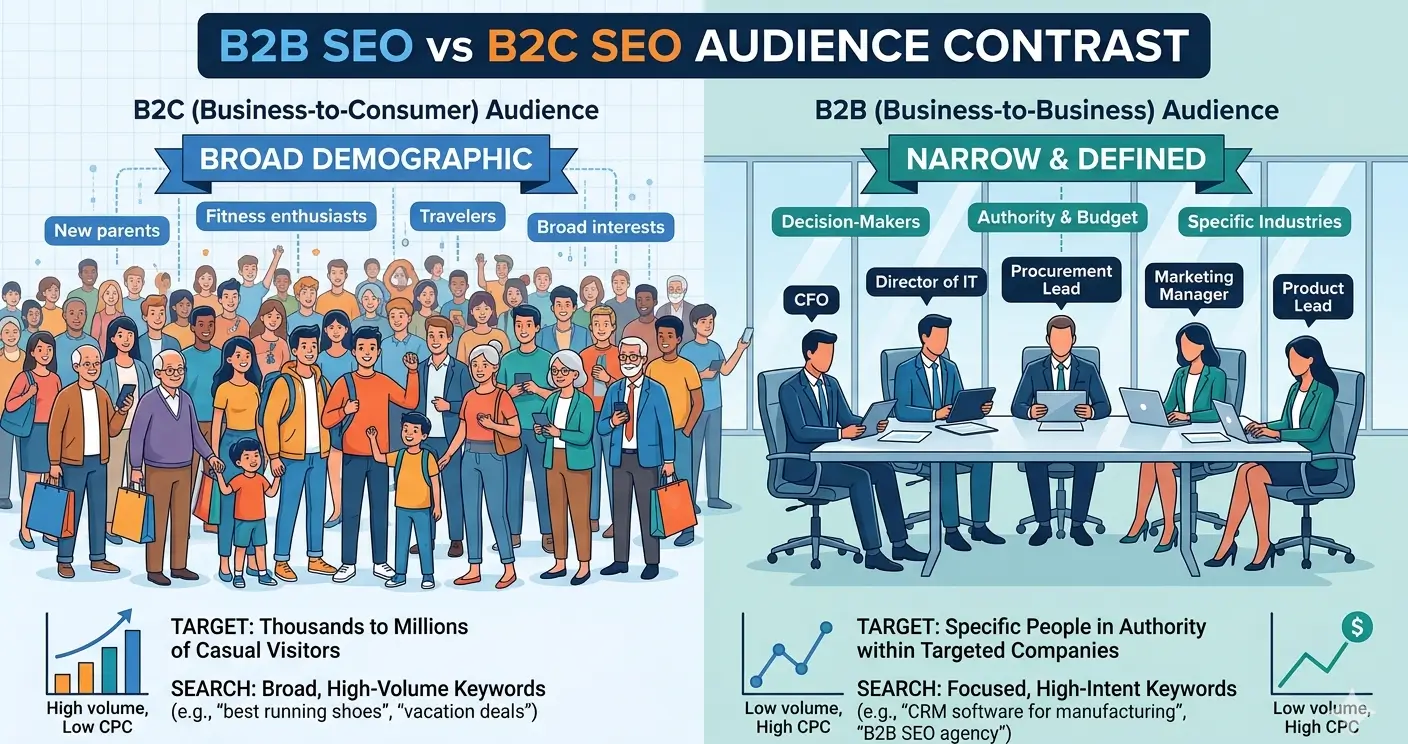
Here is what changes in practice:
- Target audience: A specific persona inside a company, not a broad consumer group
- Search volume: B2B keywords often get fewer than 100 monthly searches
- CPC (cost per click): High CPC signals high commercial intent, a more reliable metric than volume in B2B
- Buying cycle: Months, not days: decision-makers research before they ever contact a vendor
- Content channels: Blogging, white papers, and email tend to outperform social media for most B2B industries
- Conversion rates: Lower than B2C, which makes targeting the right traffic essential
A B2B keyword with 50 monthly searches and a $15 CPC is worth more than a B2C keyword with 50,000 monthly searches and a $0.10 CPC. In B2B SEO, intent matters more than volume.
Why B2B Organic Search Growth Matters
Paid ads stop the moment your budget runs out. Organic traffic compounds over time. That's the core case for investing in B2B SEO.
Nearly 49% of B2B marketers now include SEO in their core marketing strategy. Organic search drives more than 40% of B2B revenue, and companies that execute SEO with consistency often achieve more than seven times ROI within the first year. Results, however, are not immediate. Most B2B companies see meaningful organic growth after six months of consistent work. The strongest results typically appear in years two and three.
B2B buyers also do their own research before engaging with a vendor. They use search engines (and increasingly, AI-powered tools like ChatGPT and Perplexity) to compare options, read case studies, and evaluate expertise. If your content doesn't appear during that research phase, a competitor's will. Showing up early in the buyer's journey builds familiarity before the first sales conversation even happens.
Building a B2B SEO Roadmap
A B2B SEO roadmap gives your team a clear order of operations. Each phase builds on the one before it.
Phase 1: Define Your Decision-Maker Persona
Before any keyword research, identify who you are targeting inside a prospect company. That person could be a marketing manager, a CFO, a director of operations, or a product lead, depending on what you sell. In B2C, your customer is a person. In B2B, your customer is a company, and you need to reach the right person within it.
Build a detailed persona that covers their role, their daily challenges, the questions they ask, and how they search for solutions. Tools like HubSpot's Make My Persona or Semrush's Persona tool help you structure this process. The more specific your persona, the more relevant your keyword targeting and content will be.
Phase 2: Keyword Research
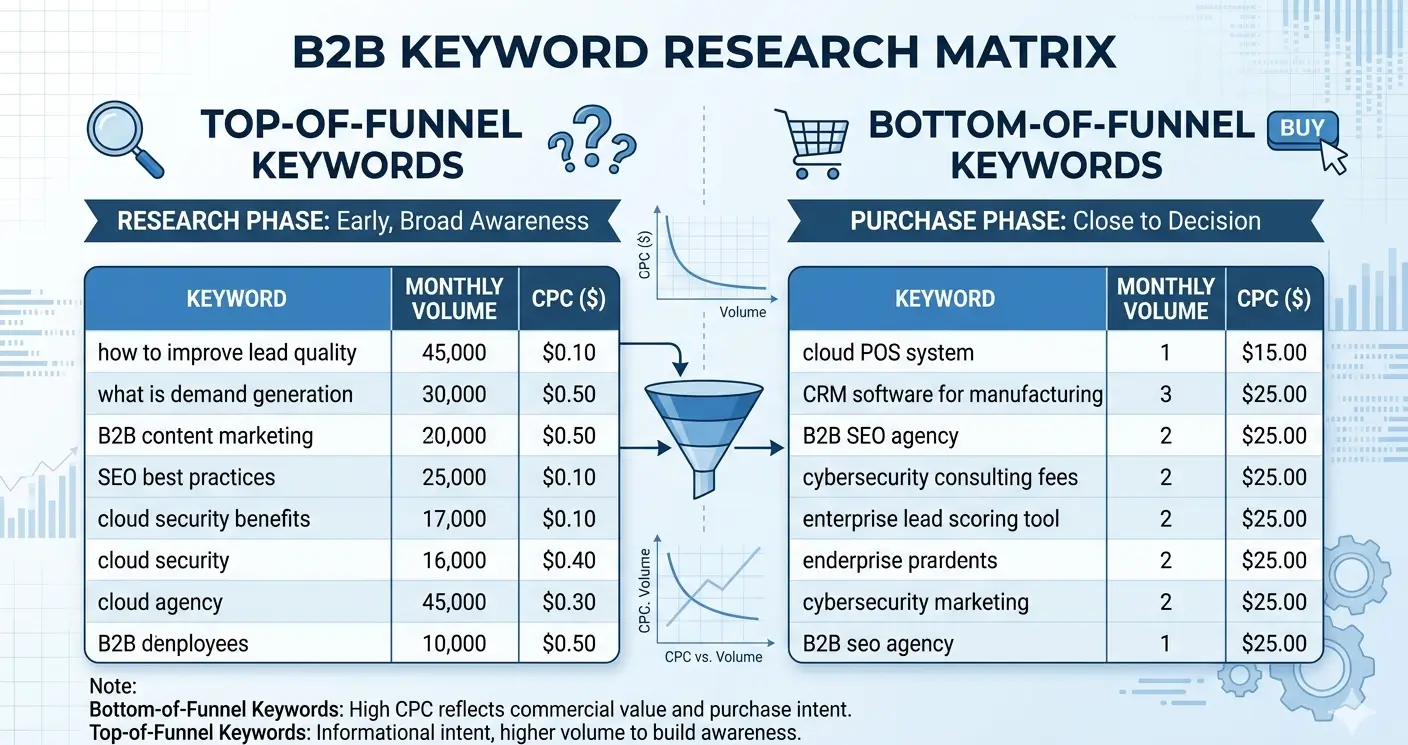
Keyword research in B2B splits into two categories.
Bottom-of-funnel keywords are terms people search when they are close to a purchase decision. They describe your product or service directly: "cloud POS system," "CRM software for manufacturing," "B2B SEO agency." Search volume is often low, but CPC is high. These keywords belong on your product and service landing pages.
Top-of-funnel keywords attract people earlier in the research phase: "how to improve lead quality," "what is demand generation," "B2B content marketing." These drive blog content. They generate more traffic and introduce decision-makers to your brand before they are ready to buy.
To find strong B2B keywords, start with Google Autocomplete or a seed keyword tool to surface the language your audience uses. Then use an SEO platform like Semrush to review CPC, keyword difficulty, and monthly search volume. Focus on CPC over volume: it shows how much advertisers pay per click, which reflects the commercial value of the search.
Filter out keywords with a CPC below $1 (or $5 for high-ticket products) to remove terms unlikely to convert.
Phase 3: Technical Foundation
Before you build content, your website needs to be technically sound. Search engines rely on clean, fast, and well-structured sites to crawl and index pages. Technical problems upstream block every effort downstream.
Key areas to address:
- Page speed: Slow pages lose visitors and rankings. Use Google PageSpeed Insights or GTmetrix to identify issues.
- Mobile optimization: Google uses mobile-first indexing. Your site must perform well on mobile.
- HTTPS: Secure sites rank better. Install an SSL certificate if you haven't already.
- Site architecture: Pages should follow a logical hierarchy: homepage → category pages → individual pages. Flat structures without hierarchy make it harder for search engines to understand your site.
- Structured data (schema markup): Helps search engines and AI tools interpret your content and display it in rich results.
- XML sitemap: Keep it updated and submitted to Google Search Console.
Run a technical audit at least once per quarter using tools like Screaming Frog and Google Search Console. These surface crawl errors, broken links, duplicate content, and indexation problems before they compound into bigger ranking issues.
→ For a complete breakdown of every technical element to audit, see Technical SEO for B2B Websites.
Phase 4: Content Strategy with Topic Clusters
A topic cluster model organizes your content around central themes. Each cluster has a pillar page (a broad, authoritative overview of a topic) supported by cluster pages that go deep on specific subtopics. Each cluster page links back to the pillar, and the pillar links out to the clusters.
This structure builds topical authority: the signal to Google that your site has depth and breadth of knowledge on a subject. It also lets you target every stage of the buyer's journey within a single content ecosystem.
For example: if your pillar page targets "B2B SEO strategy," your cluster pages might target "B2B keyword research," "technical SEO for B2B websites," "B2B SEO content," and "B2B lead generation SEO."
B2B content should span multiple formats:
- Blog posts and in-depth guides (top of funnel)
- Case studies, white papers, and webinars (middle of funnel)
- Product and service landing pages (bottom of funnel)
- Comparison and pricing pages (bottom of funnel)
Each format serves a different type of search intent. Together they give your site coverage across the full buying journey. Build a content calendar to maintain a consistent publishing schedule — search engines favor sites that publish and update content with regularity.
→ For a full breakdown of B2B content formats, keyword targeting, and editorial planning, see B2B SEO Content Strategy.
Phase 5: On-Page Optimization
Once your content exists, each page needs proper on-page optimization. This is how you help search engines understand what a page is about and how you improve the experience for visitors.
Cover these elements on every key page:
- Title tags and meta descriptions: Include your target keyword. Write them to reflect what the page is actually about.
- Header tags (H1, H2, H3): Organize your content with a clear structure. Use headers to signal the page's hierarchy.
- Keyword placement: Use your target keyword in the title, at least one header, and naturally in the body text. Do not stuff.
- Internal links: Connect related pages. This helps search engines crawl your site and distributes authority across pages.
- Image alt text: Descriptive alt tags improve accessibility and give search engines additional context about your visuals.
- URL structure: Keep URLs short, readable, and keyword-relevant.
Long-form content ranks better in B2B. Research shows the average page on Google's first page contains around 1,447 words. Short landing pages with 50 to 100 words are difficult to rank because there isn't enough content for search engines to interpret. For key pages, aim for at least 500 to 1,000 words, and more where the topic demands it.
Phase 6: Link Building
Backlinks from authoritative sites signal trust and credibility to search engines. In B2B, the most valuable links come from industry publications, trade associations, partner sites, and sector-specific directories.
Effective link-building tactics for B2B include:
- Original research and data studies: Novel data attracts links from journalists and industry blogs without requiring direct outreach.
Phase 7: Measurement and Refinement
SEO is not a one-time project. Tracking performance keeps your strategy aligned with business goals and helps you adapt to algorithm changes and shifts in buyer behavior.
Monitor these metrics consistently:
- Organic traffic and keyword rankings
- Conversion rates from organic search (form submissions, demo requests, content downloads)
- Featured snippet and AI Overview appearances
- Engagement signals: dwell time, scroll depth, bounce rate
Use Google Analytics and Google Search Console as your base. Behavioral tools like Hotjar or Microsoft Clarity add a layer of qualitative insight: they show how visitors interact with your pages, where they drop off, and what content holds their attention. Use that data to run A/B tests on headlines, CTAs, and page layouts to improve conversion rates over time.
B2B SEO Best Practices
Certain principles apply across every phase of a B2B SEO strategy. These are not one-off tactics. They are the operating conditions for long-term organic growth.
- Prioritize E-E-A-T. Google evaluates content on Experience, Expertise, Authoritativeness, and Trustworthiness. In B2B, this means content should be written by — or attributed to — people with real credentials. Author bios, original data, case study references, and third-party citations all strengthen E-E-A-T signals. B2B buyers also want to work with people who know their field. If your content demonstrates expertise, it builds trust with both search engines and readers.
- Use search intent as your primary filter. A keyword with 50 monthly searches and high commercial intent is more valuable than one with 5,000 monthly searches and no conversion potential. Before creating any page, confirm the search intent behind the target keyword (informational, commercial, or transactional) and build content that matches it.
- Update existing content. Search engines favor pages that stay current. Set a review cycle for your most important pages — at least once per year. Refreshing statistics, adding new examples, and expanding sections can improve rankings without creating new content from scratch.
SEO Strategy for SaaS Companies
SaaS companies operate within the B2B space but face specific considerations that shape their SEO approach.
The SaaS buying cycle typically involves multiple stakeholders. An end user discovers the product. A manager evaluates it. A finance lead approves the budget. Each persona has different questions and searches for different content. Your strategy needs to address all three.
That means building a content mix that includes top-of-funnel educational articles (for the end user who is just becoming aware of the problem), comparison and feature pages (for the evaluator researching options), and ROI case studies (for the decision-maker who needs to justify the purchase).
SaaS keyword research should include comparison keywords ("HubSpot vs Salesforce," "best CRM for small business") and use-case keywords ("CRM for e-commerce," "project management software for agencies"). These terms sit at the commercial intent stage and attract buyers who are actively evaluating options — not just browsing.
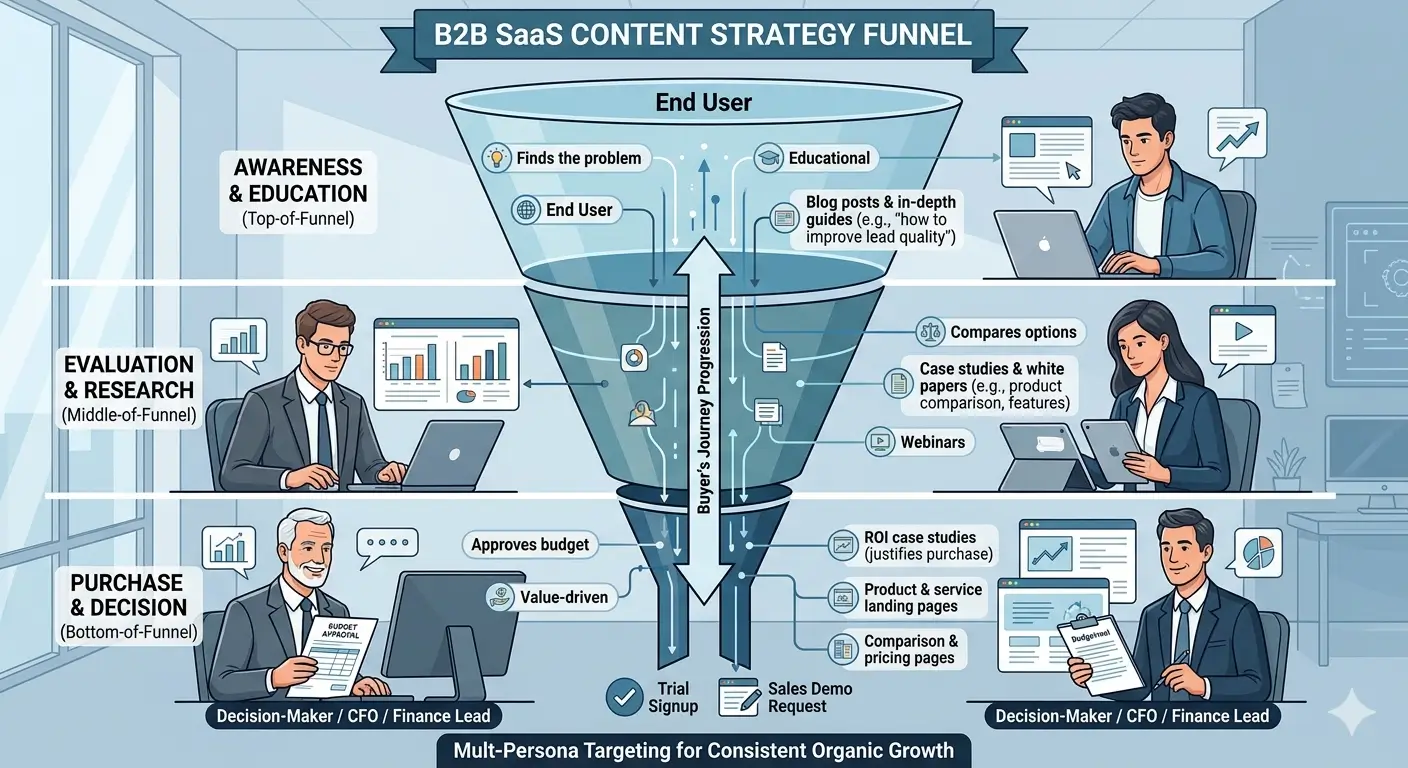
SaaS landing pages should be optimized for free trial and demo conversions. Every page that ranks organically should have a clear next step that moves the visitor toward a product touchpoint.
Finally, product-led content works well in SaaS — articles and guides where the product is part of the solution being demonstrated, not just added at the end as a call to action. This builds topical authority while showing the product in real use cases.
Putting It All Together
A strong B2B SEO strategy is built in layers: technical foundation first, then keyword research and personas, then content in a topic cluster structure, then on-page optimization, then link building, then continuous measurement and refinement.
None of these layers works in isolation. Technical problems stop good content from ranking. Great content without links lacks authority. Links without relevant content don't convert. The strategy works when all parts run together.
Define your personas. Identify your highest-value keywords. Build content that covers the full funnel. Optimize every page before you publish it. Earn backlinks from sources your industry respects. Measure what connects to revenue, not just traffic.
B2B SEO results take time. Most companies start seeing meaningful organic growth around the six-month mark, with the strongest results in years two and three. But companies that commit to this process consistently find that organic search becomes one of their most cost-effective acquisition channels — one that continues to produce results long after the initial investment.
Get In Touch
Can we help with your content and SEO needs? Have a question about our offers? Don't hesitate to get in touch, we'll reply right away!