B2B Lead Generation SEO: How Organic Search Fills Your Pipeline
Ranking on Google is not the goal. Getting the right visitors to take action is.
Most B2B SEO strategies focus on traffic as the primary measure of success. More visits, more impressions, more clicks. But organic traffic only matters if the people behind those visits are capable of becoming customers. A page that attracts 10,000 monthly visitors but converts at 0.1% generates fewer leads than a page attracting 400 visitors that converts at 5%.
This article focuses on the part of SEO that directly connects to revenue: how to use organic search to attract qualified prospects, how to build the pages that convert them, and how to measure the output in terms that your sales team and leadership actually care about. For the full strategic context, see B2B SEO Strategy.
Why Organic Lead Generation Works Differently in B2B
Organic lead generation in B2B operates on a different timeline and with different economics than in consumer markets.
B2B purchases are not impulsive. A company evaluating CRM software, security infrastructure, or a logistics partner is not buying on a whim. Multiple stakeholders are involved. Budget approval takes time. The decision cycle can stretch from weeks to months. This means that someone who reads a general awareness article today is unlikely to become a customer this quarter, regardless of how good the content is.
This is the core problem with top-of-funnel traffic in B2B. The conversion rate gap between high-intent and low-intent keywords is not marginal. Analysis from Grow and Convert of over 90 B2B blog posts shows that top-of-funnel traffic keywords convert at around 0.2%. High buying intent keywords (the ones where the searcher is actively evaluating a solution) convert at 3% to 8% on average, and up to 12.5% for the best-matched jobs-to-be-done terms. That is a difference of 20x or more.
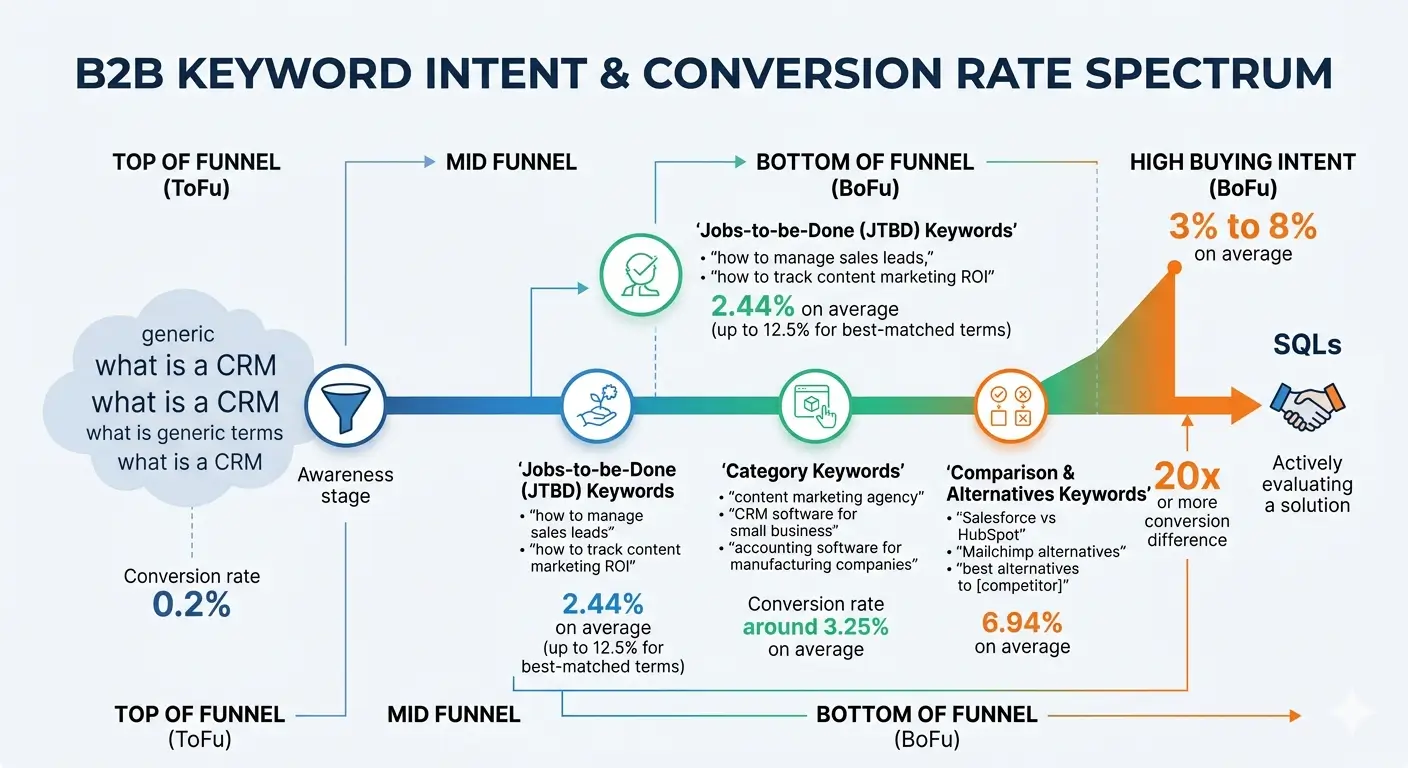
The implication is clear: B2B organic lead generation requires intentional prioritisation of bottom-of-funnel content over traffic volume.
Bottom of Funnel SEO for B2B
Bottom-of-funnel (BoFu) SEO targets searches from people who have already identified their problem and are evaluating solutions. These are the searches closest to a buying decision, and they are where organic search delivers its highest ROI in B2B.
There are three keyword categories that consistently drive the highest conversion rates in B2B.
- Category keywords describe the product or service the buyer is looking for: "content marketing agency," "CRM software for small business," "accounting software for manufacturing."
Finding High-Intent Keywords Your Competitors Miss
The obvious category keywords are relatively easy to identify. The harder work is finding the high-intent terms that most teams overlook, and the best source for those terms is not a keyword tool — it is your sales team.
Your sales team knows exactly which pain points come up most often in discovery calls, which objections repeat, and which product benefits actually close deals. This language is where high-intent JTBD keywords live, and it is almost always different from the language your marketing team uses internally.
Talking to sales before finalising your keyword strategy surfaces terms like "how to set up drip email campaigns" (for a marketing automation company) or "how to reduce customer churn in SaaS" (for a customer success platform) — specific, intent-rich queries that standard competitor analysis and keyword tools rarely surface because they lack the commercial context.
Ask your sales team specific questions that unlock this intelligence:
- What pain points do prospects mention most often in early calls?
- Which product benefits close the most deals?
- What objections come up repeatedly?
- What language do prospects use to describe their problem?
- What are they typically using or doing when they first approach us?
- Which competitors do they mention most often?
This input should directly shape your keyword list. It also creates a feedback loop: as content starts ranking and generating leads, checking in with sales about lead quality tells you whether your targeting is accurate or needs refining.
SEO Qualified Leads: The Difference Between Traffic and Pipeline
Not all leads generated through organic search are equal. Understanding the distinction between a marketing qualified lead (MQL) and a sales qualified lead (SQL) is essential for making B2B SEO accountable to revenue.
An MQL is a prospect that marketing has identified as a potential buyer based on their behaviour: they downloaded a white paper, subscribed to your newsletter, or spent significant time on a product page. They have shown interest but are not yet ready for a sales conversation. MQLs need nurturing before being handed to sales.
An SQL is a prospect that has directly engaged with your company in a way that indicates purchase intent: they requested a demo, submitted a contact form asking about pricing, called your sales line, or booked an introductory call. SQLs are active, inbound leads that should be fast-tracked through the sales process.
The goal of B2B lead generation SEO is not to maximise MQL volume. It is to generate SQLs, or at minimum, MQLs close enough to the decision stage that the gap to SQL is short.
High buying intent keywords generate a much higher proportion of SQLs because the searcher's intent is already aligned with a purchase decision. Someone searching for "best enterprise CRM with Salesforce integration" is further along in the buying process than someone searching for "what is a CRM." The first page should convert; the second page should not be expected to.
This distinction matters when you report on SEO performance. Organic traffic and keyword rankings are useful signals, but the number that connects SEO to business outcomes is lead quality: how many organic leads turned into sales conversations, and how many of those became customers.
B2B Landing Page SEO
Landing pages are where organic search traffic either converts or exits. For B2B companies, the gap between a page that ranks and a page that generates leads often comes down to how well the landing page is built for conversion.
A B2B landing page optimised for both search rankings and lead generation needs to satisfy two different requirements simultaneously. It must give search engines enough signal to rank it for the target keyword, and it must give the visitor a clear, frictionless path to take an action.
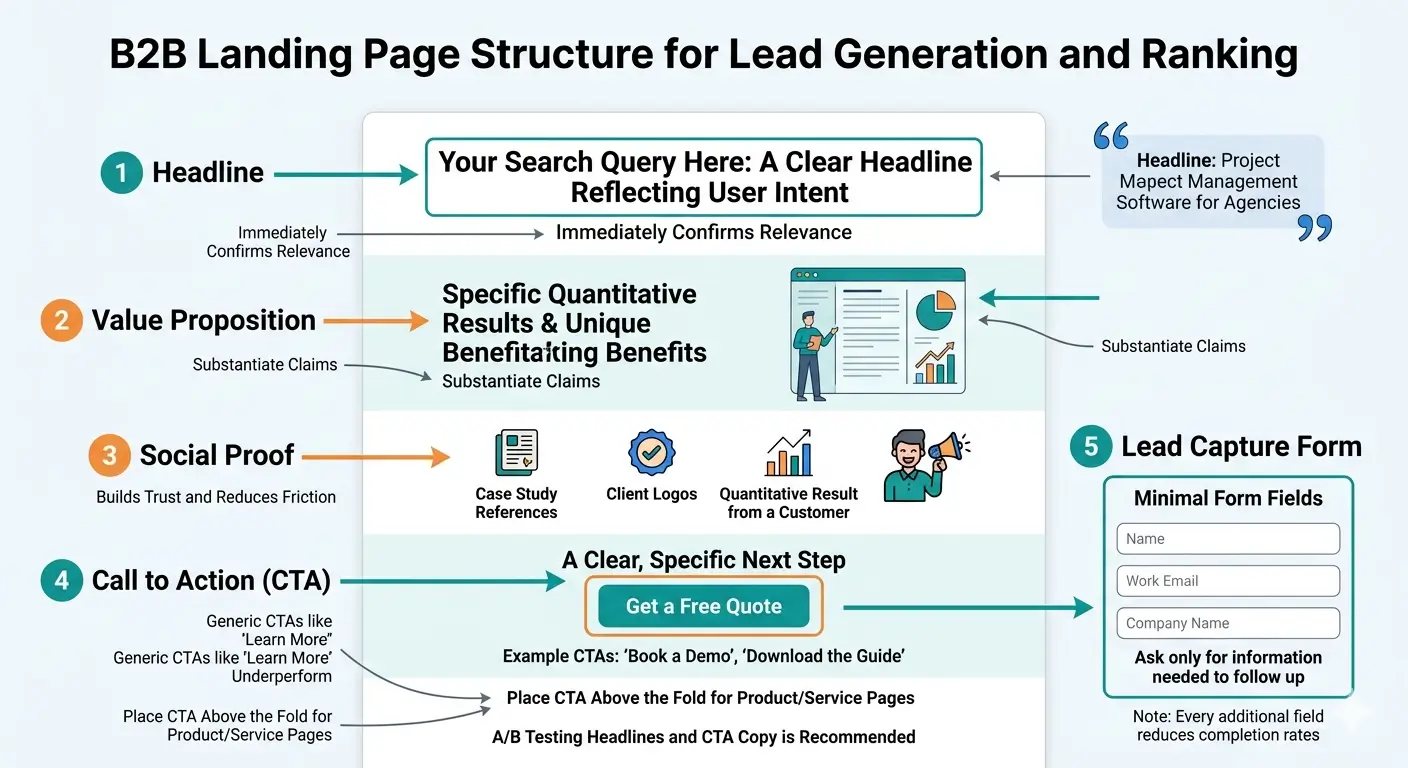
The elements that matter most for conversion on a B2B landing page are:
- A headline that reflects the search query: if someone searched "project management software for agencies," the page should confirm immediately that they are in the right place.
- A clear, specific call to action: "Get a Free Quote," "Book a Demo," and "Download the Guide" all give the visitor a concrete next step. Generic CTAs like "Learn More" underperform.
- Minimal form fields: ask only for the information needed to follow up. Every additional field reduces completion rates. Name, work email, and company name are sufficient for most B2B first contacts.
- Social proof close to the CTA: case study references, client logos, or a specific quantitative result from a customer reduces friction at the point of decision.
- Content depth for ranking: unlike paid landing pages, organic landing pages need enough content for Google to assess relevance. This means at minimum 500 to 800 words of substantive content above or around the conversion element.
For product and service pages targeting transactional keywords, place the CTA above the fold. For pages targeting comparison or JTBD keywords — which typically expect more information before a decision — a mid-page CTA after the main content performs better than a top-of-page placement.
Test landing page elements systematically. A/B testing headlines, CTA copy, and form length produces concrete data on what converts with your specific audience. Even small changes to CTA wording can affect conversion rates significantly.
B2B Conversion Rate SEO
Organic conversion rate in B2B is the percentage of organic search visitors who complete a target action: filling out a contact form, requesting a demo, downloading a gated asset, or starting a free trial.
For most B2B companies, organic conversion rate across all organic traffic sits between 1% and 3%. Pages targeting high-intent keywords with well-optimised conversion paths can reach 5% to 10%. Pages targeting low-intent informational keywords rarely exceed 0.5%, regardless of how well they are written.
Improving your organic conversion rate requires looking at two separate problems: the quality of the traffic you attract, and the quality of the conversion experience when they arrive.
Traffic quality comes down to keyword intent, which we covered above. Conversion experience comes down to page design, CTA clarity, page speed, and the absence of friction in the lead capture process.
Common conversion killers on B2B pages that rank well but convert poorly include slow page load times, a mismatch between the keyword intent and the page content, CTAs that are too weak or too buried, forms that ask for too much information, and a lack of social proof near the point of conversion.
User behaviour tools like Hotjar and Microsoft Clarity show scroll depth, click patterns, and where visitors exit. This data makes conversion problems visible. A page where 80% of visitors never reach the CTA has a different problem than a page where visitors reach the CTA but do not click it.
Connecting SEO to Business Outcomes
Organic traffic and keyword rankings indicate potential. They do not measure whether your SEO investment is generating revenue. To connect SEO to business outcomes, you need conversion tracking at the individual page level.
Set up conversion goals in Google Analytics 4 for the actions that matter: form submissions, demo bookings, gated content downloads, and phone call initiations. With these goals active, you can see which specific pages drive the most leads from organic search, which keywords produce SQLs versus MQLs, and what the organic lead-to-customer conversion rate is over time.
The core metrics to track for B2B lead generation SEO are:
- Organic leads by page: which pages generate contact form submissions, demo requests, and gated downloads
- Lead quality by keyword: which keyword clusters produce SQLs vs MQLs (requires regular input from your sales team)
- Organic lead close rate: the percentage of organic leads that become paying customers
- Cost per organic lead: your total SEO investment divided by the number of qualified leads generated
- SEO ROI: revenue attributed to organic leads divided by total SEO investment
SEO leads close at 14.6% compared to 1.7% for outbound leads. That difference in close rate is the commercial case for organic search as a lead generation channel. But that figure only becomes visible when you track leads by source and connect them to revenue outcomes.
Most B2B companies start seeing meaningful rankings within three to six months of targeted content work. Steady lead flow from those rankings typically begins once pages reach the top three positions for their target keywords. The full commercial impact of an SEO investment becomes clearest in years two and three, when the compound effect of multiple ranking pages in a well-structured topic cluster produces a consistent volume of high-intent organic leads.
Connecting SEO to Your Sales Process
Organic lead generation SEO does not work in isolation from the sales process. The leads it generates still need to be handled, qualified, and closed.
The pages that produce SQLs (demo requests, contact forms, pricing enquiries) should feed directly into your CRM with a source tag that identifies the organic channel and the specific page. This enables your sales team to see the keyword context behind each lead, which helps them tailor their opening conversation to the prospect's stated problem.
Leads from informational or mid-funnel pages that generate MQLs (white paper downloads, newsletter subscriptions, guide downloads) should enter a nurture sequence rather than immediate sales outreach. Automated email sequences that deliver related content and gradually introduce product-specific information move these prospects toward a sales conversation without the friction of a premature hard sell.
The gap between a high volume of organic traffic and a consistently filled pipeline is almost always a conversion and handoff problem, not a rankings problem. Fixing that gap — through better landing page design, sharper CTAs, cleaner lead capture, and tighter integration between marketing and sales — is where B2B lead generation SEO delivers its real return.
Get In Touch
Can we help with your content and SEO needs? Have a question about our offers? Don't hesitate to get in touch, we'll reply right away!