B2B SEO Content Strategy: How to Build It
Content is where most B2B SEO strategies either compound or stall. The technical foundation can be solid, the keyword list thorough, and the site architecture clean… but if the content itself does not match how decision-makers search and what they need at each stage of the buying process, none of that work converts into organic growth.
This article covers how to build a B2B SEO content strategy from the ground up: how to do keyword research in low-volume markets, how to structure content into clusters, how to use your blog for SEO, how thought leadership fits into search, and how to maintain what you build over time. For the broader strategic context, see B2B SEO Strategy.
Why B2B Content Strategy Is Different
B2B content strategy presents challenges that do not exist in consumer markets. Understanding them upfront saves you from designing a strategy that works on paper but fails in practice.
The most obvious difference is the buying cycle. In B2C, one person makes a purchase decision, often quickly. In B2B, a low-level manager might discover your product through a blog post, but they will not be the ones buying it. That information gets passed up the chain — to their manager, to finance, to a committee. The cycle can take months. Your content needs to serve each of those stakeholders, not just the first person who finds you.
A second difference is search volume. B2B industries, especially specialist ones, have low search volume across almost every topic. A keyword that gets 50 searches per month in a B2B niche can still be worth pursuing if the commercial intent is strong. A CPC (cost per click) of $14 on a keyword with 250 monthly searches means buyers are willing to pay to be in front of that audience. That is a signal worth taking seriously.
The third difference is content density. B2B topics are rarely simple. A piece on supply chain software for manufacturing companies requires a longer research process, more specialist input, and a more careful editing pass than a B2C lifestyle article. This is not a reason to produce less content, it is a reason to build quality into your workflow from the start.
B2B Keyword Research
Keyword research in B2B does not follow the same logic as in consumer markets. Chasing high-volume terms rarely delivers qualified traffic. The value lies in relevance and specificity.
Start with your audience, not a keyword tool
Before opening Semrush or Ahrefs, talk to your sales team. They know the exact language prospects use when describing their problems, and that language is often different from what you would find in a keyword tool. Listen to sales calls, read proposal documents, and ask for the phrases that come up most often in discovery conversations. These are the terms your content should target.
From there, you can validate search volume and CPC in a keyword tool. But the starting point is human, not algorithmic.
Prioritise CPC over search volume
In B2B, CPC is a more useful signal than monthly search volume. It shows how much advertisers are willing to pay for a single click on that term, which reflects the commercial value of the search. A keyword with 250 monthly searches and a $12 CPC is often more valuable than one with 5,000 monthly searches and a $0.40 CPC.
Filter out keywords with a CPC below $1 (or $5 for high-ticket products). What remains is a list of terms where buyers are actively searching and competitors are willing to pay to appear.
The keyword frameworks that convert in B2B
Certain keyword structures consistently generate qualified traffic in B2B. They reflect the language of decision-makers who are evaluating options, not just learning about a topic.
The most reliable frameworks are:
- [Competitor] vs [your brand]: captures buyers who are already aware of alternatives and are in the evaluation stage
- [Product] cost or [Product] pricing: targets buyers with budget authority who are close to a decision
- [Competitor] alternatives: reaches prospects who have considered a competitor but are looking for other options
- [Industry jargon] and What is [industry jargon]: attracts decision-makers searching for concepts specific to their field
- [Product] vs [product]: comparison queries from buyers doing side-by-side research
- [Keyword] template or [Keyword] checklist: practical tool-type content that attracts high-intent users
Industry jargon queries are worth starting with. They tend to have low keyword difficulty, and they directly target the searches that senior buyers and technical evaluators run most often.
Long-tail keywords in B2B
Long-tail keywords are phrases of four or more words that target a specific subtopic or question. In B2B, they are often the most commercially useful terms on your list.
Someone searching for "personalised automated email marketing software" has a clearer buying intent than someone searching for "email software." The longer phrase signals what they want to purchase. Long-tail keywords also tend to have lower competition, which makes them easier to rank for quickly. Ranking well for a set of long-tail terms in your niche can, over time, build the authority needed to rank for more competitive head terms.
Content Clusters for B2B
A content cluster is a group of pages organised around a single topic. It has a pillar page (a broad, authoritative overview) and a set of supporting cluster pages that each go deep on a specific subtopic. Every cluster page links back to the pillar, and the pillar links out to the cluster pages.
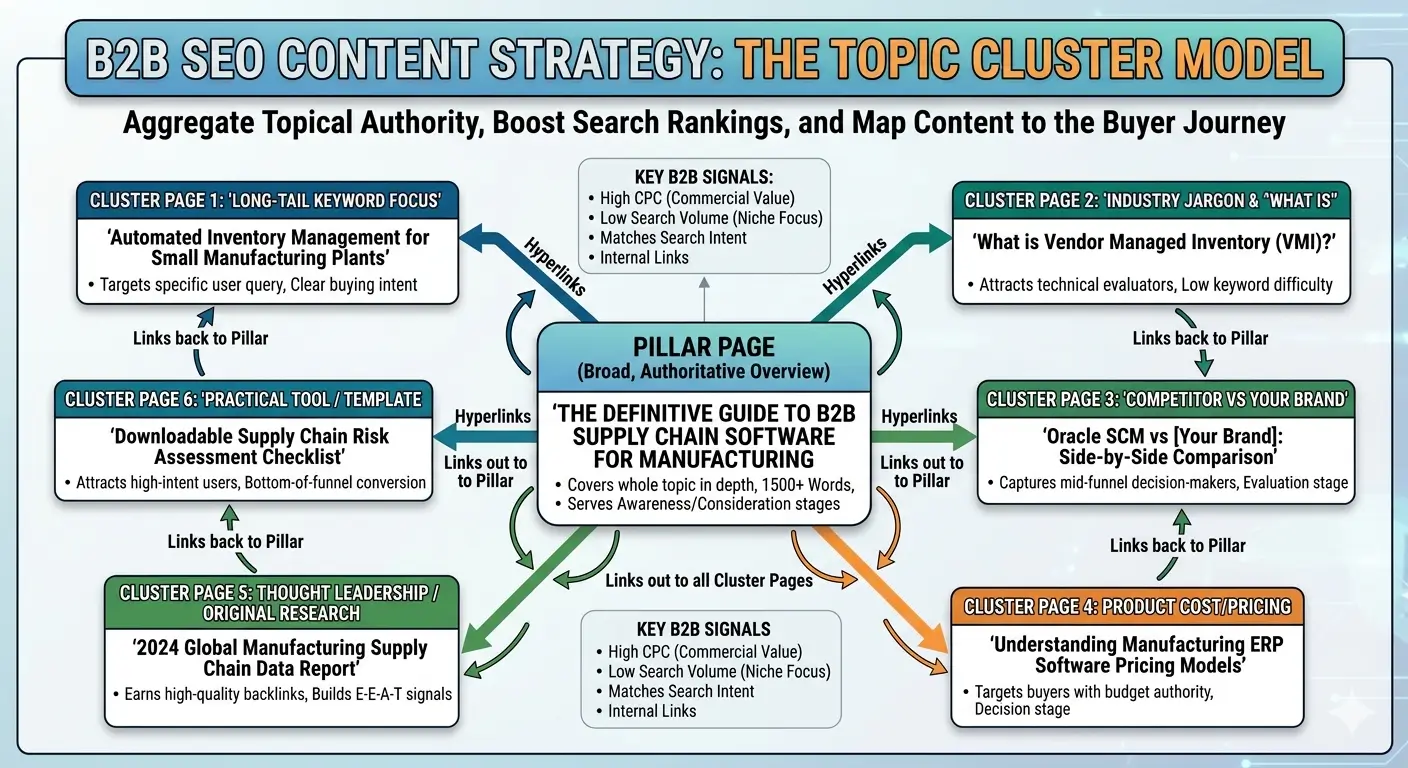
This structure builds topical authority: the signal to Google that your site covers a subject in depth, not just at surface level. It also makes it easier for visitors to navigate from a general introduction to the specific information they need, which increases time on site and reduces bounce rate.
Why clusters help in low-volume B2B markets
In B2B, where individual keywords have limited search volume, clusters let you aggregate authority across a set of related terms. Instead of relying on one high-traffic page to carry your SEO, you build a network of pages that support each other. Each page targets a slightly different query, but they all reinforce the same topical domain.
This approach also prevents keyword cannibalisation, one of the most common content problems in B2B. When two pages target the same keyword, Google cannot determine which one to rank, so it often ranks neither. Mapping each page to a distinct keyword during the planning stage is the most effective way to prevent this.
How to build your cluster structure
Start with four to six core topics that reflect the most commercially valuable areas of your business. These become your pillars. For each pillar, identify eight to twelve supporting subtopics based on your keyword research. These become your cluster pages.
Sort your keyword list by topic. Group related terms together, then assign one target keyword per page. Any keyword that does not fit cleanly into an existing group either forms its own new group or becomes a standalone piece with its own cluster in future.
Build the pillar page first. It provides the structural overview that cluster pages reference back to. Then build out the cluster pages, linking each one to the pillar and to other relevant pages in the cluster.
B2B Blog SEO
The blog is the primary channel for top-of-funnel content in B2B SEO. It attracts visitors who are in the early stages of research, builds organic visibility over time, and creates a path into your product or service pages.
Two content sections, not one
For B2B companies, a single blog can create tension between two different audience needs: early-stage visitors who are learning about a problem, and buyers closer to a decision who need more specific information. One solution is to maintain two separate content areas: a blog for top-of-funnel content and a learning centre (or resource hub) for more bottom-funnel material, such as deep guides, case studies, and product documentation.
This separation lets you tailor calls to action more precisely. A learning centre page aimed at someone close to a purchase decision can carry a more direct CTA, such as a demo request, while a top-of-funnel blog post might simply direct visitors to a related article or a downloadable guide.
What makes B2B blog content rank
B2B blog posts that rank well tend to have a few things in common. They address a specific question or problem your persona faces. They use the industry language your audience uses (not the language your marketing team uses internally). They answer the question fully, without requiring the reader to go elsewhere to complete their understanding.
The average first-page result on Google contains around 1,447 words. Blog posts with fewer than 500 words rarely rank in B2B, where topics require enough depth to satisfy the search intent. For informational queries, aim for at least 1,000 to 1,500 words. For research-intent queries, longer content is often warranted.
On-page elements still matter: include your target keyword in the title tag, the first H2, and naturally throughout the body. Use header tags to organise content by subtopic. Add descriptive alt text to any images. Internal link to related cluster pages and to your product or service pages where the connection is natural.
Maintaining a publishing schedule
Consistency matters more than frequency. Google favours sites that publish and update content with regularity. A realistic publishing schedule for most B2B teams is two new articles per week, with time built in for updating existing content. Decide what frequency your team can sustain without sacrificing quality, then stick to it.
A content calendar keeps everyone aligned: it shows what is being written, who is responsible, when it is due, and what keyword and funnel stage it targets. Without this, content production tends to drift toward topics the team finds interesting rather than topics that serve the strategy.
Thought Leadership SEO
Thought leadership content covers the same ground as SEO content in terms of format (articles, guides, white papers) but with a different primary goal: demonstrating expertise rather than ranking for a keyword. In practice, the two overlap more than they differ.
What thought leadership does for SEO
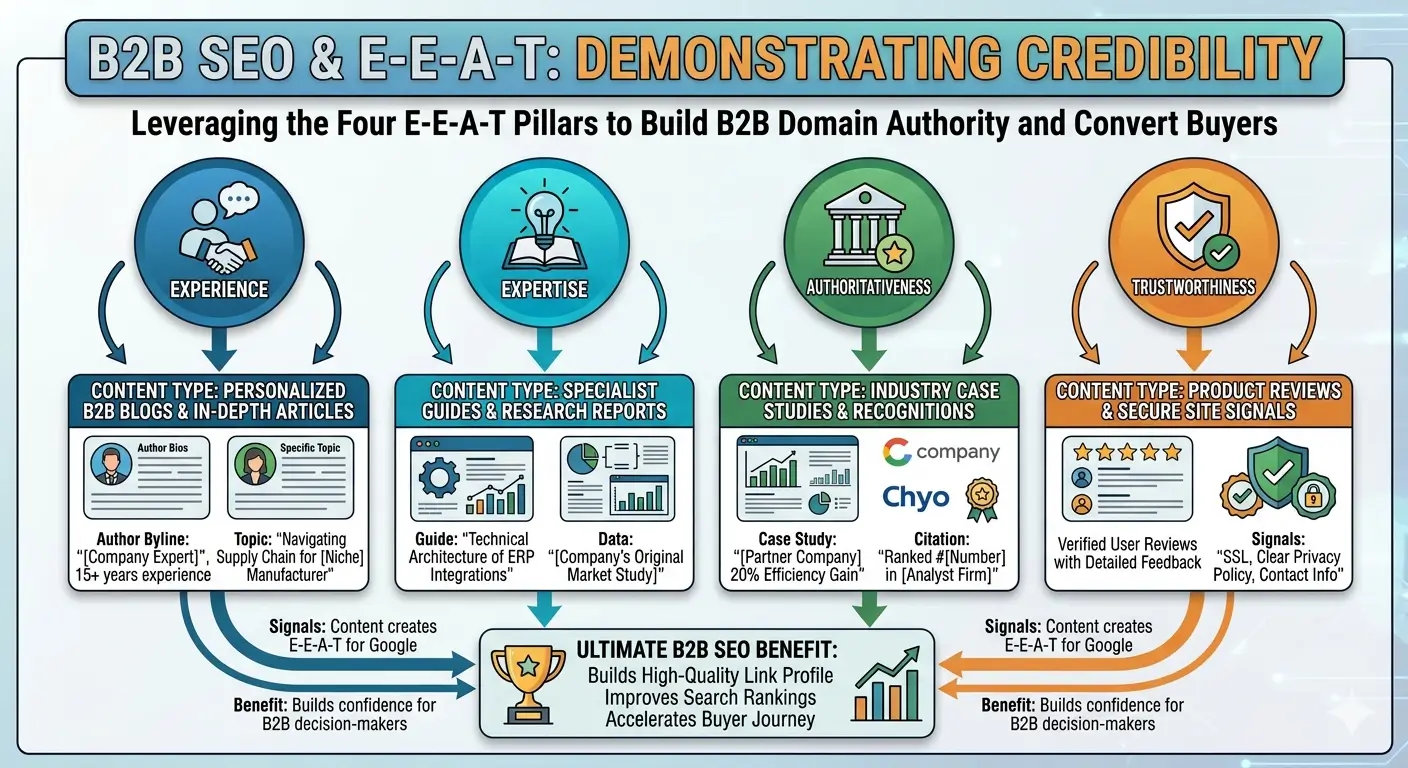
In B2B, buyers want to work with companies that understand their problem. A case study that shows measurable outcomes, a white paper with original research, or a guide that provides a framework for solving a known industry challenge all signal that kind of expertise. Search engines reward this through E-E-A-T signals: Experience, Expertise, Authoritativeness, and Trustworthiness.
Concretely, E-E-A-T affects how Google evaluates your content's quality. Author bylines with credentials, original data and research, external citations from credible sources, and third-party reviews all contribute. In B2B markets, where topics are specialist and buyers are evaluating vendors carefully, these signals matter more than in general consumer content.
Thought leadership formats that earn links and authority
Some content types are specifically designed to generate backlinks, which in turn build the domain authority that helps all your other pages rank.
The formats that work most reliably in B2B are:
- Original research and surveys: data that does not exist elsewhere. Other publications cite it, link to it, and reference it in their own articles.
- Industry guides: comprehensive references that practitioners bookmark and share.
- Annual reports: time-stamped, data-rich documents that become standard citations in their field.
- Calculators and interactive tools: high-engagement assets that attract links from resource pages.
Guest articles in industry publications add reach and domain authority simultaneously. When you contribute a piece to a relevant trade publication or specialist blog, you gain a backlink from a relevant domain and exposure to an audience that already matches your buyer profile.
Content Planning: Mapping to the Funnel
Not every page serves the same purpose. A well-planned B2B content strategy maps each piece of content to a stage in the buyer's journey, so visitors at every stage find something useful.
The three stages are:
- Awareness (top of funnel): the buyer knows they have a problem but has not named it yet. Content here introduces topics, explains concepts, and helps buyers understand what they are dealing with. Blog posts and introductory guides fit this stage.
- Consideration (mid-funnel): the buyer knows their problem and is evaluating options. Content here helps them compare approaches and understand the landscape. Comparison articles, in-depth guides, webinars, and case studies serve this stage well.
- Decision (bottom of funnel): the buyer has chosen a solution type and is evaluating vendors. Content here is more specific: product pages, pricing information, ROI case studies, and demos. These pages carry the most direct calls to action.
For B2B companies with long sales cycles and high customer lifetime value, starting with bottom-of-funnel content is often the right tactical choice. These visitors are the most qualified. Once those pages are built and performing, you can build out the top-of-funnel content that drives volume over time.
Maintaining Your Content Library
Content decays. Statistics go out of date. Competitors publish better versions of pages you wrote two years ago. Search intent shifts. If you publish and never return to your content, your rankings will slowly erode.
Set a review cycle for your most important pages, at least once a year. When you review a page, check whether the information is still accurate, whether the target keyword still reflects the search intent, and whether a competitor now ranks above you with a more complete answer. Refreshing a page — updating its statistics, expanding a section, improving its internal links — can restore rankings without requiring a completely new article.
Updating existing content is often more efficient than publishing new content, because an established page already has some authority. Google favours pages that are both accurate and frequently updated.
Track performance for each page using Google Search Console (for keyword rankings and impressions) and Google Analytics (for traffic, engagement, and conversions). Identify which pages get traffic but do not convert, which ones rank on page two and could reach page one with a targeted update, and which ones have lost traffic in the past six months and need a refresh.
The metrics that matter most depend on the page's purpose. For awareness content, measure organic traffic and engagement depth (scroll depth, time on page). For bottom-of-funnel content, measure conversion actions: form submissions, demo requests, and content downloads. Align what you measure to what the page is designed to do.
Most B2B companies see measurable organic movement within four to six months of consistent content work. Substantial gains typically appear within nine to twelve months. The compounding nature of SEO — where each page adds to the overall topical authority of the site — is what makes it one of the most cost-effective acquisition channels over a two-to-three-year horizon.
Get In Touch
Can we help with your content and SEO needs? Have a question about our offers? Don't hesitate to get in touch, we'll reply right away!