Local SEO for Financial Advisors: Google Maps, Reviews and AI Answers
How advisory firms get into Google's map pack and the local answers of AI assistants: Google's rules for advisor profiles, local pages, directories, and how to ask for reviews without breaking the SEC Marketing Rule or FINRA guidance.
 By Samy Thuillier · November 25, 2026
Local SEO for financial advisors is the work that puts your firm in Google’s map pack and in the local answers of AI assistants when someone searches for an advisor in your city. It rests on three things Google names itself: a complete, verified Google Business Profile set up under Google’s rules for practitioners, a website that backs it with one page per real office, and prominence earned through reviews, links and mentions. For advisory firms there is a fourth: every review you ask for, share or answer is regulated marketing, under the SEC Marketing Rule for RIAs and FINRA guidance for broker-dealers.
The same profile and pages now feed AI answers too. Being the advisor ChatGPT and Google’s AI features name for “advisor in [city]” prompts is what GEO for financial advisors works on; this guide covers the local foundation it builds on. Google, OpenAI, SEC, FINRA and FCA sources below were checked in November 2026.
Does your firm need local SEO?
Ask where your last 20 clients came from. If most live within driving distance of an office and found you through a referral or a search with a place in it (“fee-only advisor Boise”, “retirement planner near me”), local search is one of your most direct channels. Google answers those searches with a map and three businesses above the regular results, so a firm with no profile, or a profile in the wrong shape, is missing before the first website link.
If clients find your firm for a niche across the country, local SEO matters less. Keep an accurate profile for each office, because prospects who heard your name will look you up and see it, and put the bigger effort into niche pages and authority, as covered in our guide to SEO for financial advisors.
How Google picks the advisors in the map
Google’s help page Tips to improve your local ranking on Google is the only official statement of how local results work, and it is short:
- Relevance: how well a Business Profile matches what someone is searching for. Google asks for complete and detailed business information.
- Distance: how far each business is from the searcher. If the searcher does not share a location, Google uses what it knows about it.
- Prominence: how well known a business is, based in part on how many websites link to it and how many reviews it has. Google says more reviews and positive ratings can help.
The page also flags, as important, that there is no way to request or pay for a better local ranking. Google’s own tips are to verify the profile, keep information complete and current, add hours and attributes, reply to reviews and add photos.
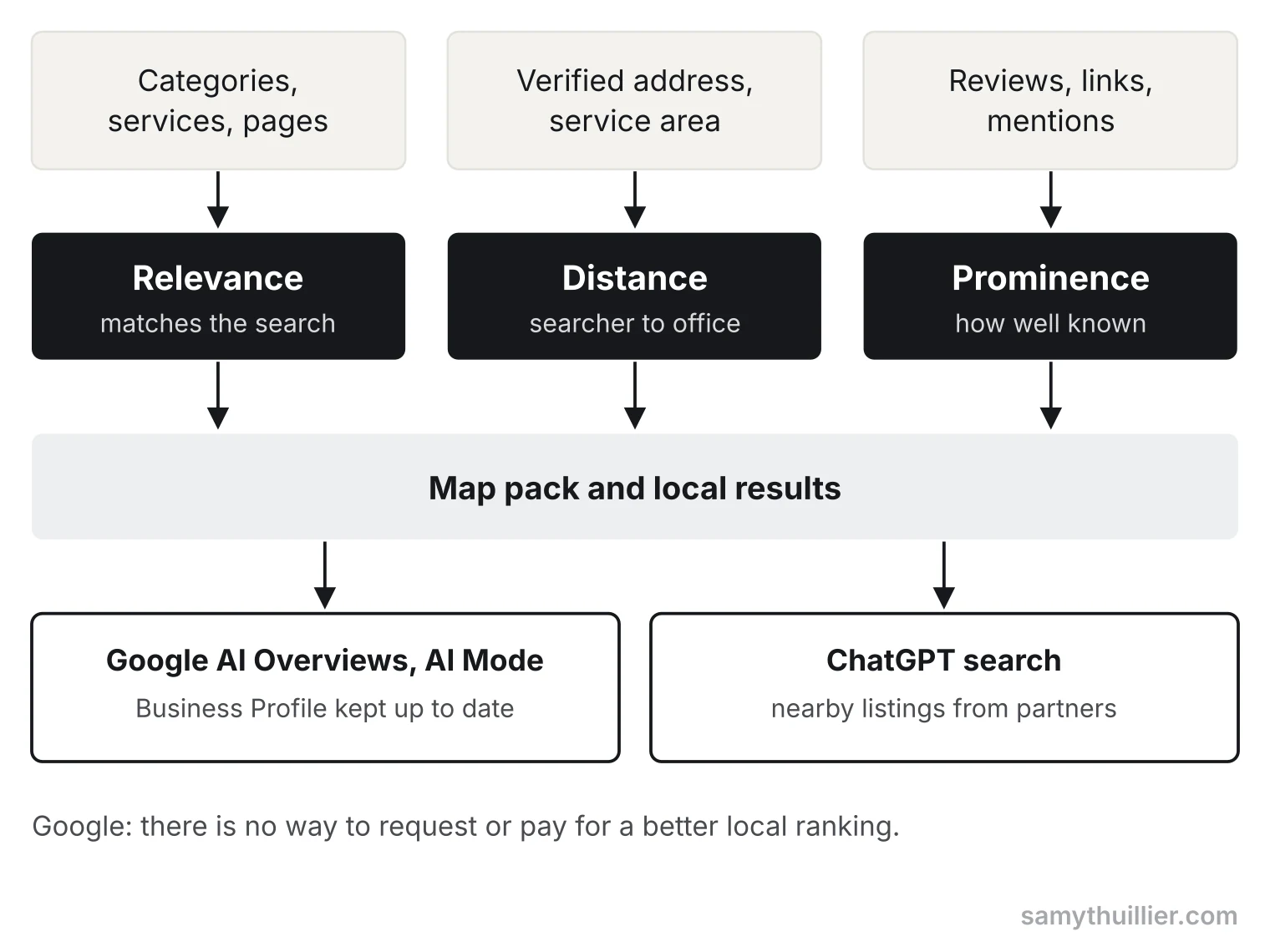
Distance is the one factor you cannot change, short of opening an office. That is why the advice below concentrates on relevance (the right profile, category and pages) and prominence (reviews, links and mentions), and why a firm several miles from a prospect can still appear if it is clearly the better match.
Step 1: Decide where local search matters
Before touching any profile, write down two lists.
- Your offices where clients actually meet an advisor during business hours. Only these can carry an address on Google (Step 2 explains why).
- The local searches your prospects use. Combine what you do with where: “financial advisor [town]”, “fee-only planner [county]”, “retirement planning [suburb]”, “wealth manager near me”. Type them into Google on a phone from that area and note who appears in the map.
The second list tells you which towns deserve a page on your site, and which competitors you are measured against. Most advisors find the map is shared by a few large brands and a few independent firms with complete profiles and steady reviews.
Step 2: Choose the right Google Business Profile setup
This is where advisory firms most often go wrong, and none of the usual local SEO checklists covers it. Google’s guidelines for representing your business name “financial planners” among individual practitioners, alongside doctors and lawyers, and set rules for them:
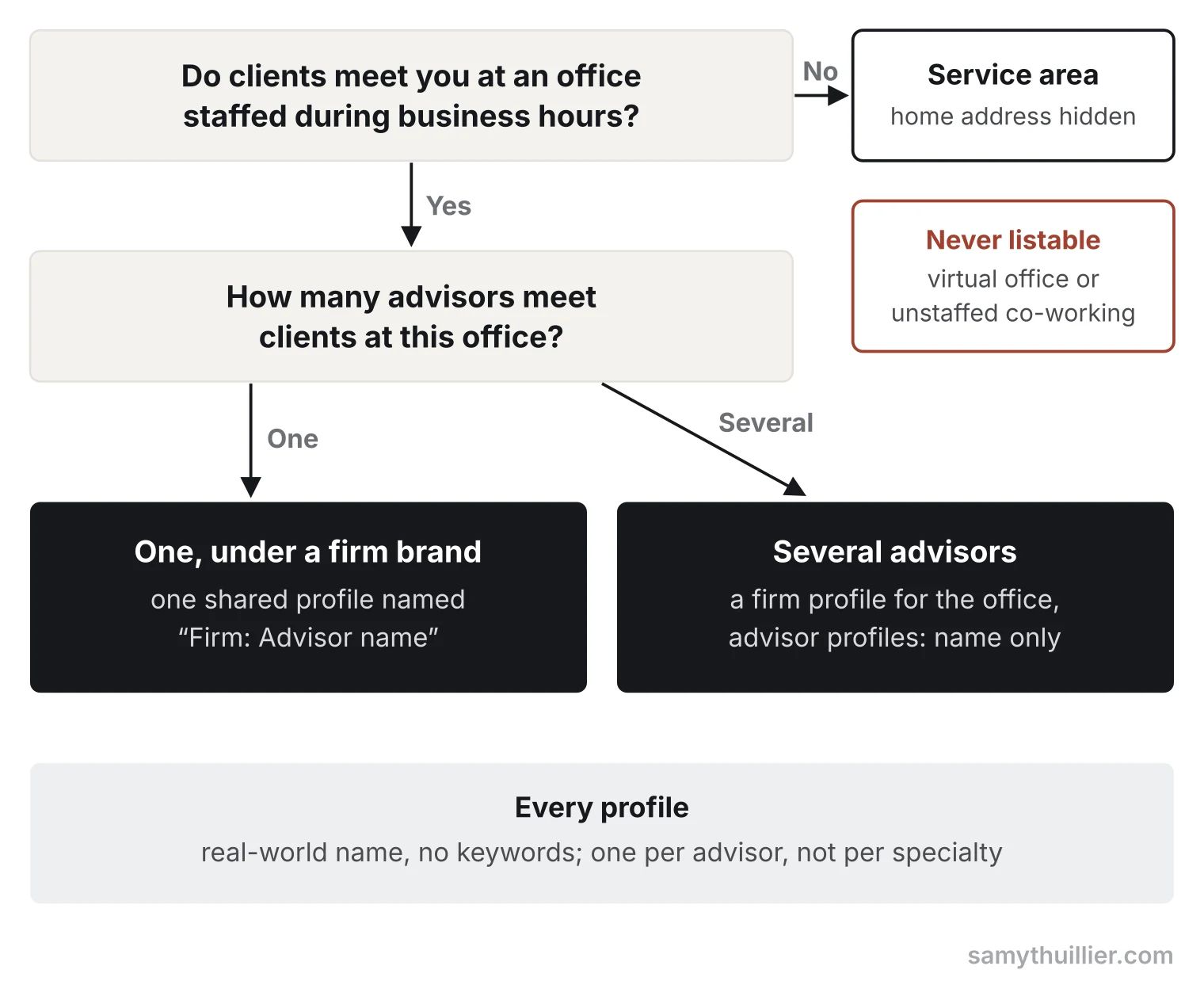
- Several advisors at one office: the firm creates a profile for the location. An advisor who is public-facing and can be reached at that office during stated hours may have a separate practitioner profile, and its title includes only the advisor’s name, not the firm’s.
- One advisor at an office under a firm brand: the advisor and the firm share one profile, named in the format “[brand/company]: [practitioner name]”. This is the common case for advisors affiliated with a large network.
- One profile per practitioner, not per specialty. An advisor should not have separate profiles for retirement, tax and estate planning. Support staff do not get profiles.
- Departments can have their own profiles when they are public-facing and distinct. Google’s own example is the bank “Wells Fargo” with the category “Bank” and the department “Wells Fargo Advisors” with the category “Financial Consultant”.
Address rules matter just as much for small firms:
- A virtual office is not eligible. A rented mailing address where you do not operate cannot hold a profile, and neither can a co-working desk unless it has clear signage, receives clients during business hours and is staffed by your team.
- No staffed office, or you meet clients at their homes: you are a service-area business. Google says to hide the address, for example a home address, and set a service area instead.
Note: Practitioner profiles also need a compliance answer. An advisor’s personal profile collects its own reviews, and those reviews are no less regulated than the firm’s. Decide with compliance which profiles exist and who monitors them before anyone creates one.
Step 3: Complete, verify and approve the profile
Once the shape is right, fill it in completely. Google’s ranking page says businesses with complete and accurate information are more likely to show up, and that verification signals you are authorized to represent the business.
- Name: your real-world firm name, as on your door, website and Form ADV. Google says adding unnecessary information to the name is not permitted and can lead to suspension. “Smith Wealth Partners” is fine; “Smith Wealth Partners | Fiduciary Financial Advisor Denver” is not.
- Category: Google asks for as few categories as possible, as specific as possible, and never categories used as keywords. Pick the primary one that describes your main business from Google’s list.
- Address or service area, hours, phone and website: a local phone number rather than a central call center where possible, and the URL of the office page (Step 4), not the home page, if you have several offices.
- Services and description: what you do and for whom, in the same approved wording as your website.
- Photos: the real office, the real team. No stock images.
Then the part generic guides skip: the profile is marketing. For an RIA, a profile that promotes advisory services is likely an advertisement under the SEC Marketing Rule; for a broker-dealer, FINRA’s social media guidance treats static content such as a profile as content that generally needs principal approval before use. Run the description, services, photos and any Google posts through your normal approval and recordkeeping, and keep a dated copy each time something changes.
Step 4: Publish one page per real office
A Business Profile links to one URL. Make it a page that confirms everything the profile says, for each office:
- the full address, phone and hours, written exactly as on the profile;
- the advisors who meet clients there, linked to their bios;
- who you serve locally and what is specific to them (the state’s tax rules, the major local employers whose stock plans you know, the retirement system of local public employees), written by someone who knows;
- directions and parking, because that is what someone who found you on a map asks next;
- links from your main navigation or contact page, so the page is not an orphan.
Skip the classic doorway tactic of one thin page per nearby town where you have no office. Those pages compete with each other, rarely rank and add pages compliance has to approve for nothing.
Structured data helps Google read these pages, with one limit. Google’s documentation recommends LocalBusiness markup with the most specific subtype for each location, and Google asks that structured data match the visible text of the page. It does not show review stars for a business’s own reviews of itself: review rich results for local businesses are only for sites that collect reviews about other businesses. Marking up your testimonials will not earn stars, and the testimonials would still be under the Marketing Rule.
Step 5: Ask for reviews inside the rules
Reviews are part of prominence, and they are where local SEO and compliance collide. Two sets of rules apply at once: Google’s and your regulator’s.
Google’s rules. The Maps content policy on prohibited and restricted content bars merchants from offering incentives (payment, discounts, free goods or services) for any review, from discouraging negative reviews or selectively asking only happy clients, and treats reviews from employees and others with a conflict of interest as a problem. Some of the guides that rank for this search suggest discounts for reviews: Google prohibits it.
The SEC Marketing Rule (RIAs). A client’s statement about their experience with your firm is a testimonial under Rule 206(4)-1. The SEC’s adopting release for the Marketing Rule explains when content on a third-party site becomes your advertisement:
- Adoption: you explicitly or implicitly endorse or approve it, for example by republishing a review on your website.
- Entanglement: you involve yourself in preparing it, for example by suggesting what a client should write.
- Letting anyone post comments, without selectively deleting or altering them, does not by itself make them yours, even if the platform would let you sort them. Deleting or suppressing negative comments, or putting the positive ones forward, does.
- Editing or removing content under a neutral, written policy (profanity, threats, spam, unlawful content, factual errors) does not count as adoption.
When a review does become your advertisement, the rule requires clear and prominent disclosure that it came from a current client, whether compensation was provided, and any material conflict, plus a reasonable basis to believe it complies. The SEC’s Division of Examinations reported what it found in a risk alert dated December 16, 2025: advisers who gave clients gift cards to write reviews on third-party websites, advisers who copied client reviews from third-party sites onto their own sites without saying they came from clients, and disclosures placed behind hyperlinks or in smaller type. Star ratings and “best advisor” awards from outside providers are third-party ratings, with their own disclosure conditions.
FINRA (broker-dealers and their reps). FINRA’s Regulatory Notice 17-18 says a third-party post becomes the firm’s communication when the firm is entangled in it or adopts it, that FINRA does not treat unsolicited third-party comments as the firm’s communications, and that a representative who likes or shares favorable comments has adopted them. A testimonial about investment advice or performance in a retail communication must disclose that it may not represent other customers’ experience, that it is no guarantee of future performance or success, and, if more than $100 in value was paid, that it is a paid testimonial. Our FINRA Rule 2210 guide covers the rest of the rule.
How common review actions land:
| What the firm does | Google’s policy | SEC Marketing Rule (RIAs) |
|---|---|---|
| Sends every client the same neutral review link | Allowed | Reviews you do not shape or share are generally not your advertisement |
| Asks only clients it knows are happy | Prohibited (selective solicitation) | Adds a fair-presentation question if you later use the reviews |
| Offers a gift card, discount or fee waiver | Prohibited (incentive) | Compensation; flagged in the December 2025 risk alert |
| Suggests wording or drafts the review | Prohibited (requesting specific content) | Entanglement: the review becomes the firm’s |
| Reports or hides negative reviews to lift the average | Report only reviews that break Google’s policy | Selective suppression makes the remaining reviews the firm’s |
| Republishes the best reviews on its website | Not a Google issue | Adoption: client status, compensation and conflict disclosures required next to each |
| Replies to reviews | Encouraged by Google | Not addressed directly; keep replies neutral, never confirm a client relationship or discuss an account, and approve templates with compliance |
The full treatment of testimonials and ratings is in our SEC Marketing Rule guide.
UK firms. The FCA’s page on regulating financial promotions and adverts says all financial promotions must be clear, fair and not misleading whatever the medium, and that a promotion can take the form of a website or a social media post. A Business Profile and the reviews a firm features belong in the same review process. Firms in other European markets answer to their own regulator, such as the AMF in France.
This section is general information, not legal advice: your firm’s compliance officer has the last word on how you ask for, answer and use reviews.
Step 6: Make firm details identical everywhere
Google, map apps and AI assistants all cross-check your firm against other sources. When the name, address, phone or services differ from one source to the next, they have to guess, and they sometimes guess wrong. Keep one master record and align these with it:
- your website (footer, contact page, office pages);
- each Business Profile;
- other map listings such as Bing Places and Apple Business Connect;
- advisor directories prospects use, such as the CFP Board’s Let’s Make a Plan, NAPFA and custodian or network “find an advisor” pages;
- LinkedIn and other social profiles that show a location;
- regulatory records: your Form ADV and the SEC’s Investment Adviser Public Disclosure (IAPD) site for RIAs, FINRA’s BrokerCheck for brokers, the FCA Financial Services Register for UK firms.
The last group is the one marketing teams forget. Prospects check it, and so do AI assistants when asked whether an advisor is legitimate. A Business Profile that says one address while the Form ADV says another is the kind of inconsistency to fix first. Old addresses from a previous office are the most common error: search your firm’s old address and phone number and correct every listing that still uses them.
Step 7: Earn local mentions
Prominence also comes from how many websites mention and link to you. For an advisory firm, the local sources worth earning are slow and durable:
- quotes and columns in local newspapers and business journals;
- talks and workshops for local employers, associations, universities and libraries, announced on their sites;
- sponsorships and board roles with a page that names the firm;
- professional partners, such as CPAs and estate attorneys, who list referral partners on their sites;
- the local chamber of commerce and professional associations’ member directories.
Never buy links or listings that pose as editorial. Beyond Google’s spam policies, a paid placement that praises the firm can turn into a paid endorsement or third-party rating under the Marketing Rule, with the disclosures that come with it.
Step 8: Test local prompts in AI assistants
A growing share of prospects ask an assistant instead of typing a search. OpenAI’s help page on searching the web with ChatGPT says ChatGPT may use an approximate location based on the user’s IP address for local results, can use device location when the user turns it on, may share general location with trusted third-party providers for information such as nearby business listings, and may show a map on iOS and Android. Google’s page on AI features and your website lists keeping Business Profile information up to date among the fundamentals for AI Overviews and AI Mode. In both cases, the inputs are the ones this guide has covered: listings, your pages and what others say about you.
Run this test once a month:
- Write 10 prompts a prospect in your market would use: “fee-only financial advisor in [city]”, “who are the best retirement planners near [suburb]”, “advisor in [city] for physicians”, and two that name your firm (“is [firm] in [city] a fiduciary?”).
- Ask each one in ChatGPT with search on, Google AI Mode, Gemini and Perplexity, in a fresh session, set to or phrased with your city.
- Log which firms are named, whether yours is, which sources are cited, and anything wrong about you (address, fees, credentials, minimums).
- Trace each error to its source and fix the source: the profile, a directory, an old article. You cannot edit the answer itself.
Answers vary from one run to the next, so judge trends over several months, not a single answer. Which firms AI engines name city by city is what this site’s AI visibility index tracks.
Step 9: Measure inquiries, not rank
Rank in the map changes with every searcher’s location, so a single “position” is misleading. Track instead:
- the Business Profile performance figures for calls, website clicks and direction requests, office by office;
- Search Console clicks to each office page;
- the answer to “how did you find us?” on every new inquiry, with “Google Maps” and “an AI assistant” as options;
- inquiries that became first meetings, and meetings that became clients.
A profile that gets more views and no calls is telling you something about the profile: a wrong category, an empty description, no photos or reviews that worry people.
Local SEO for financial advisors: doing it yourself or hiring help
Most of this guide is work a firm can do in-house in a few weeks: Steps 1 to 4 and 6 need care and time, not tools. Two parts need more. Reviews need a written policy agreed with compliance before the first request goes out. Local authority (Step 7) needs months of steady effort, which is where firms usually hire.
If you hire, ask four questions: Which profile setup do Google’s practitioner rules call for in our case? How do you ask for reviews without incentives or filtering? What do you change in our listings, and who approves it? What do you report besides rankings? Be wary of anyone who offers review packages, guaranteed map positions or “AI ranking” promises.
When the open question is what AI assistants already say about your firm in each of your cities, and which sources they rely on, that is what an AI visibility audit answers, with a fix list compliance can review. Samy Thuillier, who publishes this site, has worked on SEO since 2013, on more than 200 websites, and now focuses on AI visibility for wealth management firms. For the other channels that bring local clients, from referrals to events, see how to get clients as a financial advisor.
Frequently asked questions
Can I do local SEO myself as a financial advisor?
Yes, most of it. Claiming and completing a Google Business Profile, writing one page per office, fixing your firm details in directories and asking clients for reviews need time more than tools. What needs your compliance officer from the start is everything that touches reviews and ratings, because those are regulated as testimonials and third-party ratings.
How much does local SEO cost for a financial advisor?
The core costs nothing but time: Google says creating a Business Profile is free, and that there is no way to request or pay for a better local ranking. You pay if you hire help for pages, listings or outreach, and prices vary too much by provider and scope for a single honest number. Ask any provider to price the work in tasks and hours, not in promised rankings.
How do financial advisors get more Google reviews?
Ask every client the same way, without rewards, and never only the happy ones. Google's Maps policy bans incentives and selective solicitation, and the SEC's December 2025 risk alert flagged advisers who gave clients gift cards for reviews on third-party sites. Agree the wording of the request, and what you will do with the reviews, with compliance first.
Can ChatGPT do SEO or find local financial advisors?
ChatGPT can draft pages and check your profile for gaps, but it cannot rank you. When a user asks it for an advisor nearby, ChatGPT search uses the user's approximate location and partner search providers for nearby business listings, according to OpenAI's help center. Firms with accurate listings and clear pages are the ones it can describe correctly.
Does local SEO matter for an advisor whose clients are all over the country?
Less. If clients find you for a niche, such as physicians or tech employees with stock options, put your effort into niche pages and national authority, and keep a correct Business Profile for the office so your firm name searches look right. Local SEO pays most when most clients live within driving distance of an office.
What is the difference between local SEO and SEO for financial advisors?
Local SEO aims at searches with a place in them, which Google answers with a map and three businesses before the regular results. General SEO aims at the regular results for niche, life-event and evaluation searches. Most local firms need both, and they share the same website.
Samy Thuillier advises wealth management firms on AI authority and reputation. Former Deloitte financial consultant, SEO since 2013. More about Samy · Book a call