Social Media Marketing for Financial Advisors: Strategy and Rules
How advisory firms should choose platforms, what to post, what FINRA, the SEC and the FCA say about likes, shares, comments and records, and why your social profiles now feed what AI engines say about you.
 By Samy Thuillier · November 28, 2026
Social media marketing for financial advisors works when a firm picks one or two platforms its clients use, posts useful, reviewed education on a pace it can keep, and answers people instead of broadcasting. Every business post is also a regulated communication: FINRA Rule 2210 for broker-dealers, the SEC Marketing Rule and its recordkeeping rule for registered investment advisers, the FCA’s financial promotion rules in the UK. And since prospects now check firms in ChatGPT, Perplexity and Google AI, your public profiles and posts are among the pages those engines read about you.
This guide covers the marketing side first (platforms, content, cadence, measurement), then the compliance side by regulator, then what social media changes in AI answers. That last part is the same problem AI reputation management for wealth managers deals with: what engines say about a firm depends on the sources they can read.
What social media marketing for financial advisors is for
Social media rarely closes a client by itself. Its jobs are slower and more useful:
- Proof before the first meeting. A referred prospect looks you up. An active, coherent profile confirms what the referrer said; an empty or outdated one raises a question.
- Reach into the next generation. Firms serving families need to be known by the heirs, who check people online before they call.
- Staying in mind between meetings. Clients and centers of influence see your thinking every week without a sales call.
- Listening. Questions in comments and messages tell you what to write next and which worries are current.
- A source for AI engines. Public profiles and posts are web pages. When an AI assistant describes your firm, it builds the answer from pages like these (more on that below).
Treat it as a long-term channel. Tip lists that promise leads in weeks skip the review time, the records and the months it takes for an audience to form.
Choose one or two platforms
Ask your best clients, and their adult children, where they spend time. Then pick the platform whose format you can sustain with your compliance review in the loop.
| Platform | Best use for an advisory firm | Typical format | Compliance watch-point |
|---|---|---|---|
| Professionals, business owners, centers of influence | Short posts, articles, comments | Recommendations and endorsements on profiles; personal vs business accounts | |
| YouTube | Longer education that keeps working for years | Longer explainers, short clips | Static content: review before publishing; comment moderation policy |
| Local community, existing clients, events | Posts, event pages, groups | Reviews and recommendations on the page; what you like or share | |
| Personality, team, community | Photos, short video, stories | Short formats squeeze out balance and disclosures | |
| X | Real-time commentary | Short posts, threads | Interactive replies still supervised; character limits |
| TikTok | Younger audiences, short education | Clips under a few minutes | Hard to keep balance in seconds; check firm policy first |
LinkedIn is the default for many advisors because it maps to how business owners and professionals network. It deserves its own playbook; here it is one channel among several. Whatever you choose, register only accounts you can staff: an abandoned profile still sits in search results.
Note: This guide covers organic social media. Paid social advertising raises its own targeting and disclosure questions and is not covered here.
What to post
Start from the questions clients actually ask. Each one is a post, and the best of them become longer pieces (see content marketing for financial advisors for the full content system).
Formats that work across the top advisor guides, with the compliance angle added:
- Client-question answers. “Should I pay down my mortgage or invest?” explained in general terms, with the trade-offs on both sides. Keep it educational, not a recommendation to a specific person.
- Seasonal and life-stage topics. Year-end tax planning, open enrollment, required distributions, selling a business, a first child. Timely content gets read.
- Plain explanations of news. A rate decision or a tax change, in two paragraphs, with what it does and does not mean.
- Polls and questions. “What is your biggest planning worry this year?” invites replies and tells you what to write next.
- The firm and its people. The team, a community event, a new hire, the way a first meeting works. People hire people.
- Invitations. Webinars, workshops, office hours. These promote your services, so they are clearly marketing and go through review.
What to keep out, on every platform:
- Performance claims and predictions without the full treatment the rules require.
- Guarantees and promissory words: “will”, “guaranteed”, “safe”, “best”.
- Specific security recommendations in interactive posts. FINRA’s Regulatory Notice 10-06 suggests firms consider prohibiting interactive communications that recommend a specific investment product.
- Testimonials and client stories unless compliance has cleared them, with the disclosures in the post itself.
Cadence and engagement
There is no required frequency. Pick the pace your review process can hold for a year: one reviewed post a week that never stops beats a daily plan that ends in March. Batch drafting and review, and schedule posts in advance.
Engagement matters as much as posting. Answer comments and messages, comment thoughtfully on posts by clients and local professionals, and move any personal question to a private, supervised channel. Two cautions:
- Replies are communications too. Under FINRA rules they are supervised like correspondence. Do not give individual advice in a public thread.
- Every like and share is a choice. It can mean you adopted someone else’s words (next sections).
Financial advisor social media compliance by regulator
Rules checked on the regulators’ own pages in November 2026. This article is general information, not legal advice: your firm’s compliance officer has the last word on how these rules apply to your accounts and posts.
Broker-dealers: FINRA Rule 2210 on social media
FINRA’s social media page states that its rules on communicating with the public apply to social media. The structure:
- Static content (a profile, a banner, a post that stays up) is generally a retail communication: “most static material must be approved by a registered principal prior to use.”
- Interactive content (a real-time exchange) does not need pre-use approval if it is supervised like correspondence. Rule 2210(b)(1)(D)(ii) carves out retail communications posted on an online interactive electronic forum, and (c)(7)(M) excludes them from filing.
- The site itself. A registered principal must review any social media site an associated person uses for business before it is used.
- Personal use is not subject to the advertising rules, but firms must train people on the difference.
- Third-party posts generally are not the firm’s communication, unless the firm adopts them (endorses or approves them) or becomes entangled (helps prepare them).
FINRA’s Regulatory Notice 11-39 (August 2011) adds that what must be kept depends on the content, not the device, and that firms may use risk-based post-use review of interactive content. Regulatory Notice 17-18 (April 2017) covers sharing, influencers and likes, below. For the full rule, see FINRA Rule 2210 explained.
SEC-registered advisers: the Marketing Rule on social media
For an RIA, a post that offers or promotes advisory services is likely an advertisement under Rule 206(4)-1. The SEC’s adopting release for the Marketing Rule (Release IA-5653, pages 20 to 25) has a section titled “Guidance on social media” built on two tests:
- Adoption: the adviser “explicitly or implicitly endorses or approves” third-party information after it is published.
- Entanglement: the adviser involves itself in preparing it.
Applied to social media, the release says:
- Letting third parties post public comments on your page does not, by itself, make them yours, “so long as the adviser does not selectively delete or alter the comments or their presentation and is not involved in the preparation of the content.”
- Having a sorting feature you do not use does not change that. Merely permitting “like”, “share” or “endorse” features does not implicate the rule.
- Deleting or suppressing negative comments, or pushing positive ones to the top, makes the comments your advertisement. Editing under a neutral, pre-set policy (profanity, spam, unlawful content, factual errors) does not.
- A hyperlink to third-party content calls for the same adoption and entanglement analysis.
- Employees’ personal accounts: if the adviser has policies reasonably designed to prevent their use for marketing the adviser’s services, the SEC generally would not treat those posts as the adviser’s marketing. The release suggests prohibitions, training, attestations and periodic review of public posts.
The SEC exam staff’s December 2025 risk alert on the Marketing Rule reported advisers using social media influencers without always recognizing the arrangement created an endorsement, compensation disclosures for influencers that left out material terms, and third-party ratings shown on social media profiles without the required due diligence. The rule itself is covered in the SEC Marketing Rule explained.
UK firms: FCA guidance on financial promotions on social media
The FCA’s FG24/1 finalised guidance (March 2024) says its financial promotion rules are technology neutral and apply on every channel. Points that matter for wealth managers:
- Standalone compliance. Each promotion must comply on its own; a link to more information does not fix a non-compliant post.
- Character-limited media. Firms should consider whether a short format suits a complex product at all, or whether to use “image advertising” that promotes the firm without naming specific products.
- Sharing. If someone reposts your promotion, any breach in the original stays your responsibility. If your firm shares a customer’s post, you are responsible for it if it amounts to a financial promotion.
- Influencers. Communicating a financial promotion in the course of business without an authorised person’s approval breaches section 21 of FSMA, which the guidance notes is a criminal offence.
In the EU, the national regulator applies (the AMF in France, for example), and the rules differ by country and by product. Check each market where your posts are aimed.
Likes, shares, comments and reviews: who owns what
This is where most firms slip, because a click feels like nothing. Side by side, from the sources above:
| Action on social media | FINRA (broker-dealers) | SEC Marketing Rule (RIAs) | FCA (UK) |
|---|---|---|---|
| A client posts a comment on your page | Generally not your communication | Not yours if you do not edit, select or prepare it | Depends on whether you then share it and what it says |
| You like or share a favorable client comment | Notice 17-18: you have adopted it, and it may be a testimonial | Endorsing or approving it after publication is adoption | Sharing a customer’s post can make you responsible for it |
| You delete only negative comments | Not addressed directly; treat as a risk of adoption (our reading) | Makes the comments your advertisement | Not addressed directly; a fair, clear and not misleading question (our reading) |
| You ask a client or influencer to post about you | Entanglement (Notice 17-18) | Entanglement; may be a compensated testimonial or endorsement | Possible financial promotion needing approval |
| You link to a third-party article | Not allowed if you know or should know it is false or misleading | Adoption and entanglement analysis; linking to known false content is fraudulent | Your post must still stand alone |
Notice 17-18 also confirms that unsolicited third-party opinions posted on a social network are not, by default, communications of the firm, and that testimonial disclosures can sit in the interactive post itself, close to the testimonial.
Influencers, employee advocacy and personal accounts
Three situations need a written policy before anyone posts:
- Influencers and creators. If the firm arranges, pays for or shapes a post, FINRA treats the firm as entangled, and the SEC may treat it as a testimonial or endorsement with disclosure and oversight duties. In the UK, an influencer communicating a promotion without authorised approval is a section 21 problem.
- Employee advocacy. Advisors resharing firm content from their own profiles are using those profiles for business. That content needs the same review and archiving as the firm’s own posts.
- Personal accounts. Personal posts are outside the advertising rules, but the line depends on content. Train staff, set clear rules (no client talk, no product talk, no performance), and for RIAs, follow the release’s suggestion of attestations and periodic review.
Recordkeeping: what to archive and for how long
Archive by content, whatever the device or app. FINRA’s Regulatory Notice 11-39 is explicit that the analysis does not depend on the device or technology used.
| Regime | What to keep | How long |
|---|---|---|
| FINRA member firms | Business communications on social media, including interactive ones | Not less than three years, per FINRA’s social media page |
| SEC-registered advisers | Each advertisement disseminated directly or indirectly, plus communications to ten or more persons (Rule 204-2(a)(11)) | Five years from the end of the fiscal year in which it was last disseminated, the first two in an appropriate office of the adviser |
| UK firms | Records of financial promotions approved and communicated | Ask compliance: the period depends on the firm’s permissions and the FCA rules that apply to it |
Make sure your archiving covers edits and deletions, comments you hid, direct messages used for business, and video and live streams. Edited posts are new versions: keep the history.
A pre-post compliance checklist
Copy this into your review workflow. Every “no” goes back to the author.
| Check | Yes / No |
|---|---|
| The post is fair and balanced: every benefit sits next to its risk or limit in the same post | |
| No guarantee, prediction or promissory wording (“will”, “safe”, “best”) | |
| No performance figures, or compliance cleared them with the required treatment | |
| No recommendation of a specific security in an interactive or short format | |
| The firm is identified, and the account is one compliance approved | |
| Any testimonial, client story or rating has its disclosures in the post itself | |
| Links point only to content you have checked and are prepared to stand behind | |
| UK audience: the post complies on its own, without the link | |
| Approved by: name, date (static content), or covered by the interactive supervision policy | |
| Archived automatically, including later edits and comments |
How your social presence feeds AI answers
None of the advisor guides that rank for this query deal with AI engines, yet this is where social media now meets reputation. When a prospect asks ChatGPT, Perplexity or Google’s AI Mode about your firm, the answer is built from public pages the engine can read. Google’s documentation on AI features and your website says there are no special requirements to appear as a supporting link in AI Overviews or AI Mode: the page must be indexed and eligible to show in Search with a snippet. A public LinkedIn post, a YouTube video page or a Facebook page is, in that sense, just another page.
For RIAs, the link between social media and the public record is formal. Form ADV Part 1A, Item 1.I, asks whether the firm has websites or accounts on publicly available social media platforms and, if so, to list each firm account in Schedule D, Section 1.I (not employees’ accounts, and not accounts whose content the firm does not control). That filing is public through the SEC’s IAPD site, one of the regulator records AI engines can read when they describe an adviser.
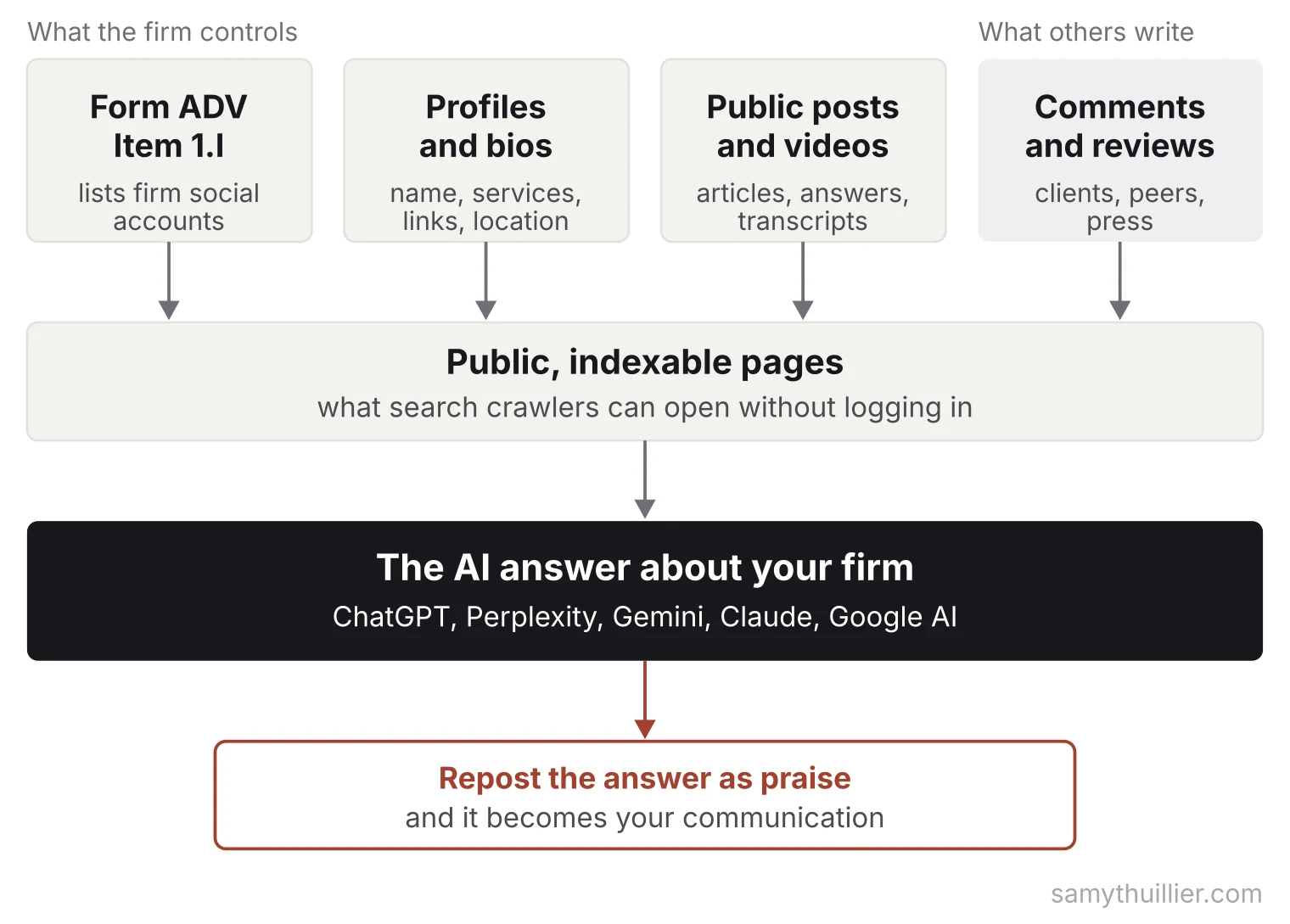
What that means in practice:
- Consistency beats volume. The firm name, the services, the location and the type of client should read the same on every profile, on your website and in your regulatory filings. Engines that see three different descriptions produce a vague or wrong one.
- Abandoned accounts still speak. An old profile with a former partner, a closed office or outdated services can surface in an answer. Close or update what you no longer run, and keep Form ADV in step.
- Public education is quotable. A clear, balanced answer to a common question, posted publicly, is the kind of passage an engine can lift. Keep the balance inside the passage, since the quote travels without your footer.
- Do not repost the AI answer as praise. A flattering ChatGPT summary is third-party content. Screenshot it into a post and you have adopted it, with every claim in it.
- Check what engines cite. Ask the engines the questions a prospect would ask about your firm and read the sources they cite. If a social profile is among them, it is part of your reputation, whether you post there or not.
If you want that picture measured before you invest more in social media, Samy Thuillier’s AI visibility audit shows what each engine says about a firm today and which sources it relies on.
What may change: FINRA’s proposal on interactive content
FINRA’s Regulatory Notice 26-14 asked for comment on modernizing Rule 2210. For social media, it proposes to remove the distinction between interactive social media and other communications, and to replace the fixed principal pre-use approval requirement with risk-based procedures in which each firm decides which retail communications need approval. The comment period closed on September 11, 2026. As checked in November 2026, nothing in it is in effect: the static vs interactive split above still applies.
Measuring what social media does
Likes are the weakest signal. Track what connects to the business:
- Prospects who mention it. Add “How did you hear about us, and did you look us up?” to intake.
- Profile and website visits from social, and which posts drove them.
- Questions received, as a source of topics and a sign of trust.
- Referral conversions: whether referred prospects who checked you online booked the meeting.
- What AI engines say about the firm, checked each quarter with the same set of questions, and which of your pages they cite.
Expect months, not weeks. If a quarter of consistent posting brings no conversations at all, revisit the platform choice and the client you are writing for before you add volume.
In-house or outside help
Most firms run social media in-house with a marketing lead, a compliance reviewer and an archiving tool, and that is enough for a weekly cadence. Outside help makes sense for production (video editing, design) or for a firm that cannot spare the time; keep approval and the account credentials inside the firm, and put the review and archiving duties in the contract. When the question is less “what should we post” than “what do AI engines say about us and why”, that is a reputation and visibility problem, not a posting problem.
Frequently asked questions
Do financial advisors need compliance approval for social media posts?
Often, yes. For broker-dealers, FINRA says most static content (profiles, posts that stay up) must be approved by a registered principal before use, while interactive content in a real-time exchange is supervised like correspondence instead. For SEC-registered advisers, a post that offers advisory services is an advertisement under Rule 206(4)-1 and must be kept under Rule 204-2. Your compliance officer sets the exact workflow.
Which social media platform is best for financial advisors?
The one where your target clients already spend time and where your firm can keep up a reviewed cadence. LinkedIn fits professional and business-owner audiences, YouTube fits longer education, Facebook and Instagram fit community and local relationships. Most firms do better with one or two platforms run well than five run poorly.
Can financial advisors like or share client comments on social media?
Be careful. FINRA Regulatory Notice 17-18 says a representative who likes or shares favorable comments has adopted them, which can turn them into testimonials. Under the SEC Marketing Rule, allowing others to comment is fine, but endorsing, editing or selectively deleting comments can make them your advertisement.
What is the 70/20/10 rule for social media?
It is a common marketing rule of thumb, not a regulation: about 70% of posts give value (education, answers), 20% share other people's content, and 10% promote your services. For an advisory firm, the 20% of shared content needs the most care, because sharing or linking to third-party content can count as adopting it under FINRA and SEC guidance.
What are some creative social media posts for financial advisors?
Answer one real client question per post, explain a seasonal topic (year-end tax planning, open enrollment), run a poll on a planning worry, invite people to a webinar, or show the team at a community event. Avoid performance claims, guarantees and specific security recommendations, and check testimonials with compliance first.
How long do financial advisors have to keep social media records?
Broker-dealers keep business communications on social media for at least three years, according to FINRA. SEC-registered advisers keep advertisements for five years from the end of the fiscal year in which they were last disseminated, the first two years in an appropriate office, under Rule 204-2. Archive by content, whatever the device or app used.
Samy Thuillier advises wealth management firms on AI authority and reputation. Former Deloitte financial consultant, SEO since 2013. More about Samy · Book a call