FCA Financial Promotions Rules: A Guide for UK Wealth Managers
What UK wealth managers and IFAs may publish under section 21 FSMA, COBS 4 and the Consumer Duty, checked against the FCA's own pages in November 2026, including social media, risk warnings and content written to be quoted by AI engines.
 By Samy Thuillier · November 28, 2026
The FCA financial promotions rules decide what a UK firm may say to win investment business. Section 21 of the Financial Services and Markets Act 2000 (FSMA) bans any invitation or inducement to engage in investment activity, made in the course of business, unless an authorised firm communicates it, a permitted authorised firm approves it, or an exemption applies. Authorised firms then follow the FCA Handbook, mainly COBS 4 for investment business: every promotion must be fair, clear and not misleading, and under the Consumer Duty it must also support the customer’s understanding.
Every rule statement below was checked against the text of section 21 FSMA, the FCA Handbook and the FCA’s own guidance pages in November 2026. This article is general information, not legal advice: your compliance officer has the last word on any promotion.
What the FCA financial promotions rules are
The regime has two layers, and most confusion comes from mixing them up.
- The financial promotion restriction (the law). Section 21 FSMA says a person must not, in the course of business, communicate an invitation or inducement to engage in investment activity. It does not apply when the communicator is an authorised person or when an authorised person has approved the content. The Treasury’s Financial Promotion Order 2005 (FPO) adds exemptions. Breaching section 21 is a criminal offence: the FCA’s social media guidance, FG24/1, puts the maximum at two years in prison, an unlimited fine, or both.
- The FCA’s financial promotion rules (the Handbook). Once a promotion is lawfully communicated by an authorised firm, or approved by one, the FCA’s conduct rules apply to its content. For wealth managers, IFAs and private banks doing investment business, that is COBS 4, plus Principle 12 and PRIN 2A (the Consumer Duty) when retail customers are likely to receive it.
FG24/1 draws the line clearly: an illegal promotion breaches section 21 (an unauthorised person promotes without approval or exemption); a non-compliant promotion was lawfully communicated but breaks the FCA’s rules, for example through an obscured risk warning.
If you are an FCA-authorised wealth manager publishing your own content, you are almost always in the second layer. The question is not “may we publish” but “does this piece meet COBS 4 and the Duty”. That same content is what AI engines read when they describe your firm, which is why compliant visibility sits at the center of AI search optimization for wealth management firms.
Is it a financial promotion? The five-question test
Section 21 and FG24/1 give a sequence of questions. Three points in the statute matter most for a firm’s marketing team:
- “Communicate” includes causing a communication to be made (s21(13)). Content an affiliate or partner posts with your referral link can be yours, and FG24/1 (paragraph 3.19) says so for affiliate marketing.
- Reach, not intent, decides UK scope. A promotion originating outside the UK is caught if it is capable of having an effect in the UK (s21(3)). FG24/1 adds that a promotion does not need to target UK consumers to be caught.
- The business test needs a commercial interest. FG24/1 (2.9) says it excludes genuinely non-business talk, such as friends chatting in a pub. An adviser posting about the firm’s service on LinkedIn has a commercial interest; that is our reading of the test, and most compliance teams treat such posts as promotions.
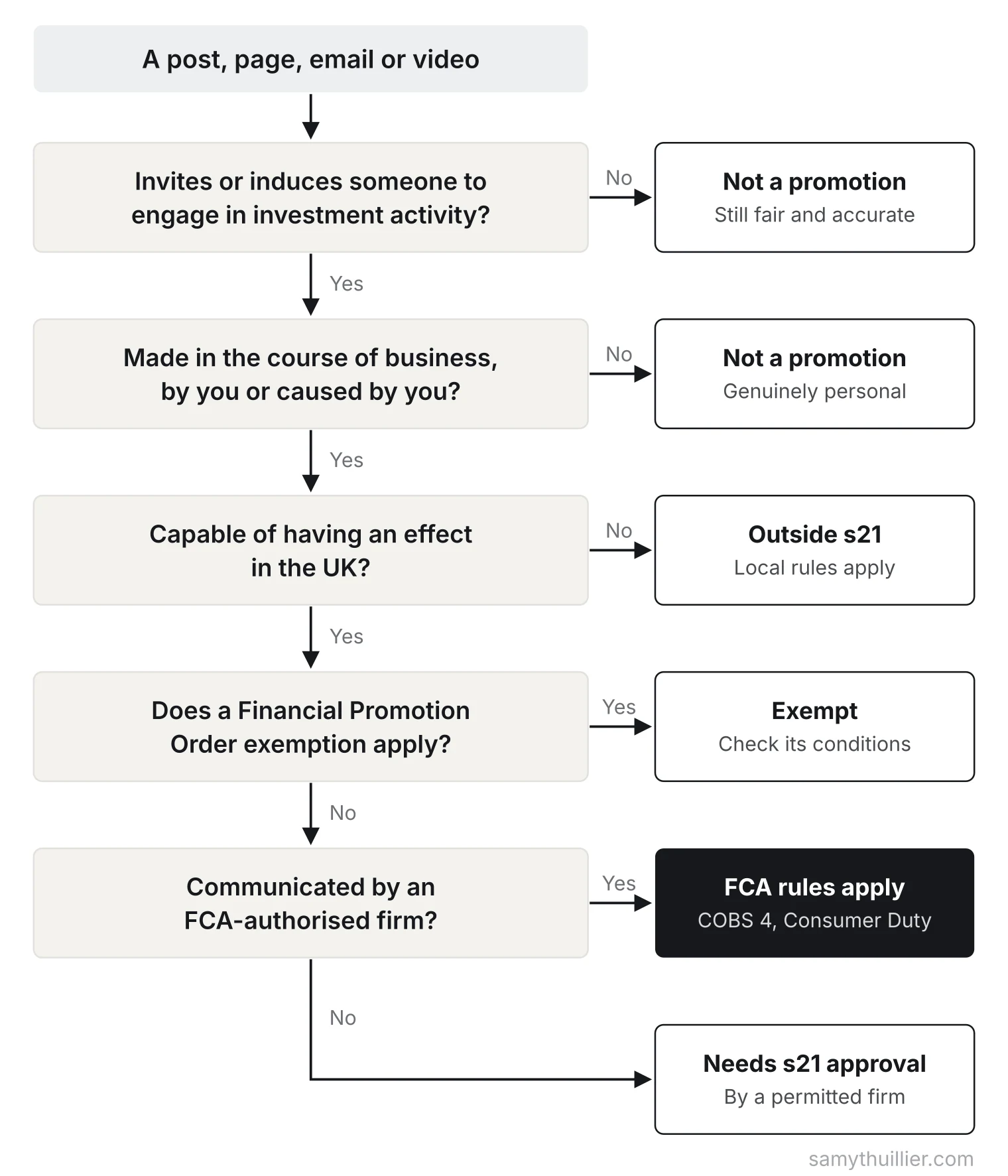
What usually lands where for a wealth firm:
| Piece | Usual status | Why |
|---|---|---|
| Service page (illustrative: “discretionary management from £250k”) | Financial promotion | Invites engagement with an investment service |
| Blog post on pension or tax planning ending with “talk to us” | Financial promotion | The call to action makes it an inducement |
| Market commentary with no call to action | Often treated as a promotion anyway | Many compliance teams register all content; see below |
| Name, logo, contact point and the services you offer | Image advertising | FG24/1 (2.14): likely exempt from many rules, may not be a promotion at all |
| Adviser’s personal post about the firm’s offer | Usually a promotion | Commercial interest; caused by the firm if it encouraged it |
| Reposting a client’s post praising you | Depends on content | FG24/1 (3.11): if it is an inducement, the firm is responsible for it |
Compliance consultancies often go further than the statute and treat every client-facing communication up to the point of investment as a promotion to register and review. That is a policy choice, not an FCA rule, but it is the safer default for a firm whose whole business is investment advice.
The core rule: fair, clear and not misleading
COBS 4.2.1R(1) requires a firm to ensure that a communication or financial promotion is fair, clear and not misleading. The FCA’s page on risk warnings for mainstream investments (first published 11 December 2025, updated 18 May 2026) lists what that means in practice for investment promotions, with the rule references:
- Balance: give a balanced impression of the benefits and risks (COBS 4.5.2R(2), or COBS 4.5A.3R(2)(b) for MiFID business).
- Capital at risk: make clear when a product or service places the customer’s capital at risk (COBS 4.2.4G(1)).
- No disguising: do not disguise, diminish or obscure important information or warnings (COBS 4.5.2R(4), or COBS 4.5A.3R(2)(e)).
- Fair comparisons: comparisons, including cash against investments, must be meaningful and presented in a fair and balanced way (COBS 4.5.6R or COBS 4.5A.7R).
COBS 4 also has specific sections for past, simulated and future performance (COBS 4.6 for non-MiFID business, the COBS 4.5A provisions for MiFID business), and stricter regimes for high-risk investments (COBS 4.12A, COBS 4.12B for cryptoassets, COBS 22). Most wealth managers promote mainstream services and never touch the high-risk rules, but if you market a fund that falls under them, the prescribed warnings and bans on incentives to invest apply.
What the FCA says about risk warnings (and what it does not)
Several of the top results for this query, and many firms’ house styles, treat a risk warning as a box to tick on every piece. The FCA’s May 2026 page corrects that directly. Its “misunderstanding vs reality” list, summarized:
| Common belief | What the FCA says |
|---|---|
| Promotions must use the phrase “capital at risk” | It does not prescribe risk wording for mainstream investments, and its testing suggests “capital at risk” alone is often ineffective |
| Every investment promotion needs a separate risk warning | No such requirement for mainstream investments; the requirement is a balanced view of benefits and risks |
| Risks must come before benefits | The FCA does not mandate an order; use whatever order best supports understanding |
| Brand advertising must include risk information | Image advertising, such as branding, does not need risk information |
| Warnings must be repeated on every page of a journey | Promotions must be standalone compliant, but that does not require generic warnings on every page |
The FCA also says generic warnings can mislead by distracting from the relevant risks, and that it supports contextualized risk statements that explain benefits and risks together. For a wealth manager that means: write the real limits of the service next to its benefits (“we manage portfolios from £250k; investments can fall as well as rise, and our fees reduce returns”), rather than a footer nobody reads. The figure here is illustrative. Prescribed wording still applies where a rule prescribes it, for example for restricted mass market investments.
Consumer Duty: higher than fair, clear and not misleading
The Consumer Duty came into force on 31 July 2023 for open products and services. FG24/1 (3.1) is explicit that the Duty’s standards, Principle 12 and PRIN 2A, apply to financial promotions likely to be received by retail customers, including when a firm approves someone else’s promotion, and that being fair, clear and not misleading is not sufficient on its own to comply with the Duty.
What that adds for a firm’s marketing, according to FG24/1 and the FCA’s risk warnings page:
- Support understanding. Promotions must equip customers to make effective, timely and properly informed decisions.
- Know the target market. Tailor communications to the characteristics of the target market and of the channel, including each social platform’s features (3.3).
- Test. Where appropriate, test communications with consumers (PRIN 2A.5.10R).
- Disclaimers do not restrict an audience. Labeling a post “for professional investors only” is not enough if retail customers can see it (3.4).
- No pressure. Bombarding consumers with repeated promotions is not acting in good faith (PRIN 2A.2.1, cited at 3.5).
- Monitor and adapt. Firms should regularly test, monitor and adapt communications (3.6).
The Duty is the reason UK compliance teams now review service pages and FAQs for comprehension, not only for accuracy. The guidance that develops it, FG22/5, is referenced throughout FG24/1.
Social media and FCA financial promotions: FG24/1
FG24/1 (March 2024) replaced the FCA’s 2015 social media guidance (FG15/4). It creates no new rules; it explains how the existing ones apply on social platforms. The points that matter for a wealth manager’s LinkedIn, X, Instagram or YouTube:
- Standalone compliance. Each communication must comply when considered on its own. A link to more information is fine for complex products, but the initial post must still be compliant by itself.
- Prominence on the platform, not around it. Benefits in the video and risks in the caption is poor practice. So is required information hidden behind “see more” truncation.
- Channel suitability. Character-limited media may not suit complex products. FG24/1 suggests using social media to signpost to fuller information, or using image advertising instead.
- Sharing. If a third party shares your non-compliant post, the breach is still yours. If you share a customer’s post, you are responsible for it if it is an inducement.
- Affiliates and influencers. Firms remain responsible for every promotion they make or cause to be made, and should monitor affiliates actively. Unauthorised influencers promoting without approval may be committing a criminal offence.
- Sign-off and records. Firms need an adequate sign-off system for digital media, by someone of appropriate competence and seniority (SYSC 3 and 4), and adequate records (SYSC 9 and sector rules). FG24/1 warns firms not to rely on platforms to keep records, because platforms may delete older content.
- Follows and likes are not relationships. Being a follower or liking a page is not an “established existing client relationship” for the cold-calling rules (3.13).
For prescribed risk warnings, FG24/1’s Table 1 gives the standard by format: on every slide of a carousel, on screen for the relevant part of a livestream or long video, across the screen throughout short-form video, and complete within the text in character-limited media.
Approving promotions for others: the s21 gateway
Wealth managers sometimes approve promotions for unauthorised businesses: an introducer, an event partner, a group company. Since the Financial Services and Markets Act 2023 inserted section 21(2A), fully in force from 7 February 2024 according to the annotations on legislation.gov.uk, an authorised person may approve a promotion only with FCA permission to do so (section 55NA) or under an exemption in regulations. The FCA’s guidance lists exemptions for promotions of the firm’s own appointed representatives, of unauthorised companies in the same group, and of the firm’s own promotions communicated by an unauthorised person. A permitted approver must confirm the promotion complies with the rules before approving it, monitor it afterward (COBS 4.10.2R), and report its approval activity to the FCA.
The Financial Promotion Order’s exemptions, including those for certified high net worth individuals and sophisticated investors, have been amended and then partly reversed since 2023. Check the current text of the FPO on legislation.gov.uk before relying on any threshold.
Approval, records and review inside your firm
The rules above translate into a short operating routine. This is a template to adapt with your compliance officer, not an FCA checklist:
| Step | What to keep | Rule basis |
|---|---|---|
| Register every promotion | Copy, channel, owner, date first used | SYSC 9; COBS 4 record rules |
| Sign-off before use | Name and role of the approver, date, version | FG24/1 3.15; SYSC 3 and 4 |
| Balance check | Benefits and risks in the same piece; capital at risk made clear | COBS 4.2.1R, 4.2.4G, 4.5.2R |
| Duty check | Target market, comprehension, testing where appropriate | PRIN 2A; PRIN 2A.5.10R |
| Archive outside the platform | Screenshots or exports of social posts | FG24/1 3.16 |
| Review on a schedule | Re-approve or withdraw pages with figures that date (tax allowances, fees, performance) | Fair, clear and not misleading over time |
The last row deserves emphasis. A 2023 blog post about capital gains tax allowances is still a live promotion in 2026 if it sits on your site with a call to action. A “correct at the time of writing” disclaimer does not make outdated figures fair. Set an expiry date per piece.
FCA powers and enforcement
The FCA can ask a firm to change or withdraw a promotion, ask it to write to misled customers, warn or fine it, and ban a promotion under section 137S FSMA. Its interventions are frequent: the FCA’s financial promotions data for 2024 reports 19,766 promotions by authorised firms amended or withdrawn after its intervention, up from 10,008 in 2023, and 20 finfluencers interviewed under caution as part of its 2024 work.
The Advertising Standards Authority handles the non-technical side of financial ads, such as taste, decency and social responsibility, and its code covers financial marketing the FCA does not regulate.
FCA promotions and AI search: pages written to be quoted
Firms now write answer-first pages, FAQ blocks and comparison tables so that ChatGPT, Perplexity, Gemini and Google AI Overviews quote them. None of that changes the rules. A page published by an authorised firm is a financial promotion like any other page, with the same sign-off, balance and Duty checks. Being written “for AI” is not an exemption.
FG24/1 does not mention AI tools or AI search engines, and as of November 2026 we found no FCA rule or guidance that addresses AI-generated answers. What follows is our reading of the existing rules, for your compliance officer to confirm:
- The engine’s answer is generally not your promotion. An AI engine that summarizes your page writes its own text, much like a journalist. You did not communicate it.
- It becomes yours when you cause or adopt it. “Communicate” includes causing a communication to be made (s21(13)). Paying for placement in content that feeds the engines, prompting a tool to write copy you then publish, or reposting a flattering AI answer all bring the content back into your promotions. FG24/1’s logic on sharing a customer’s post (3.11) applies to sharing an AI answer.
- Standalone compliance is the right test for quoted passages. Engines rarely quote a whole page. They lift a paragraph, a table row or an FAQ answer. FG24/1’s standard, that each communication complies on its own, is the best guide: if a paragraph states a benefit, its limit belongs in the same paragraph, because a footer disclaimer will not travel with the quote.
- The FCA register is part of what engines read. Your firm’s entry on the FCA’s Financial Services Register is a public fact source. Keep the trading names and permissions there consistent with what your site claims.
A practical test before sign-off: cut any paragraph out of the page and read it alone. If it would still be fair, clear, balanced and identify the firm, it is ready to be quoted. If you want to see which of your pages AI engines already quote and what they say about your firm, an AI visibility audit starts there.
UK, US and FINRA rules side by side
Many wealth groups market in several jurisdictions. The standards rhyme, but the mechanics differ:
| FCA (UK) | SEC Marketing Rule (US advisers) | FINRA Rule 2210 (US broker-dealers) | |
|---|---|---|---|
| Legal base | s21 FSMA, COBS 4, PRIN 2A | Rule 206(4)-1, Advisers Act | FINRA Rule 2210 |
| Core standard | Fair, clear and not misleading, plus Consumer Duty | Seven general prohibitions on misleading ads | Fair and balanced, no promissory or misleading claims |
| Who signs off | Person of appropriate competence and seniority | Firm’s compliance program | Registered principal before use, for retail communications |
| Social media guidance | FG24/1 (2024) | Adopting release: adoption and entanglement | FINRA social media guidance: static vs interactive |
| Scope trigger | Capable of having an effect in the UK | Advertisement by an SEC-registered adviser | Communication by a FINRA member |
The US side is covered in our guides to the SEC Marketing Rule and FINRA Rule 2210. For turning compliant pages into a content program, see content marketing for financial advisors.
Frequently asked questions
What is the FCA definition of a financial promotion?
The definition comes from section 21 of the Financial Services and Markets Act 2000: an invitation or inducement to engage in investment activity, communicated in the course of business. Communicate includes causing a communication to be made. A website page, a LinkedIn post, a newsletter or a video can all qualify.
What is the FCA's core rule for all financial promotions?
A promotion must be fair, clear and not misleading, the standard in COBS 4.2.1R for investment business and its equivalents in the other sourcebooks. The FCA applies it whatever the medium. For promotions likely to reach retail customers, the Consumer Duty adds a duty to support customer understanding, which the FCA says goes further than fair, clear and not misleading on its own.
Can a business that is not FCA-authorised promote investments or financial services?
Only if the promotion is approved by an authorised firm that is permitted to approve it, or if an exemption in the Financial Promotion Order 2005 applies. Communicating an unapproved, non-exempt promotion breaches section 21, a criminal offence punishable by up to two years in prison, an unlimited fine, or both. Since 7 February 2024, approvers generally need FCA permission to approve promotions for unauthorised firms.
What's the difference between the FCA and the PRA?
The FCA regulates the conduct of financial firms, including how they market, and is the regulator whose financial promotion rules this article covers. The Prudential Regulation Authority, part of the Bank of England, supervises the safety and soundness of banks, insurers and some large investment firms. A private bank can be authorised by the PRA and still follow FCA conduct and promotion rules.
Does the FCA's guidance on financial incentives apply to marketing?
No. The FCA's guidance on risks to customers from financial incentives (FG13/1, first issued in January 2013) is about how firms pay and reward sales staff and advisers, and the mis-selling risk that creates. It is separate from the financial promotion rules. Incentives offered to customers inside a promotion are a different question: some high-risk investments are banned from offering incentives to invest.
Do UK investment promotions have to say 'capital at risk'?
Not for mainstream investments. The FCA's page on risk warnings for mainstream investments, updated in May 2026, says it does not prescribe risk wording for them and that a separate warning is not required. What is required is a balanced view of benefits and risks, and making clear when capital is at risk. Prescribed warnings apply to specific products such as high-risk investments.
Samy Thuillier advises wealth management firms on AI authority and reputation. Former Deloitte financial consultant, SEO since 2013. More about Samy · Book a call