AI Marketing for Financial Advisors: Supervision and AI Search
AI in advisor marketing has two sides: the content your firm drafts with AI, which regulators treat as your own communication, and the answers AI engines give about your firm. This guide covers both, with the regulators' own words.
 By Samy Thuillier · November 28, 2026
AI marketing for financial advisors means two things at once: using AI tools to plan, draft and repurpose your firm’s marketing, and making sure the AI engines your prospects now ask (ChatGPT, Perplexity, Gemini, Google AI Overviews) describe and recommend your firm accurately. On the first side, regulators are clear: content drafted with AI is your communication, held to the same rules, review and records as anything a person wrote. On the second side, the engines build their answers from your pages and from what others publish about you, so the content you produce with AI also decides how AI talks about you.
This guide covers both sides for RIAs, broker-dealers and UK wealth managers. It does not review AI software: tool choice is a procurement decision, and the rules below apply whatever tool you pick. If what you need is to be named by AI engines, that work is covered on the page about GEO for financial advisors.
Every rule below was checked on finra.org, sec.gov and fca.org.uk in November 2026. This article is general information, not legal advice: your firm’s compliance officer has the last word on any communication.
AI marketing for financial advisors has two sides
Most articles on this topic stop at one side. Agencies and software vendors write about the tools that produce content and leads; a few write about getting recommended by ChatGPT. The two are the same loop. What your firm publishes, with or without AI, becomes the raw material AI engines read when a prospect asks who to hire.
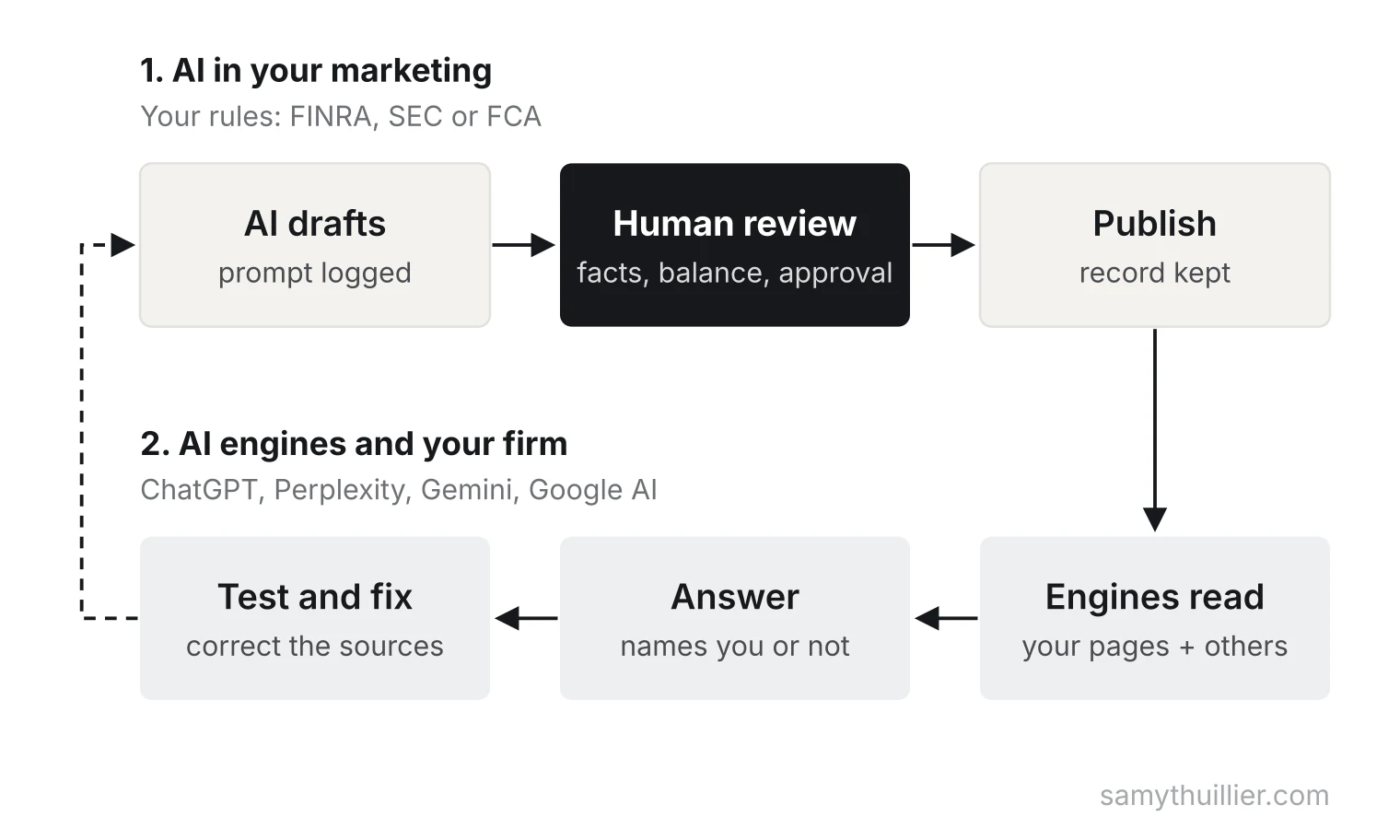
The top row is where compliance lives. The bottom row is where visibility lives. A firm that supervises the top row well and never checks the bottom row may be compliant and invisible. A firm that chases the bottom row with unreviewed AI content takes regulatory risk for little gain.
Where AI earns its keep in an advisory firm’s marketing
AI tools are good at volume and structure. They are weak on facts about your firm, on the rules that govern your claims, and on anything that needs judgment about a specific client. A useful division of labor:
| Marketing task | What AI does well | What a person must own |
|---|---|---|
| Blog posts and guides | Outlines, first drafts, rewriting for reading level | Every fact, figure and claim; the firm’s actual view |
| Repurposing | Turning one approved article into a newsletter, a LinkedIn post, a FAQ | Checking that the shorter version is still fair and balanced |
| Email and outreach drafts | Variations of approved templates, subject lines | Consent and opt-out rules, the final send list |
| Website copy and FAQs | Structuring answers question by question | Fees, services and credentials, matched to Form ADV or your disclosures |
| Research for content | Summarizing public sources, listing questions prospects ask | Verifying each source before anything is cited |
| Seminar and webinar material | Slide outlines, speaker notes | Any performance, projection or product statement |
| Prospect research | Summarizing public information about a business owner | What you may say to them, and how you store their data |
Three things should not go to a general AI tool without your compliance team’s explicit approval: performance figures and hypothetical performance, testimonials and endorsements, and client data. The first two carry the heaviest conditions in the SEC Marketing Rule and FINRA Rule 2210. The third raises privacy obligations your firm already has.
For the content side in more depth (what to publish and how prospects search), see the guide to content marketing for financial advisors.
The rules: AI-written marketing is still your marketing
No regulator in the US or the UK has written a separate rulebook for AI-drafted marketing. Each says the existing rules apply, and two of them have said so in writing.
FINRA (broker-dealers and their representatives)
- FAQ D.8, “AI Created Communications” (posted May 10, 2024). FINRA’s Rule 2210 FAQ answers the question directly: “Firms are responsible for their communications, regardless of whether they are generated by a human or AI technology.”
- FAQ B.4, chatbots (same date). The firm must supervise chatbot communications under FINRA rules, and they can be correspondence, retail or institutional communications depending on who receives them.
- Regulatory Notice 24-09 (June 27, 2024). FINRA intends its rules to be technologically neutral, and “the content standards of Rule 2210 (Communications with the Public) apply whether member firms’ communications are generated by a human or technology tool.” Under Rule 3110, the firm needs a supervisory system tailored to its business, including technology governance. The notice states it creates no new requirements.
- The 2026 Regulatory Oversight Report. Its GenAI section lists practices firms may consider: storing prompt and output logs, tracking which model version was used and when, and human-in-the-loop review of outputs with regular checks for errors or bias, including hallucinations. Its communications section adds procedures for communications created with GenAI, and asks that retail communications mentioning AI tools or services accurately describe how those offerings use AI.
In practice, an AI-drafted blog post or LinkedIn post that reaches more than 25 retail investors in 30 days is a retail communication: principal approval before use (unless an exception applies), the content standards, and the records. The details are in our guide to FINRA Rule 2210.
SEC (registered investment advisers)
The SEC Marketing Rule, Rule 206(4)-1, does not mention AI. It applies to every advertisement an SEC-registered adviser disseminates, whatever produced it. The SEC’s small entity compliance guide sets out the seven general prohibitions, which matter most for AI drafts, since language models produce confident sentences with nothing behind them:
- no untrue statement of a material fact, or omission that makes a statement misleading;
- no material statement of fact you have no reasonable basis to believe you can substantiate on demand by the SEC;
- no implication or inference that would be untrue or misleading;
- no discussion of benefits without fair and balanced treatment of material risks;
- no reference to specific investment advice that is not fair and balanced;
- no performance results, or time periods, chosen or presented in a way that is not fair and balanced;
- nothing otherwise materially misleading.
Testimonials, endorsements, third-party ratings and performance carry their own conditions on top, and the adviser keeps a copy of each advertisement under the books and records rule. The full rule is in our SEC Marketing Rule guide.
The SEC’s fiscal year 2026 examination priorities say the Division of Examinations will “review for accuracy registrant representations regarding their AI capabilities” and assess whether firms have policies and procedures to monitor or supervise their use of AI.
FCA (UK wealth managers and IFAs)
The FCA’s page AI and the FCA: our approach (updated November 18, 2026) says: “We do not plan to introduce extra regulations for AI.” It relies on existing frameworks, naming the Consumer Duty (including communicating in a way that meets customers’ information needs) and the Senior Managers and Certification Regime, which puts accountability on named senior managers. An AI-drafted financial promotion is still a financial promotion and must be fair, clear and not misleading, approved where the rules require it.
Note: Across all three regulators, “the AI wrote it” is never a defense. The approval, the content standard and the record attach to the firm and to the person who signed off.
A review workflow for AI-drafted marketing
FINRA’s guidance names the ingredients (written procedures, human review, logs); none of it tells a marketing team what to do on Monday. Here is a workflow you can adapt with your compliance officer. It assumes your firm has already approved which AI tools staff may use.
| Step | What happens | What to keep |
|---|---|---|
| 1. Brief | Marketer states the audience, the channel and the claims the piece may make | The brief |
| 2. Draft | AI produces a first draft from approved inputs only (no client data, no unapproved figures) | Prompt, output, tool and model version, date (if your procedures require logs) |
| 3. Fact check | A person verifies every fact, number, name and source against the original | Sources for each figure |
| 4. Rule check | Check against the general prohibitions or Rule 2210 content standards: balance, substantiation, no promissory language, testimonial and performance conditions | Reviewer’s notes |
| 5. Approve | Principal approval (FINRA retail communications) or the review your SEC or FCA procedures set | Final version, approver’s name, approval date |
| 6. Publish | Post on the approved channel, unchanged | Date of first use |
| 7. Re-review | Any material edit, or a repurposed version, goes back to step 3 | Each version, with dates of first and last use |
Two failure modes show up as soon as a team uses AI at scale. The first is volume: AI makes it cheap to produce ten posts a week, but review capacity does not grow with it, so either review becomes a rubber stamp or the backlog grows. Set the publishing cadence from review capacity, not drafting capacity. The second is drift: repurposed versions get shorter and lose the risk language that kept the original balanced. Treat every derivative as a new piece.
Social posts add one more distinction for broker-dealers: static content (a profile, a pinned post) generally needs approval before use, while interactive posts in a live thread are supervised like correspondence. The FINRA Rule 2210 guide covers it.
Saying you use AI is a marketing claim too
Firms that adopt AI are tempted to say so: “AI-powered planning”, “our AI finds opportunities others miss”. Those sentences are advertisements, and regulators have acted on them.
On March 18, 2024, the SEC announced settled charges against two investment advisers, Delphia (USA) Inc. and Global Predictions Inc., for false and misleading statements about their use of AI. The SEC found Delphia violated the Marketing Rule with advertisements containing untrue statements of material fact about AI capabilities it did not have; Global Predictions had called itself the “first regulated AI financial advisor”. They agreed to pay civil penalties of $225,000 and $175,000, without admitting or denying the findings. The SEC’s then-chair called the practice “AI washing”.
Add the 2026 exam priority quoted above and FINRA’s report asking that retail communications accurately describe how offerings use AI, and the test is simple:
- Can you show, on request, what the AI does in your process?
- Would a client reading the claim understand the AI’s role correctly, including what a person still decides?
- Is the claim still true after your last tool change?
If any answer is no, cut the claim. “We use AI tools to draft first versions of our educational content, which our team reviews” is accurate and dull. That is the point.
Why generic AI copy makes you invisible to AI engines
Here is where the two sides meet. A prospect who asks ChatGPT for “a fee-only adviser for physicians in Denver who handles stock options” gets an answer built from pages that match that question. If your site reads like every other AI-drafted advisor site (“we help clients achieve their financial goals”), there is nothing specific for the engine to match, and nothing to cite.
AI drafting pushes toward the average of what is already published. To be named, a firm needs what the average lacks:
- Specific facts about the firm: who you serve, which problems you handle, your fee model, your credentials, your locations, written plainly and kept identical everywhere they appear.
- Answers to the exact questions your niche asks, one question per section, the answer first. AI tools can help structure these; the substance has to come from your advisors.
- Pages engines can reach. OpenAI’s crawler documentation says OAI-SearchBot is what surfaces websites in ChatGPT’s search features and recommends allowing it in robots.txt. Google’s guidance on AI features says there are no extra requirements to appear in AI Overviews or AI Mode beyond being indexed and eligible for a snippet.
The compliance discipline from the previous sections helps here. A paragraph that is factual, balanced and dated is exactly the kind of passage an engine can lift and quote without distorting your firm.
How AI engines describe and recommend your firm
When a prospect asks an AI engine about advisors, or about your firm by name, the answer draws on several kinds of sources at once:
| Source | Examples | Who controls it |
|---|---|---|
| Your own pages | Services, team, fees, FAQ, articles | You, under your marketing rules |
| Public regulatory records | SEC IAPD and Form ADV, FINRA BrokerCheck, the FCA register | You file it; the regulator publishes it |
| Directories and profiles | CFP Board, NAPFA, Google Business Profile, industry directories | Partly you |
| Reviews and ratings | Review sites, award lists | Third parties; republishing them is regulated |
| Press and mentions | Trade media, podcasts, local press | Third parties |
An engine’s answer is generally third-party content, not your advertisement. It can become yours if you adopt it, for example by posting a screenshot of ChatGPT recommending your firm. FINRA’s FAQ F.1 applies the same adoption and entanglement logic to third-party content in general. Our SEC and FINRA guides discuss how far that reasoning extends to AI answers; no regulator has addressed AI engines’ answers by name as of November 2026.
Because you cannot edit the answer, the work is upstream: make your own pages specific and consistent, keep regulatory records and directory profiles current and aligned with your website, and fix wrong facts at the source the engine cites. How engines rank firms across the sector is what our Wealth Management AI Visibility Index tracks.
Test what AI engines say about your firm
This takes an afternoon and needs no software:
- Write the prospect questions. Ten to fifteen questions a prospect in your niche would type: your city, your specialty, your firm’s name, “is [firm] a fiduciary”, “[firm] fees”.
- Run them in each engine. ChatGPT, Perplexity, Gemini and Google AI Mode. Save each answer with the date.
- Log names and sources. Which firms are named, what is said about yours, and which pages each answer cites.
- Fix the sources. Wrong fee, old address, a departed advisor, a missing specialty: correct it where the engine found it, with your compliance team where the fix is a public statement.
- Repeat on a schedule. Monthly or quarterly. Answers change as models and indexes update.
Two cautions. Answers vary by user, wording and day, so look for patterns across many questions rather than reacting to one answer. And do not publish or share flattering answers without compliance sign-off, for the adoption reason above.
If you would rather have this done from outside, with the sources mapped and the compliance risk of each flagged, Samy Thuillier, who advises wealth management firms on AI authority and reputation within SEC, FINRA, FCA and AMF rules, runs an AI visibility audit built on this test.
Frequently asked questions
Can financial advisors use ChatGPT for marketing?
Yes. No US or UK regulator bans AI tools for drafting marketing. FINRA, the SEC and the FCA treat the result exactly like content a person wrote: it must meet the same content standards, go through the same review and be kept as a record. Check your firm's written policies first, since many firms restrict which tools staff may use.
Does FINRA allow AI-generated content?
Yes, under its existing rules. FINRA's Rule 2210 FAQ D.8 says firms are responsible for their communications whether they are generated by a human or AI technology, and Regulatory Notice 24-09 says the Rule 2210 content standards apply either way. An AI-drafted retail communication still needs principal approval before use unless an exception applies.
Do firms have to keep the prompts used to write marketing?
The rules require you to keep the communication or advertisement itself. FINRA's 2026 Regulatory Oversight Report lists storing prompt and output logs, and tracking which model version was used, among the practices firms may consider. Whether you keep prompts is a decision for your compliance officer and your written procedures.
Can an advisory firm say it uses AI in its marketing materials?
Yes, if the statement is true and you can back it up. In March 2024 the SEC settled charges against two advisers for false and misleading statements about their use of AI under the Marketing Rule, and its fiscal 2026 exam priorities say staff will review representations about AI capabilities for accuracy. Describe what the AI actually does, in plain terms.
How do AI engines decide which financial advisors to recommend?
Search-connected engines such as ChatGPT search, Perplexity and Google AI Overviews look up the web and build an answer from the pages they find: the firm's own site, directories, reviews, press and public records such as IAPD and BrokerCheck. Firms with specific, consistent and verifiable information across those sources are easier to name for a specific question.
Samy Thuillier advises wealth management firms on AI authority and reputation. Former Deloitte financial consultant, SEO since 2013. More about Samy · Book a call