Best Reputation Management for Financial Advisors: 8 Providers
Eight reputation management providers for financial advisors, checked on their own sites in November 2026: review platforms, search result agencies and AI reputation advisory, with who each one fits, its limits, its prices and the rules that apply.
 By Samy Thuillier · November 27, 2026
The best reputation management for financial advisors depends on which part of your reputation is the problem. For what AI assistants say about a wealth management firm, the AI reputation advisory of this page’s author is built for that job alone. For collecting compliant client reviews, Wealthtender is made for advisors, and Yext, Reputation and Birdeye manage reviews and listings for firms with many advisors or offices. To push down a harmful search result, Status Labs, ReputationDefender and, in the UK, Igniyte are the specialists.
Disclosure: the author of this page is one of the providers listed, and he ranked himself first. He is an independent advisor on AI authority and reputation for wealth management firms, so he is a provider of one kind of service on this list. He is first because criterion 1 below puts AI answers at the center, and his practice is the only entry that does nothing else, for this sector only. The same six criteria are applied to every entry, including him, and his entry says plainly where the others fit better: for classic review collection, review response, or removing and suppressing content, they do. Every fact about the other providers comes from their own websites, read in November 2026. We did not hire or test any of them, and nothing here is a rating of their results.
How we chose these providers
A provider made the list only if its own website showed the following. Each entry is described against the same six points.
- Reputation is the core service. Reviews, listings, search results or AI answers are what the provider sells, not an add-on to web design or ads. Because prospects now check advisors inside ChatGPT, Perplexity, Gemini and Google AI, we also note whether the provider says it works on those answers.
- It fits advisory firms. The site names financial services, wealth management or advisors, or, for personal reputation, professionals and executives.
- Compliance posture. What the site says about working within SEC, FINRA or FCA rules, or that it says nothing.
- It works on the sources AI engines read. Reviews, directories, press, search results or the firm’s own pages, as stated by the provider.
- It respects regulatory records. None of the pages we read for the eight providers offers to remove or hide a BrokerCheck, IAPD or FCA register entry. We would have excluded any that did.
- Verifiable. The site was readable in November 2026, and we show its prices when it publishes them.
What we left out: lead-generation directories that match investors to advisors, general marketing agencies with a reputation page, and pages that promise to “eliminate” negative reviews without saying how. For crisis communications led by a PR firm, see our list of PR firms for financial advisors.
Best reputation management for financial advisors at a glance
| Provider | Type | Best fit | Advisor or finance focus on its site | Says it works on AI answers | Compliance stated on its site | Prices on its site (Nov 2026) |
|---|---|---|---|---|---|---|
| Samy Thuillier | Independent advisory | Wealth firms whose problem is what AI engines say | Yes: wealth management only | Yes: the core of the service | Works within SEC, FINRA, FCA and AMF rules | Not published |
| Wealthtender | Review platform and directory | Advisors who want compliant client reviews | Yes: built for advisors | Yes: says its reviews are cited in AI tools | Says it was designed for SEC Marketing Rule compliance | From $59 per advisor per month |
| Yext | Listings, reviews and pages software | Multi-office firms and advisor networks | Yes: financial services and advisors | Yes: Google, ChatGPT, Perplexity | Compliance guardrails for messaging and reviews | Not published |
| Reputation | Reviews and listings software | Firms with many branches or advisors | Yes: banks, wealth, insurance | Yes: AI-readable location pages | Pre-approved templates and approval workflows | From $80 per location per month |
| Birdeye | Reviews and listings software | Local practices wanting review volume | Yes: financial services page | Search AI listed in plans | Not described | Not published |
| Status Labs | Reputation agency | Firms or executives with a search or press problem | No finance page | Yes: dedicated AI search (GEO) service | Not described | Not published |
| ReputationDefender | Personal reputation and privacy | Individual advisors and executives | Professionals and executives | Not described | Not described | Not published |
| Igniyte | Reputation agency (UK) | UK wealth firms and their partners | Businesses and individuals; no finance page we read | Not described | Not described | £1,620 to £20,000 per month plus setup |
AI reputation advisory
1. Samy Thuillier
What it is. An independent advisor, not an agency, who works only with wealth management firms: RIAs, wealth managers, private banks and family offices. Since November 2026 his practice has one goal: making those firms the answer ChatGPT, Perplexity, Gemini and Google AI recommend, and keeping what those engines say about them accurate, within SEC, FINRA, FCA and AMF rules. The method is described on the AI reputation management page: check what the engines say about the firm and its partners, trace each statement to its sources, and correct the sources.
Who it is for. Firms whose concern is the AI answer itself: a wrong fee description, an outdated team, a competitor named instead of them, or an old story that keeps coming back.
What stands out. Background in finance and search: financial consultant at Deloitte from 2008 to 2013 after HEC Paris, then SEO since 2013 on more than 200 websites outside wealth management, and a place in Favikon’s top 3 SEO experts in France. He works with a handful of clients at a time.
Limits. His wealth management practice started in November 2026, so there are no sector case studies yet. He does not run review software, collect or answer reviews for you, or remove and suppress content: for those jobs, the platforms and agencies below fit better.
Pricing. Not published.
Review and listings platforms
2. Wealthtender
What it is. A directory and educational site where investors find and compare advisors, with reviews. It calls itself “the industry’s first find-an-advisor reviews website designed for SEC (Securities and Exchange Commission) compliance”.
Who it is for. Individual advisors and small RIAs that want a steady, compliant flow of client reviews they can also show on their own website.
What stands out. Its advisor plans include “Certified Advisor Reviews™, compliantly collected and published”, testimonial widgets for your site, and dashboards for staff to monitor reviews across advisors. It says the reviews are indexed and cited in Google, ChatGPT and other AI tools.
Limits. It is a directory that receives compensation from the advisors listed, which prospects and AI engines may weigh. It does not handle search results, press or a crisis, and its compliance design is its own claim: your compliance officer still reviews how you use the reviews.
Pricing. Convert $59 a month ($54 billed annually), Compound $79 ($73), Command $99 ($92), with volume discounts from 5 advisors (checked November 2026).
3. Yext
What it is. Software that manages listings, reviews and web pages. Its financial services page covers listings “across 200+ endpoints”, review requests and responses, and AI-optimized advisor and branch pages.
Who it is for. Broker-dealers, banks’ wealth arms and large advisor networks that need every advisor’s data consistent across Google, directories and AI engines.
What stands out. It aims to make advisors and branches “appear first” across Google, ChatGPT and Perplexity, and describes compliance guardrails for social, reviews and messaging, with “built-in compliance review on every message” for email.
Limits. Built for scale; a single-office RIA will use a fraction of it. Its page asks how it supports FINRA requirements but did not answer the question when we read it.
Pricing. Not published; demo and sales only (checked November 2026).
4. Reputation
What it is. A reviews, listings and surveys platform. Its financial services page is “purpose-built for multi-branch and advisor-driven operations” and names wealth management brands among its users.
Who it is for. Firms with many offices or advisors that want review requests, responses and listings run from one place.
What stands out. “Pre-approved templates and workflow approvals” for responses, listings kept accurate “across 100+ platforms and directories”, and location pages it says AI engines can read.
Limits. The page does not name the SEC or FINRA rules, and its tools are priced per location, which suits branch networks more than a single practice.
Pricing. Rep Core $80, Rep Core + Pulse $115, Rep Core + Surveys $150 per location per month; Enterprise custom (checked November 2026).
5. Birdeye
What it is. A reviews, listings and messaging platform with a financial services page aimed at firms that want more reviews and better local visibility.
Who it is for. Local practices that want to ask every client for a review and answer them quickly.
What stands out. Review requests tied to your CRM, AI-drafted responses, and listings management; its plans list “Search AI” alongside reviews and listings.
Limits. Its financial services page does not address regulatory compliance, and AI-drafted review responses still need your firm’s review before they go out.
Pricing. Not published: each plan shows “Schedule for quote” per location per month (checked November 2026).
Search result and personal reputation agencies
6. Status Labs
What it is. An online reputation management agency with offices in Austin, New York, Miami, London, Los Angeles and Hamburg, working for companies and individuals.
Who it is for. A firm or an executive with a negative article, an old news story or a misleading result on page one.
What stands out. A dedicated AI search (GEO) service covering ChatGPT, Google AI Overviews, Gemini, Claude, Perplexity and Bing Copilot, next to its search and personal reputation work. It says it declines tactics that would “deceive those systems or the people who rely on them”.
Limits. No financial services page, and no mention of advisor compliance rules: you bring the compliance review.
Pricing. Not published: “We do not use tiered packages”, every engagement is quoted (checked November 2026).
7. ReputationDefender
What it is. A personal reputation and privacy service. Its site offers content suppression for professionals and businesses, privacy protection for families, and VIP services for executives.
Who it is for. An individual advisor or partner whose name brings up a harmful or outdated result, or who wants home address and family details off people-search sites.
What stands out. Suppression by building “stronger, more accurate content so positive and neutral results can move up over time”, and data broker removal, useful for advisors who are public figures in their town.
Limits. Personal reputation, not firm-level reviews or AI answers. Nothing on its site addresses financial advisors or their rules.
Pricing. Not published; the plan is quoted after a consultation (checked November 2026).
8. Igniyte
What it is. A UK online reputation management firm with offices in London, Leeds and Dubai, offering review management and search visibility work, and saying it “can challenge content that breaches laws or website guidelines”.
Who it is for. UK wealth managers, IFAs and their partners who need a UK team for a search, press or review problem.
What stands out. Business and personal reputation packages, a reputation monitoring dashboard, and a Trustpilot partnership.
Limits. Its home page does not describe financial services work or the FCA rules, and the packages run on an annual contract.
Pricing. Its fees page states between £1,620 and £20,000 per month plus a one-off setup fee (£1,735 + VAT for business reputation management), on an annual contract (checked November 2026).
How to choose by the problem you have
- You have too few reviews, or none. Start with a review platform: Wealthtender for an individual advisor or small RIA, Reputation, Yext or Birdeye for many offices. Agree the review policy with compliance first, and answer negative reviews within that policy rather than trying to get them taken down.
- A harmful result sits on page one of Google for your name. Status Labs, ReputationDefender or, in the UK, Igniyte. Ask how they work and what they will not do.
- ChatGPT or Perplexity describes your firm wrongly, or recommends competitors instead. That is AI reputation work: find the sources the engines use, then fix them. The AI reputation advisory listed first does only this; Status Labs and Yext also say they work on AI answers.
- A crisis is reaching the press. A PR firm with a crisis practice comes first; reputation agencies help clean up afterwards.
- The problem is a regulatory disclosure. No provider on this list can change it. Talk to your compliance officer and counsel (see below).
If you are not sure which of these is your problem, an AI visibility audit shows what each engine says about your firm today and which sources it relies on, before you sign with anyone.
Where AI answers about your firm come from
Prospects can now check an advisor by asking an AI assistant. The answer is built from four layers of sources, and each layer has a different owner. That is why no single provider covers all of reputation management: review platforms change one layer, agencies another, and the regulator’s records change only through the regulator.
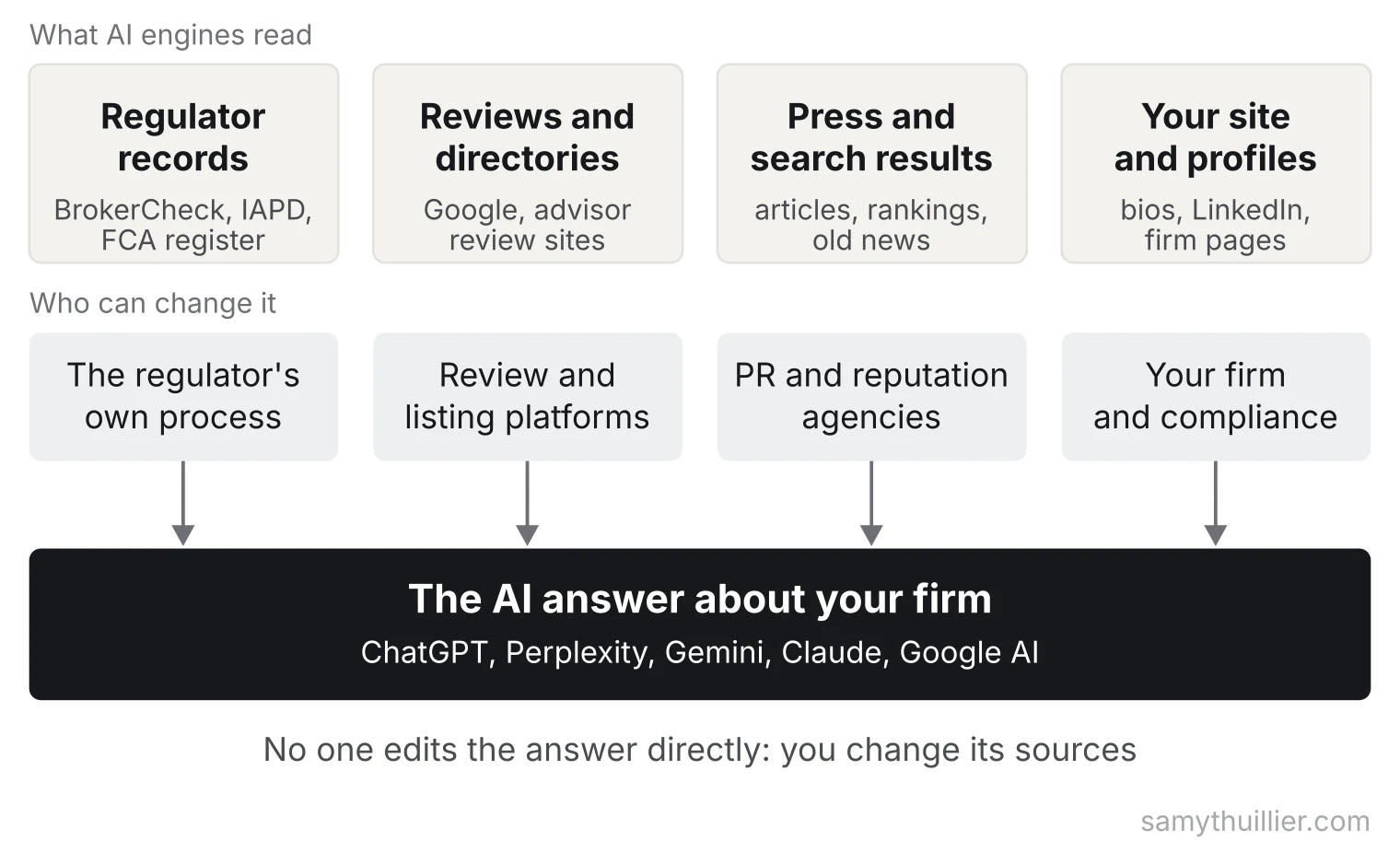
In practice, a wrong AI answer often traces back to an outdated directory profile, an old article or a thin “About” page on the firm’s own site, all of which can be corrected. For the visibility side of the same question, see the best AI visibility agencies for wealth management.
What no vendor can change: BrokerCheck, IAPD and the FCA register
Regulator records are official, and no reputation provider can edit them.
- BrokerCheck. FINRA’s page on expungement of customer dispute information says this information leaves CRD and BrokerCheck only through a FINRA arbitration award that finds one of narrow grounds (the claim is factually impossible or clearly erroneous, the person was not involved, or the claim is false) and is confirmed by a court, or through a court order. Verify the current process on finra.org with your counsel.
- IAPD. The SEC’s Investment Adviser Public Disclosure site shows information from regulatory filings. A vendor cannot edit it.
- FCA register. In the UK, the Financial Services Register is maintained by the FCA. A vendor cannot edit it either.
What a firm can do is make sure the rest of the picture is accurate and current, so an AI engine does not repeat an old matter as if it were new. Never try to hide or bury a regulatory disclosure, and treat any provider that offers to do so as a red flag.
The rules on reviews and testimonials
Rules checked November 2026. This article is not legal advice: your firm’s compliance officer has the last word on how you collect, share and respond to reviews.
- SEC-registered investment advisers. The SEC Marketing Rule (Rule 206(4)-1) permits testimonials and endorsements in an advertisement if it clearly and prominently discloses whether the person is a client and whether they are compensated, and the adviser oversees compliance. Third-party ratings need disclosures and criteria on how the rating was prepared. A review you feature on your website is a testimonial. More in the SEC Marketing Rule explained.
- Broker-dealers. FINRA Rule 2210 governs communications with the public. On third-party sites, FINRA’s social media guidance says third-party posts generally are not subject to its advertising rules, unless the firm adopts the content (endorses or approves it) or becomes entangled with it (helps prepare it). Ask compliance before you share, comment on or ask for changes to a review: that involvement may count as adoption or entanglement. More in FINRA Rule 2210 explained.
- UK firms. The FCA requires financial promotions to be clear, fair and not misleading, which covers how you reuse reviews and ratings in your marketing.
Whichever provider you choose, put in writing who drafts review responses, who approves them, and who keeps the records.
Questions to ask before you sign
- Which layer of my reputation do you change: reviews, listings, search results, press or AI answers?
- How do drafts and review responses reach my compliance officer, and how fast?
- What will you not do? A good answer includes fake reviews, undisclosed paid content and anything that touches regulatory records.
- How do you measure progress: review count and rating, page one results for named searches, or what AI engines say in repeated tests?
- What happens to the reviews, pages and content if we stop working together?
Frequently asked questions
What is reputation management for financial advisors?
It is the work of shaping what prospects find when they check an advisor: client reviews, directory profiles, search results, press, and now the answers ChatGPT, Perplexity, Gemini and Google AI give about the firm. For an advisor it always runs inside the marketing rules: reviews and testimonials used in marketing fall under the SEC Marketing Rule or FINRA Rule 2210, and regulator records are not part of what a vendor can change.
What tools do financial advisors use to manage their reputation?
Most use three kinds: a review platform that collects and displays client reviews with the required disclosures (Wealthtender is built for advisors), a listings and reviews tool that keeps profiles accurate across Google and directories (Yext, Reputation, Birdeye), and monitoring of search results and AI answers. Larger firms add a PR firm for crisis work.
What are the best companies for personal reputation management?
For an individual advisor or executive with a negative search result, ReputationDefender, Status Labs and, in the UK, Igniyte offer personal reputation work, mostly by building accurate content that outranks the harmful result and by challenging content that breaks the law or a platform's rules. None of them can remove a regulator's record, and a reputable provider will say so.
Can a reputation management company remove a BrokerCheck disclosure?
No. Customer dispute information leaves CRD and BrokerCheck only through FINRA's expungement process: an arbitration award on narrow grounds that a court confirms, or a court order. A firm that promises to erase or hide a disclosure is selling something it cannot deliver, and hiding regulatory information can create its own compliance problem.
How much does reputation management cost for a financial advisor?
It depends on the job. Wealthtender publishes advisor plans from $59 to $99 a month, Reputation publishes plans from $80 to $150 per location per month, and Igniyte states fees between £1,620 and £20,000 a month plus a setup fee (all checked November 2026). Yext, Birdeye, Status Labs and ReputationDefender quote per engagement.
Can financial advisors respond to online reviews?
Usually yes, but the response is a communication your compliance team should cover in its policies. Under FINRA guidance, a firm that endorses or helps prepare third-party content can make it the firm's own communication, and under the SEC Marketing Rule a review you use in your marketing becomes a testimonial with disclosure conditions. Never reveal that the reviewer is a client unless your policy allows it.
Samy Thuillier advises wealth management firms on AI authority and reputation. Former Deloitte financial consultant, SEO since 2013. More about Samy · Book a call